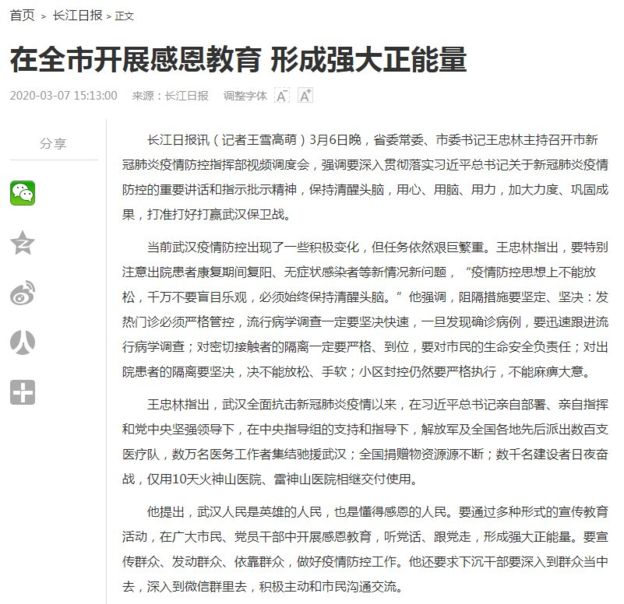
On March 7, 2020, the Changjiang Daily published an article titled “Carry Out Gratitude Education Across the City and Build Strong Positive Energy.” It disclosed instructions from Wang Zhonglin, then Party secretary of Wuhan, at a video meeting of the city’s Covid prevention and control headquarters. He called for “gratitude education” among citizens, Party members, and cadres, centered on “listening to the Party, following the Party, and building strong positive energy.”
As soon as the article appeared, public opinion exploded. People criticized the Wuhan government for spending precious energy on such trivial work when the epidemic had not yet been effectively controlled. Under broad public condemnation, the media outlet quietly withdrew the article.
But withdrawing the article does not mean the end of “gratitude education.” Or rather, the retreat of this particular instance does not mean such education will disappear. On the contrary, throughout China’s long history since the Qin and Han, the culture of being grateful to power or grateful to the state has always been the greatest form of “positive energy.” As long as this culture and the soil that supports it remain, countless forms of “gratitude education” will not truly vanish.
During China’s modernization, many people have mistakenly blamed this “gratitude culture” on Chinese tradition or so-called Confucian thought, and then launched a broad attack on Chinese tradition. In my view, however, these people seem to have chosen the wrong enemy at the very beginning of the revolution.
Who are our enemies? Who are our friends? This is the first question of revolution. The basic reason why all past revolutionary struggles in China achieved so little is that they failed to unite with real friends in order to attack real enemies.
Mao Zedong, “Analysis of the Classes in Chinese Society”
First, there is a real problem in what exactly people mean by the “Confucian thought” they criticize. Mencius of the Warring States period, whom modern people almost treat as a contemporary of Confucius, already differed sharply from Confucius on many issues. Confucianism then evolved over more than two thousand years, to the point that it resembles the Ship of Theseus . To treat “Confucian thought” as one unified thing and attack it under the label of “feudal ethics” is to pick the wrong enemy.
Those who attack Confucianism seem able to see only “the body, hair, and skin are received from the parents and must not be damaged, which is the beginning of filial piety,” while ignoring “the people are most important, the state comes next, and the ruler is least.” The richness of Confucian thought and the variety of its schools are flattened by these “progressive” attackers into one backward and rotten image.
Second, the reason Confucianism came to appear backward and rotten in modern times is partly its own richness and partly the deliberate summaries of its attackers, but more importantly the domineering nature of imperial rule. China’s imperial system was highly practical. For Chinese emperors, anything useful for maintaining rule could be taken and used. In that environment, no matter how different schools of thought were at the beginning, they would eventually become highly homogenized under pressure from power.
In other words, even if the intellectual winner under Emperor Wu of Han had not been Dong Zhongshu’s Confucianism, but Huang-Lao thought, Yin-Yang thought, or some other school, later history would not have changed much. In fact, Dong Zhongshu’s Confucianism was already far removed from the Confucianism of Confucius and Mencius. To meet the needs of power, it had shed many of its inconvenient edges.
So who is the real enemy we should attack? Or to put it another way, where does China’s long-running “gratitude culture” really come from?
That is the topic I want to discuss today. As mentioned above, if ancient Chinese imperial rule played the game of “Confucianism on the outside, Legalism on the inside,” meaning it used Confucian morality on the surface to add legitimacy to rule while constantly practicing Legalist techniques of controlling the people, then the culprit behind “gratitude culture” should be the inner Legalism, not the outer Confucianism.
At this point, the answer is clear: when we oppose “gratitude culture,” what we should truly oppose is imperial rule and its Legalist methods, not the innocent Confucian thought worn as its outer garment.
“Gratitude education” and the “gratitude culture” behind it are enduring parts of imperial rule. They will not naturally disappear just because the times move forward. If we never identify what we are truly opposing, gratitude education will continue. Today, when Article 1 of the Constitution of the People’s Republic of China states clearly that all power belongs to the people, there should be no more “gratitude education.”