For quite a few people, including me, memorizing words has almost become a necessity. Whether it is to prepare for exams, obtain various levels of certificates, or simply improve language skills, vocabulary is a challenge that we have to face head-on. In today’s Internet age, the method of memorizing heavy vocabulary books or dictionaries has been abandoned by most people, because it is boring and inefficient. It not only kills our enthusiasm for learning a language, but is also not conducive to cultivating a sense of language and putting it into practical use.
In this context, a number of “vocabulary memorization” software came into being. These include Kaixin Ci Chang (https://cichang.hujiang.com/ “Xichang Ci Chang Official Website”), [Scallop English] (https://www.shanbay.com/ “Scallop English Official Website”) and [Baicizhan] (https://www.baicizhan.com/ “Baicizhan Official Website”) and other relatively excellent products. However, these software more or less have the following irreparable flaws:
- Thesauruses are mostly pre-made by manufacturers and lack room for customization according to personal circumstances, and are not very flexible.
- Most of the supported languages are English, Japanese, Korean and other popular languages, which cannot meet the needs of learners of minor languages (such as Hebrew).
- For profit-making purposes, it integrates many fancy functions that are not commonly used, and cleansing is not concise enough.
- Also for profit purposes, some functions are only available to paying users, and free users have limited experience.
All these are the reasons why I have been unable to find a vocabulary memorization software that suits me for a long time. However, just nearly two years ago, when I was preparing for the graduate exam, I encountered Anki , a god-like memory software. The reason why it is called “memory software” rather than “word memorization software” is because it supports almost all content formats that need to be memorized, unlike many of the “professional software” mentioned above that can only be used to memorize words in specific languages. In fact, if you want, Anki Can be used to memorize Tang poetry, idioms, and even [Navajo](https://baike.baidu.com/item/%E7%BA%B3%E7%93%A6%E9%9C%8D%E5%AF%86 %E7%A0%81/9482868?fromtitle=%E7%BA%B3%E7%93%A6%E8%8D%B7%E5%AF%86%E7%A0%81&fromid=6646373 “Baidu Encyclopedia entry for the Navajo Code”).
Simply put, Anki is a tool that uses a card mechanism similar to Flash Cards to assist memory and supports high customization. So far, I have found that it has the following advantages that traditional word memorization software does not have:* Supports almost all content forms, there is nothing that Anki does not support except what you can’t think of.
- Not only supports traditional flip-up word cards, but also supports various answer forms such as fill-in-the-blank questions, multiple-choice questions, etc. to meet various needs.
- According to the [Ebbinghaus forgetting curve](https://baike.baidu.com/item/%E9%81%97%E5%BF%98%E6%9B%B2%E7%BA%BF/7278665?fromt itle=%E8%89%BE%E5%AE%BE%E6%B5%A9%E6%96%AF%E9%81%97%E5%BF%98%E6%9B%B2%E7%BA%BF&fromid=3905802 “Baidu Encyclopedia entry on Ebbinghaus’ forgetting curve”) scientifically customizes learning and review plans to ensure efficient use of energy and time.
- The cloud backs up the vocabulary and learning progress in real time, and supports operating systems including PC, Mac, iOS, Android, etc., allowing users to easily synchronize learning progress across platforms and study anytime and anywhere.
- Supports the export and import of decks, combined with active communities and various resource sharing channels, so that users who are unwilling to make their own decks can efficiently enter the learning state by downloading and importing decks made by predecessors.
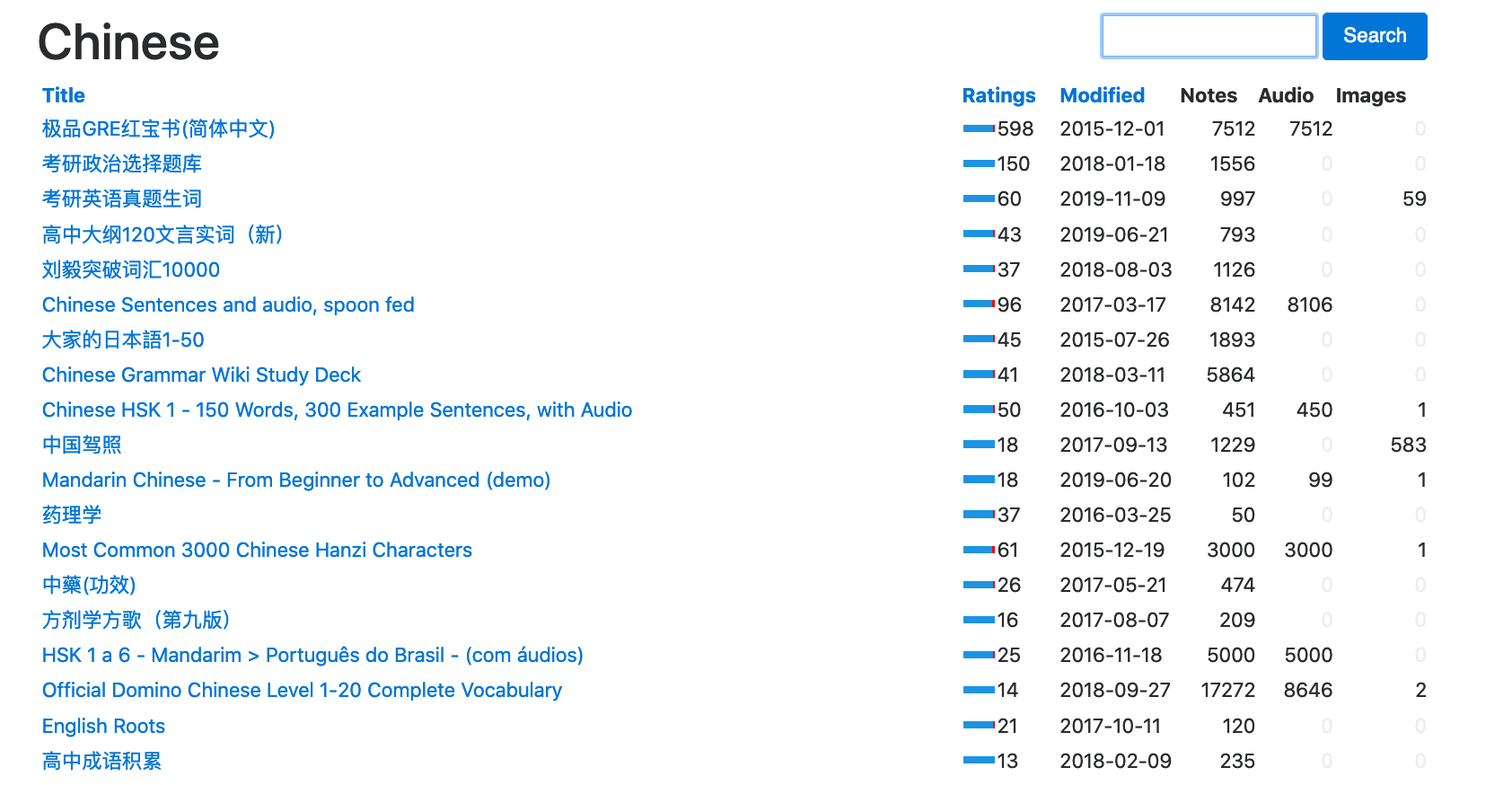 Anki’s desktop version (including Windows and Mac) and mobile version (including iOS and Android) have almost identical functions, but the former is completely free and the latter must be paid. If you are neither willing to pay nor use a pirated version, then just use the desktop version. In this way, apart from not being able to obtain the experience of multi-platform synchronous learning, there will not be any specific functional restrictions.
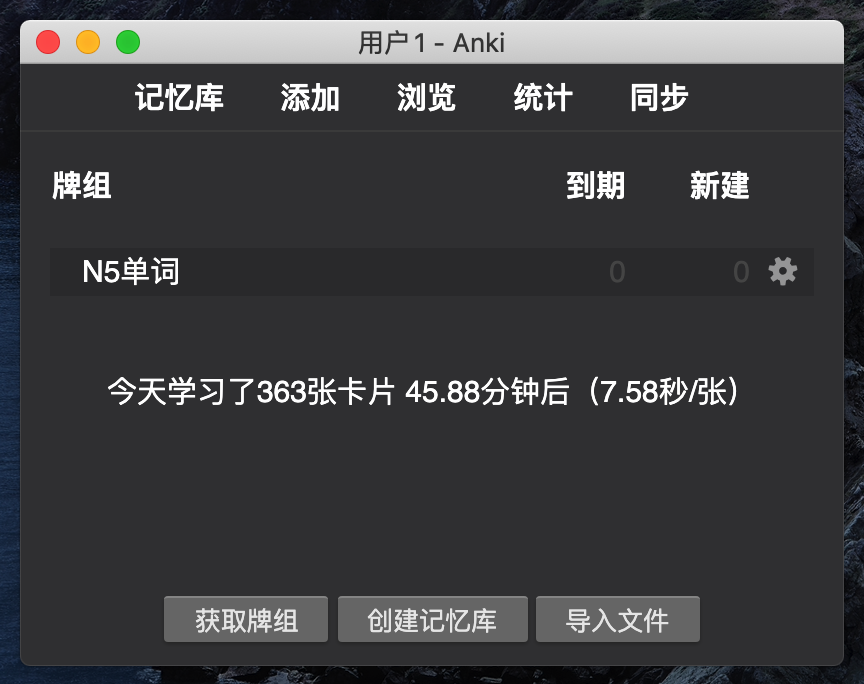
Anki’s desktop interface is very simple. You can click “New Memory” to customize your own deck, or click “Get Deck” to enter the Anki official website to browse and download ready-made decks uploaded by other users. In addition, there are sellers on trading websites such as Taobao or Xianyu who sell their own Anki decks for a fee. If you purchase those decks, you can easily import the purchased decks by clicking the “Import File” button.
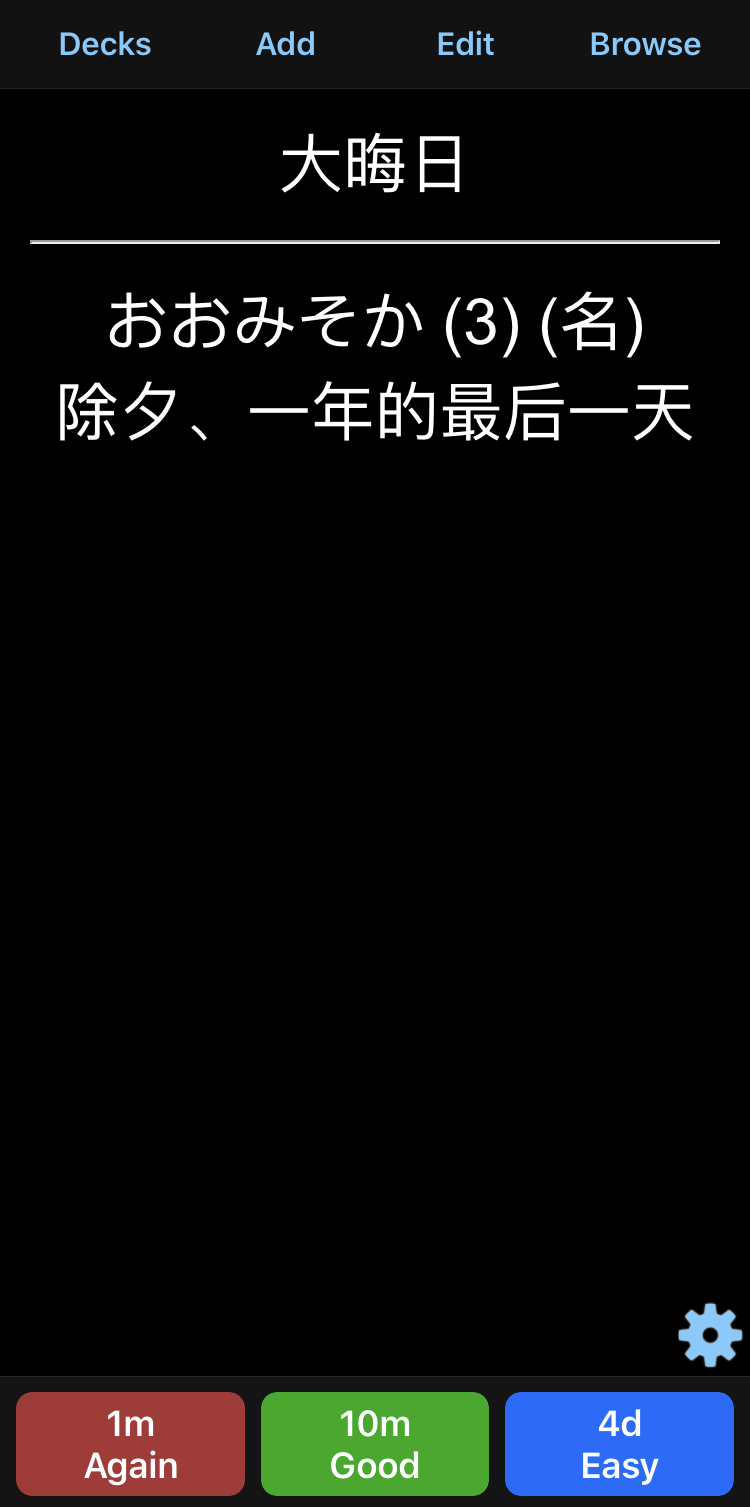
 Taking the mobile phone as an example, during the process of learning decks, we can click on the buttons of different colors below according to our own answering conditions. In this way, Anki will add the corresponding cards to the corresponding review sequence, and dynamically arrange the learning plan based on the Ebbinghaus forgetting curve and our subsequent recall status. It can be said that Anki’s characteristic of dynamically customizing learning plans based on personal memory conditions is the most fundamental reason why it stands out from many “vocabulary memorizing software”.
 This time last year, I was preparing for the postgraduate re-examination of the school I was applying for. If I can say that the ideal score in my postgraduate foreign language examination is “mostly” the result of my own efforts, then Anki is “less than half” the reason.