Many years later, when I opened this moldy CD book from more than ten years ago, I remembered those sultry afternoons in middle school, when I squeezed into the small cubicle on the second floor of the computer city to select pirated game CDs. At that time, China was in an era when game consoles had not yet been banned, digital copyrights were not popularized, and physical channels were extremely scarce. At that time, poor students could only rely on pirated discs on the street and cracked game forums to access and play the latest stand-alone games. I am no exception.
Similar to the traditional audio and video industry, the piracy era of Chinese video games has ended with the end of the physical era**. In the physical era when audio and video products are still distributed in physical discs or tapes, a country with lax enforcement of intellectual property rights will inevitably see widespread piracy. A pirated disc like this costs 2 yuan a piece, and there is almost no technical threshold for production. However, with the popularization of the Internet, digital copyright has gradually replaced physical channels and become the most important distribution method for audio and video products. People’s usage habits of audio-visual products have also gradually changed during this process. Traditional DVD players and tape players have been gradually eliminated, and mobile phones, computers, and a series of portable digital media players have become mainstream. By this time, physical pirated discs were on their way out.
The Tao is one foot high and the devil is one foot high. Early online digital distribution, due to many limitations of network bandwidth and traffic, could only be carried out in the form of digital copies. This provides new opportunities for piracy. Although the traditional physical piracy industry has declined at this time, because digital copies are easy to copy and spread, the spread of piracy in the form of BT and eDonkey has become increasingly rampant. Even though publishers are racking their brains to technically protect digital copy services, such as encrypting the file format of digital copies, or requiring buyers to use their own playback software for playback, etc. But these efforts were in vain. Cracking or reverse engineering has been the main technical weapon of online piracy channels for a long time.
Today, digital streaming services, or online streaming services, have brought this dispute to a complete end**. Different from the previous methods of selling or distributing through downloading or copying, digital streaming services provide consumers with a convenient experience of clicking and playing without downloading. For example, Spotify and Netflix, although the latter also started out as a physical disc rental business, their main businesses today are subscription-based digital streaming services. The improvement of network infrastructure and the reduction of traffic rates have made it possible to enjoy streaming services through the network anytime and anywhere. In this tug-of-war over intellectual property rights, technological progress has undoubtedly given copyright owners a good chance of victory.
Electronic games have also experienced a similar development process, but compared to the traditional audio and video industry, games occupy larger data capacity, and their interactive consumption methods also require more specific environments and hardware. Therefore, digital copy services represented by Steam became popular later than the music or movie industry. Nowadays, as long as we connect a network cable, we can download digital games at high speed without purchasing physical game discs. Those “tomato plates” and “banana plates” full of memories have gradually appeared on the stage of history.As I said before, the consumption method of video games is interactive, which has extremely high requirements on the timeliness of operation and feedback. This is the real reason why the game industry has been slow to move from the digital copy era to the streaming era. The so-called digital streaming service of electronic games refers to a new consumption method in which players do not need to download game data locally, but only accept the game screen and send operation instructions through the network to complete the playing process. It is also called “cloud gaming” by some people because game data will always be stored on the service provider’s cloud server.
In 2019, Google launched its game streaming service Stadia at its annual game developers conference, GDC 2019. Google said that through Stadia, players do not need to download any game data locally, and can play the latest video games with 4K60 frames on devices on different platforms through the Chrome browser. This is what digital streaming services like Netflix have achieved in the field of video games.
At present, it seems that the only obstacle facing ** game streaming services is network latency**. When we usually play online games, a delay of about 100ms can bring an excellent gaming experience. But the network delay here only occurs when we interact with other players. In other words, there is no delay problem for the characters controlled by our players. Because all the game resources we see have been downloaded locally in advance. Game streaming is completely different. It requires our network to not only transmit a large amount of game resource data in real time, but also to be able to transmit our control instructions back to the cloud in a timely manner, and then the cloud calculates the feedback corresponding to our control instructions and the game screens corresponding to these feedbacks. This entire process must be completed within 10ms so that players will not feel obvious operational lag.
Traditional optical fiber networks or cellular mobile networks are of course unable to meet the stringent network latency requirements of game streaming. But in the not-too-distant future, with the popularization of 5G standards, high-bandwidth, low-latency networks are almost within sight. With the support of these new technologies, game streaming services that people once thought were impossible will actually come to people.
On June 12, Sony finally announced PlayStation’s next-generation game console: PS5. Microsoft also announced details of its next-generation console, Xbox Series X, a few months ago. Compared with the previous generation, the performance improvement of these two new consoles is actually very limited, far less than the progress from PS2 to PS3. This is why these two new consoles caused controversy as soon as they were announced. As the biggest highlight of PS5, the high-speed solid-state drive is derided by many people as a gimmick.
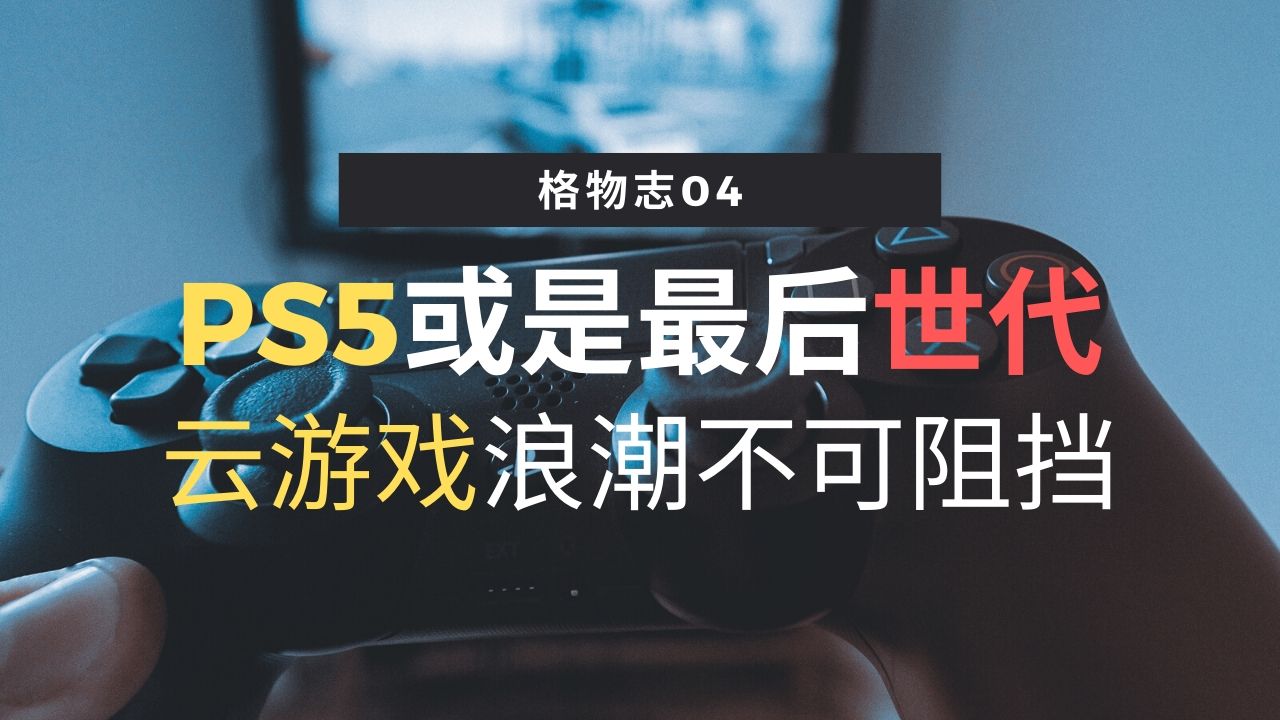
It is foreseeable that as the price of PC hardware continues to decrease and game streaming services become more popular in the future, the living space of game consoles will become smaller and smaller**. Video games will always exist, but the carrier carrying them will shift from physical to online. Just like we no longer need to buy special MP3 players to listen to music, one day we will no longer need special game consoles. PS5 may be the last generation, game consoles will eventually die, and the trend of game streaming is unstoppable.I am actually a loyal Sony and Nintendo player, and console games have brought me a lot of happy times. Just like when I was in middle school, I took out my Sony music player and put on my headphones to listen to Pink Floyd during my lazy lunch break. It will eventually become a beautiful past along with my youth.
My name is Gu Yue. Thank you for listening to “Ge Wu Zhi”. I will try my best to learn more about history and society in this program. If you like this episode, please subscribe to my channel, or give my video a like, and leave your thoughts in the comment area. See you next time.