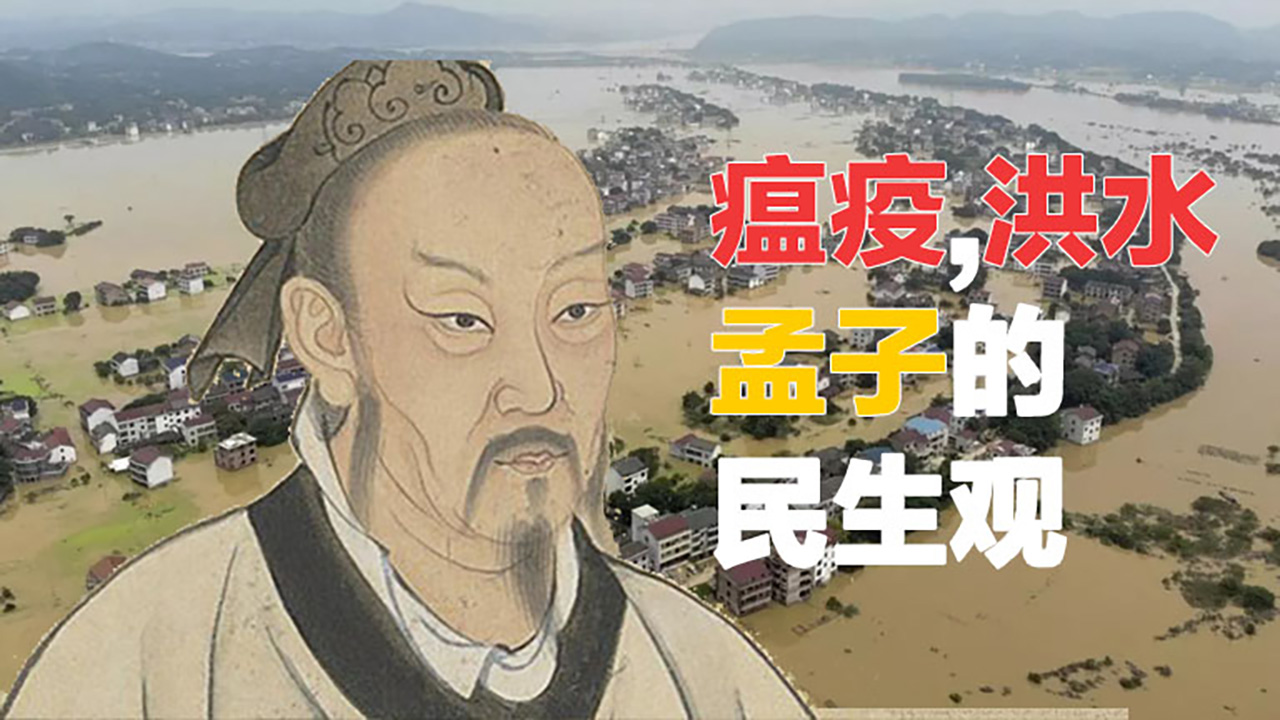
This summer, southern my country suffered a rare flood in history. Many residents in rural areas not only suffered huge economic losses due to flood discharges or dyke breaches, but also had to leave their hometowns and become refugees in other places. In the face of huge losses and pain, doubts and accusations about policies will inevitably arise. Many residents who were on the verge of bankruptcy or homeless due to flood discharges expressed their complaints through social networks. In most cases, these complaints can be recognized and sympathized by netizens, but criticism and accusations also follow.
Critics believe that both plagues and floods are natural disasters that cannot be controlled by humans. Everyone is equal before natural disasters, and disasters and losses are inevitable. Those refugees who are financially bankrupt or homeless can only say that they are unlucky and have no one to blame. Besides, the government has done its best to fight floods and provide disaster relief. It has worked very hard. Why do you blame it?
Mencius had already given a powerful response to this voice more than two thousand years ago. There is a famous exposition in “Mencius: King Hui of Liang”, which is considered by later generations to be the basis of Mencius’ thought of “benevolent government”.
King Hui of Liang said: “I only care about my country with all my heart and ears. If there is trouble in the river, move the people to the east of the river, and move the millet to the river. The same is true for the trouble in the east of the river. If you look at the government of neighboring countries, you can’t compare with the intentions of the few. If the people of the neighboring countries don’t increase the number, and the people of the neighbors don’t increase the number, why not?”
King Hui of Liang said [to Mencius]: “I have put all my efforts into this country. When there was a famine in Hanoi, I moved the people there to the east of the river, and then transported the grain from the east of the river to Hanoi. I will do the same when there is a disaster in the east of the river. I have also inspected the internal affairs of neighboring countries, and none of them can be as attentive as me. But the people of those countries have not decreased, and my people have not increased. What is the reason?
There is a background that needs to be explained here. ** Mencius, as an advocate of the idea of benevolent government, would tell him every time he met a monarch: A country that implements benevolent government will continue to attract people from other countries to settle there; a country that does not implement benevolent government will not be able to retain people, and the people there will vote with their feet and continue to immigrate to countries that implement benevolent government**. In this case, since the population is the foundation of a country’s prosperity, “benevolent government” is an excellent way to make the country prosperous and ultimately make the country rich and powerful.
Mencius tried to use this set of rhetoric to induce the monarchs of various countries to implement benevolent policies driven by the dream of a great nation. Because in Mencius’ theory, benevolent government is a necessary condition for a strong country. The reason why King Hui of Liang asked the question mentioned above was precisely because he heard Mencius’s rhetoric about benevolent government. We don’t know whether King Hui of Liang asked the question sincerely or deliberately made things difficult for Mencius. But in any case, this passage from King Hui of Liang is a powerful challenge to Mencius’ theory of benevolent government. So how did Mencius respond to such a challenge?
Mencius said to him: “The king likes war, please use the metaphor of war. After filling up the drum, the weapon was connected, abandoning the armor and dragging the soldiers away. It may take a hundred steps and then stop, or it may take fifty steps and then stop. What if you take fifty steps and laugh at a hundred steps? Said: “No; if it is not straight for a hundred paces, it is also walking.” “If the king knows this,” he said, “there is no hope that the people will be more numerous than those of neighboring countries.” “Mencius replied: “Your Majesty, you like to fight, so let me use war as an analogy. If some people abandon their armor and drag their weapons and run away at the beginning of the war. Some people run a hundred steps before stopping, and some people stop after running fifty steps. Under such circumstances, can those who ran fifty steps laugh at those who ran a hundred steps?” King Hui of Liang said: “Of course not, although he did not run to one hundred steps. A hundred steps, but this is also an escape. “Isn’t this a fool’s errand?” Yes, that’s right! The idiom “laughing at fifty steps and laughing at a hundred steps” comes from here.
After hearing King Hui of Liang’s answer, Mencius secretly rejoiced, thinking that you had finally fallen into my trap. Mencius said: “Since your Majesty understands this truth, then stop hoping that your people will be more numerous than those of your neighboring countries.” Next, Mencius used a long and rigorous discussion to demonstrate why King Hui of Liang tried his best to provide disaster relief, but he was still the same as those countries that did not implement benevolent governance, unable to obtain the dividends of benevolent governance. King Hui of Liang laughed at the lack of benevolent government in other countries, but he was actually “laughing at fifty steps and laughing at a hundred steps”. His policies were not essentially different from those of other countries.
Grain, fish and turtles cannot be eaten, and wood cannot be used. This is to make the people live and die without regret. Maintaining one’s health and losing one’s life without regrets is the beginning of the king’s way.
There is so much food, fish and meat that they can’t eat it all, and there is so much wood that they can’t use it up. This makes the people have no dissatisfaction with life, death and burial. The people no longer had any dissatisfaction with life, care, death, and burial, and the royal way began.
If you don’t take away a hundred acres of land, then a family of several people will not be hungry. I sincerely follow the teachings of Xiangxu⒂, apply the meaning of filial piety and brotherhood, and award the white ones to live up to the road. Those who are seventy years old can wear silk and eat meat, and the people are neither hungry nor cold. However, there is no king who is not king.
If a family has hundreds of acres of arable land and does not hinder their production, then the family can have enough to eat. If you run some good schools and educate them in the principles of filial piety and brotherhood, then the gray-haired old people will no longer have to carry heavy loads on their backs. Even the elderly over seventy years old have clothes to wear and meat to eat, and the people of Li are neither hungry nor cold. It is impossible for such a country not to make the world submit.
A dog eats human food but does not know how to check it; when a person dies, he says, “It’s not me, it’s Sui.” ’ How is this different from stabbing someone and killing them, saying, ‘It’s not me, it’s a soldier. ’ When the king was innocent, all the people in the world were here.
[This is not the case now] The pigs and dogs of the rich eat the people’s food without checking or stopping it. In ordinary years, there are corpses of people who died of starvation on the road, but they never thought that the granary should be opened for rescue. When he kills someone, he says, “It’s not my fault, it’s just a bad year.” ’ This statement is equivalent to stabbing someone to death with a knife, but saying, I didn’t kill the person, but a weapon. Your Majesty, if you do not shift the responsibility to natural disasters [but carry out fundamental reforms to the system], then people from other countries will naturally come to seek refuge.
Compared with remedial measures after natural disasters, Mencius obviously paid more attention to the overall welfare of society. As long as the government no longer imposes excessive taxes and uses heavy taxes and rising housing prices to drain the people’s economy, then even if plagues and floods come, the people themselves will have a strong ability to resist and will not go bankrupt or cut off their supply as soon as they lose their jobs. Therefore, in Mencius’ view, free markets and social welfare are safety nets that help people resist natural disasters. Only with these can it be called the true “kingly way”, attract the people of other countries to yearn for it, and finally make the world return to its heart. And those who readily shift the blame to natural disasters, no matter how hard they try to provide disaster relief and rescue operations, are still far from the right path. These people laugh at other countries, just like taking fifty steps to laugh at a hundred steps.