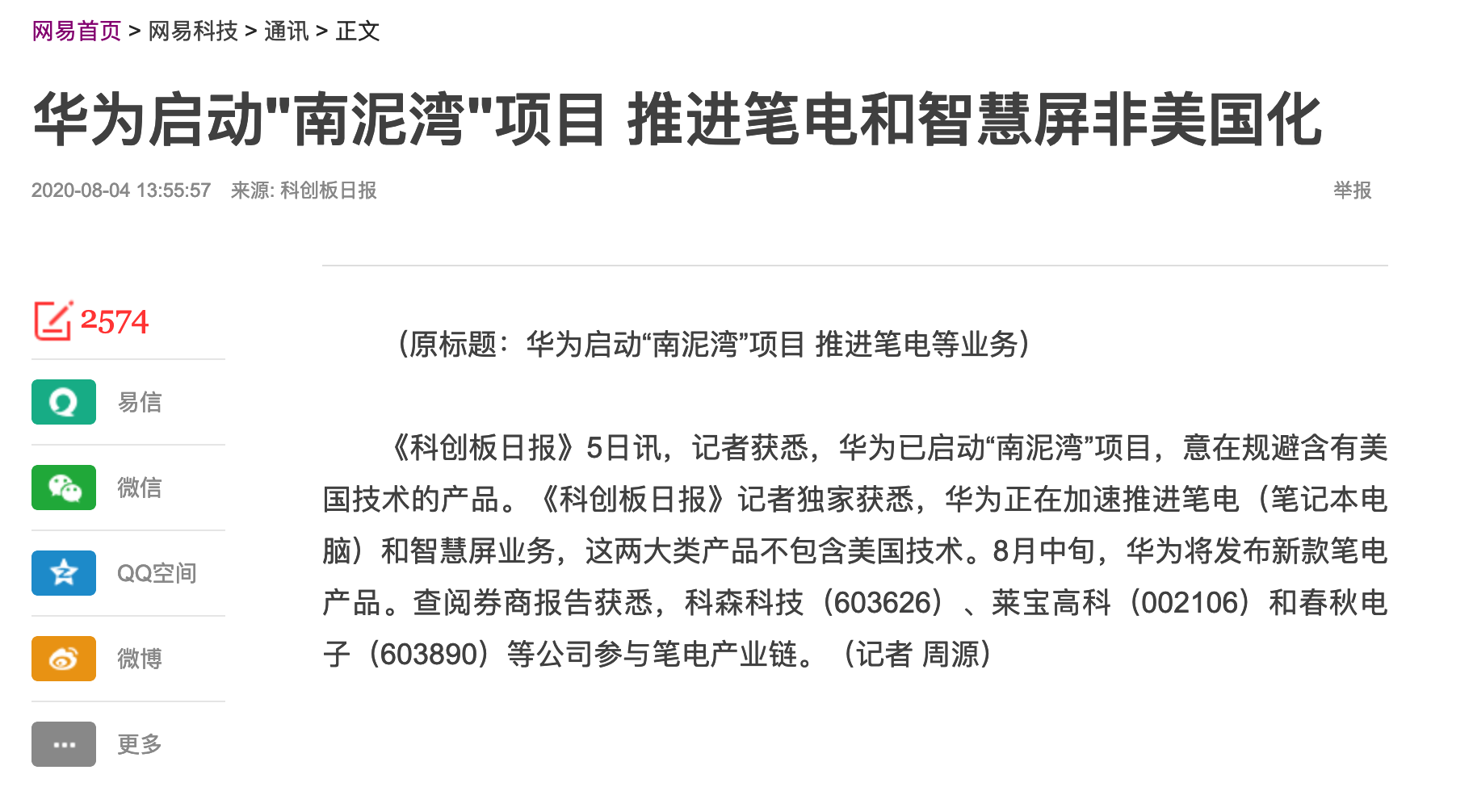
Huawei launches “Nanniwan” project
Today, a [news] about Huawei suddenly spread on the Internet (https://tech.163.com/20/0804/13/FJ6L182N00097U7S.html) . “Kechuangban Daily” reported that Huawei has launched the “Nanniwan” project to accelerate the development of its laptops, smart TVs and other products, aiming to avoid products containing American technology. This marks that under increasingly severe external pressure, Huawei has to shift its attention away from areas with higher technology density such as 5g and chips, and instead invest in areas with lower technology density such as consumer electronics. Because compared to the former, investment in consumer electronics can not only circumvent technological blockades and sanctions from Western countries, but also enable Huawei to obtain higher sales profits with less research and development costs. As a company with shareholders at the top and employees at the bottom, this strategic shift is completely in line with Huawei’s interests and can be said to achieve multiple goals with one stone.
But what is very regrettable is that as a company famous for its high technology, Huawei, which was once regarded as the “national pride” by many patriots, cannot escape the fate of “involution”. Personally, I believe that Huawei, which was forced to launch the “Nanniwan” project, and ByteDance, which was forced to sell Tiktok, together constitute the epitome of the embarrassing situation of my country’s national enterprises in this era. They also have extraordinary innovation capabilities, are also trying to go out of China and into the world, and they once truly had world-class influence. However, under the influence of a series of untimely strategies or policies by the government, they had to give up their martial arts skills, turn their long-term vision of targeting the international market to the domestic market, and become one of the participants in the domestic competition that has been fought like the Red Sea**.
Some people will blame the embarrassing situation of Huawei and ByteDance on the exclusion and suppression of Western countries led by the United States. They believe that in order to maintain its hegemony, the United States has to use various means to suppress China’s outstanding companies. Others blame the Chinese government’s strategic misjudgments and policy mistakes for the unfavorable situation of Chinese enterprises. They believe that the government’s reduced credibility and a series of excessive diplomatic words and deeds are the real reasons that hinder national enterprises from “going global” and plunge Chinese society into involution. No matter which view you take, there is no denying the fact that almost all social entities, including national enterprises, have inevitably stepped out of the golden age of China’s development. What follows will be a “cold winter” that will not be too short.
The involution crisis of Chinese society
The concept of “involution” was mentioned earlier. The so-called involution refers to the phenomenon that a certain society stagnates after developing to a certain stage, and extremely fierce but meaningless competition occurs among its internal members, resulting in the inability of the society as a whole to move to a more advanced stage. Although it is still doubtful whether the development of human society must follow the law of “from lower to higher”, it is undeniable that, as a purely empirical induction, the phenomenon of involution does occur from time to time in human history. For example, the mainstream view in academic circles believes that without the intervention of Western civilization, the Qing Empire would not have been able to develop modern capitalism by relying on its own strength alone, nor would it have been able to modernize politically or ideologically. It can be said that compared with Western European countries, China in the 19th century or even earlier had actually fallen into the quagmire of involution.Similar to the idea of involution, there is also the concept of the so-called “middle-income trap”. It refers to a situation where a country has reached a certain level of income due to certain advantages, but remains at that economic level and cannot develop further**. So far, countries recognized by the world as having fallen into the middle-income trap include Brazil and South Africa. They have all experienced a period of rapid growth, but as labor costs continue to increase, these countries have lost their original competitive advantages. At the same time, industrial transformation and technological progress did not arrive in time. Therefore, after these countries reached the middle-income level, they fell into a long period of stagnation until today.
Chinese society is currently on the verge of involution or the middle-income trap. With the successive failures of institutional reform and industrial transformation, China’s economic development has gradually lost momentum. Coupled with the impact of many “black swan” events such as the COVID-19 epidemic and nationwide floods, it is no longer possible to return to the past high-speed growth state. Under such circumstances, large-scale salary cuts and even unemployment are inevitable. The extension of working hours and the reduction of employee benefits are nothing more than a few waves in this historical trend. A more turbulent reality is still to come in the near future.
Since 2018, the anxiety permeating the urban middle class has been increasing day by day. The huge tension between sluggish income growth and rising housing prices is eroding the lives of the middle class. Especially the younger generation who have just entered society are already facing huge competitive pressure due to excessive enrollment expansion in colleges and universities and the disconnect between the teaching system and social needs. The overall deterioration of the economic situation has made the already fierce competition even more severe. In recent years, the trend of candidates for non-professional skills positions becoming more highly educated has become increasingly apparent. Jobs that only required a college degree to get an interview ten years ago now require a bachelor’s degree or above as a stepping stone. This phenomenon is not a manifestation of the increase in the popularity of higher education in our country, but a manifestation of social involution. In an involutional society, individual competition that was supposed to promote the overall development of society has become meaningless internal friction.
Causes and solutions for involution
Fundamentally speaking, the reason why a society will become involution is because its own development model is too radical and its industrial structure lacks stamina, not because of the exploitation or ulterior motives of so-called developed countries. A famous conspiracy theory related to the latter attribution method believes that the reason why Japan quickly slid from the rapid growth stage in the 1980s to collapse and decline, leading to the “lost 30 years (1990-2020)”, is because it signed the “Plaza Accord” with Western countries headed by the United States. This agreement was considered by many Chinese people as evidence that the United States suppressed the development of Japan, then the world’s second largest economy, in order to maintain its world hegemony.But the truth is not that simple. The Plaza Accord was originally intended to devalue the U.S. dollar in order to promote U.S. product exports. However, with the help of a series of fiscal and monetary policies by Japan’s Ministry of Finance, the yen appreciated rapidly. A large amount of hot money poured into the Japanese market, causing Japan’s stock market and housing prices to soar since the signing of the Agreement in 1985 until the bubble burst in the early 1990s. In this process, Japan’s Ministry of Finance’s decision-making errors and improper handling were the real reasons for the expansion and bursting of the bubble. The Plaza Accord, which many Chinese people talk about, was at best a trigger. Therefore, it is useless to blame the stagnation or decline of a country’s economy on the suppression of external forces. To avoid the decline and involution of society as a whole, we must face the shortcomings of our own development model, reflect on policy mistakes and lessons, and constantly seek industrial transformation methods that suit our national conditions.
In the mainstream political theory of modernization, the government should assume the function of safeguarding the development of individuals and enterprises. As for the direction and path of development, even if it does not appear in the economic blueprint of public opinion organs (such as Congress), it should be left to the people themselves to decide. Empty plans without scrutiny will only become a shackles for the development of individuals and enterprises, restricting their own progress. As for the implementation of “wolf warrior diplomacy” to arouse the resentment of the international community and then backfire on one’s own national enterprises, it is far from the responsibilities of a modern government. If we ignore this and fail to examine any mistakes, no matter how many “strategies” or “initiatives” we launch to increase production capacity, it will not help. The arrival of involution will not be delayed by the rejection of personal will, and the fate of the Chinese people must be in their own hands.