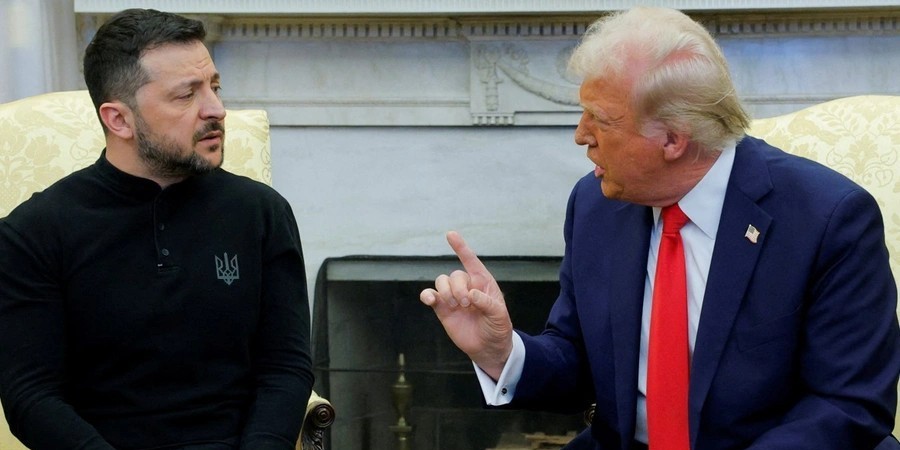
On February 28, 2025, the meeting between Trump and Zelensky in the Oval Office of the White House turned into an unprecedented public conflict. This high-level meeting, which was originally intended to sign an important mining agreement, turned into a fierce quarrel due to differences between the two sides on the resolution of the Russia-Ukraine conflict. US Vice President Vance even accused Zelensky of not being grateful enough for US assistance. The diplomatic conflict, which occurred on live television, sharply deteriorated relations between the two countries. Trump eventually canceled the joint press conference and asked Zelensky to leave the White House, using social media to express that “he disrespected the sacred Oval Office of the United States.” This incident demonstrated the extreme manifestation of the Trump administration’s “America First” foreign policy and had a serious impact on the future destiny of Ukraine and the unity of the Western alliance. It also highlighted the fundamental change in Trump’s attitude towards Putin.
Background and preparation for the meeting
The high-stakes meeting took place at a time when Ukraine’s future fate hangs in the balance, and all parties have high hopes for it. The main purpose of Zelensky’s trip is to sign an agreement with the United States on rare earth minerals, which is considered to be a condition for continued military assistance from the United States [2]. The meeting follows weeks of intense negotiations between U.S. allies trying to reconcile differences between Washington and Kyiv. French President Macron and British Prime Minister Starmer have both met with Trump and tried to persuade him to have constructive dialogue with Zelensky [2]. These diplomatic efforts have adopted a flattering tactic, with Macron recalling Trump’s visit to Notre Dame and Starmer hand-delivering a letter from King Charles.[2]
A key background for this meeting is that the Trump administration has previously held peace negotiations with Russia, but excluded Ukraine and Europe [3]. This unilateral action triggered strong dissatisfaction in Kyiv and further aggravated tensions between the two parties. Before Zelensky arrived at the White House, his team was forced to formally agree to Trump’s plan on Wednesday, which finally led to Friday’s meeting [1]. According to the Associated Press, U.S. officials have made it clear that Trump will not meet with Zelensky unless he is willing to accept a negotiation plan with Russia.[1]
Violent clashes at White House meeting
From peaceful beginnings to violent quarrels
The atmosphere at the beginning of the meeting was relatively friendly, and it was reported that within the first half hour, Trump and Zelensky expressed politeness and respect to each other.[1] Trump even expressed his willingness to continue to provide some military assistance to Ukraine until a lasting peace agreement with Russia is reached [1]. However, the situation took a turn for the worse when Zelensky expressed distrust of Putin’s ceasefire commitment[1].
The key turning point for the deterioration of the situation occurred in Zelensky’s speech. He directly called Putin a “murderer and terrorist” and expressed the hope that Trump could stop Putin with a tough stance [3]. This comment obviously offended Trump, who believed that Zelensky’s “hatred” for Putin was an obstacle to peace negotiations[1][3]. When Zelensky tried to explain that Russia had repeatedly violated the ceasefire agreement, Vice President Vance intervened and scolded him for “it is disrespectful to try to argue in the Oval Office in front of the American media”[1][3].
Trump and Vance’s accusations
Trump issued a stern warning to Zelensky, directly threatening: “You either make a deal or we withdraw. If we withdraw, you fight on your own. I don’t think the outcome will be very good, but you will fight."[3] He further accused Zelensky of “risking World War III” and said that Zelensky’s behavior was “very disrespectful to a country that supports you more than many people think it should”[1][3].During the debate, Trump exaggerated the amount of U.S. aid to Ukraine, claiming that it had provided $350 billion, while the actual figure was less than $200 billion[2]. He also claimed that without US military support, the conflict could have ended “within two weeks”[2]. Trump made it clear that he was in the “middle ground” and had no “alignment” with Putin, but he was dissatisfied with Zelensky’s hatred of Putin and believed that this made it difficult for him to broker an agreement[1][3].
Vance became more aggressive in the argument, asking Zelensky if he had ever said “thank you” once.[3] He pointed out that Ukraine is “forcibly recruiting frontline soldiers because you have a manpower problem” and said that Zelensky “should thank the president for trying to end this conflict” [3]. Vance also suggested that the previous Biden administration’s condemnation of Putin only prolonged the conflict [2].
Zelensky’s response
Zelensky has tried to defend himself in the face of these accusations. When Vance mentioned “diplomacy” as the path to peace, Zelensky asked: “What kind of diplomacy are you referring to, JD?” and cited examples of Russia’s past ceasefire violations [1]. He also reminded Vance that Putin had violated the agreement during the Trump administration in 2019[2].
When accused of lacking gratitude, Zelensky tried to express more gratitude, but was interrupted by Trump.[2] In a particularly poignant moment, Zelensky said to Vance: “First of all, during the war, everyone had problems, including you. But you had beautiful oceans that you can’t feel now, but you will in the future."[3] This comment immediately triggered a counterattack from Trump: “Don’t tell us what we will feel. We are trying to solve the problem. Don’t tell us what we will feel."[3]
Consequences and Impact of Conflict
Immediate Consequences
This fierce conflict led to the cancellation of the planned joint press conference and the signing of the economic agreement [1][3]. After the meeting, Trump asked Zelensky to leave the White House and issued a brief but stern statement on social media: “I have determined that President Zelensky is not ready to accept peace if the United States participates because he believes that our participation will give him a huge advantage in negotiations. I don’t want an advantage, I want peace. He disrespected the United States of America in the precious Oval Office. When he is ready to accept peace, he can come back."[2][3]
Zelensky later appeared on Fox News in an attempt to repair damaged relations, saying that public disagreements with Trump and Vance “would be unhelpful to both parties."[1] However, he insisted that Ukraine would not enter into peace discussions with Russia without receiving security guarantees against future aggression[1]. “This is a very sensitive issue for our people,” Zelensky added. “They just want to hear that the United States is on our side, not Russia, but us. That’s all."[1]
Impact on Ukraine’s future
This diplomatic conflict seriously jeopardizes the future of U.S.-Ukraine relations and Kyiv’s ability to defend itself against Russian aggression [1]. Zelensky admitted in a Fox News interview that without the support of the United States, the situation in Ukraine will become more “difficult”[1]. The incident shows that the Trump administration’s support for Ukraine is rapidly waning, which may leave Ukraine in a weaker position in future peace negotiations.
U.S. Senator Lindsey Graham of South Carolina, a defense advocate and a staunch supporter of Trump, had previously warned Zelensky to “not be fooled” when meeting with Trump [1]. The suggestion highlights concerns among many U.S. politicians about Trump’s diplomatic style and worries about Ukraine’s future prospects.## Changes in Diplomatic Relations and Geopolitical Significance
Trump’s shift in foreign policy
This conflict clearly demonstrates how Trump is shifting U.S. foreign policy toward his “America First” philosophy, far exceeding the policies of his first term.[1] The unexpected clash has been described as one of the most heated public disputes between global leaders in the Oval Office in recent times, with traditional diplomatic protocol devolving into accusations, shouting and apparent contempt.[1]
The incident occurred a week after U.S. allies tried to resolve differences between Washington and Kyiv, and they tried to persuade Trump not to overture Moscow.[1] On Monday, French President Macron met with Trump to discuss establishing a European-led peacekeeping force in Ukraine, aimed at deterring future Russian aggression and encouraging the US president to adopt a more skeptical attitude towards Putin [1].
Trump’s attitude towards Putin
All parties have observed that Trump shows a clear preference for Putin. When asked if he was “aligned” with Putin, Trump responded: “I’m not aligned with Putin. I’m not aligned with anyone. I’m aligned with the United States of America, for the good of the world. I’m aligned with the world, and I want to end this."[3] However, he then suggested that Zelensky was the main obstacle to negotiations: “Do you see his hatred of Putin? It makes it very difficult for me to make a deal."[3]
Trump’s attitude toward Putin may stem from his belief that Russia was treated unfairly during his first term. He mentioned during the meeting: “Putin has been through a lot with me. He faced a fraudulent witch hunt, and they used him and Russia. Russia, Russia, Russia."[2] This comment refers to the finding by US intelligence agencies that Russia interfered in the 2016 election to benefit Trump’s election.[2]
Jonathan Abbott (Susan Glasser), a journalist who has written books on Putin’s rise, commented: “Donald Trump has changed his position on the conflict, and I believe that context explains the conflict we just saw."[2] This comment implies that Trump is now more aligned with Russia’s position than traditional U.S. support for Ukraine.
Conclusion
The diplomatic dispute in the White House on February 28, 2025 marked a major turning point in the relationship between the United States and Ukraine, reflecting that the Trump administration’s “America First” foreign policy is completely reshaping the United States’ position on the international stage. The open conflict not only damaged relations between the two countries but also exposed deep divisions in the Western alliance over its response to Russian aggression. Trump’s apparent tilt toward Putin contrasts with his harsh criticism of Zelensky, raising widespread concerns about a shift in the direction of U.S. foreign policy.
For Ukraine, the incident could mark a turning point in Western support, putting Kyiv in a more disadvantageous position in future peace talks. Zelensky’s predicament exemplifies the vulnerability of small-state leaders vis-à-vis the geopolitical interests of great powers, especially when the support of powerful allies begins to waver. As the Russian-Ukrainian conflict enters its fourth year, this White House spat could become a critical moment in determining the final resolution of the conflict, with repercussions that will extend far beyond the walls of the Oval Office and reshape the entire European security landscape.
Sources
Zelensky invades Trump’s ‘disinformation space’ | CNN Politics
Trump and Zelenskyy key takeaways: Oval Office meeting explodes into shouting match - ABC News
Trump Berates Zelensky in Fiery Exchange at the White House - The New York Times
Full transcript: Trump, Zelenskyy and Vance argue in the Oval Office | National Post
Trump and Zelensky Clash in the Oval Office | Council on Foreign Relations 7. Trump objected to Zelenskyy disrespect, White House says
What Trump and Zelenskyy said during their heated argument in the Oval Office | PBS News
February 28, 2025: Donald Trump presidency news | CNN Politics
Zelenskyy’s White House meeting ends in blowup with Trump and Vance over Ukraine’s future - CBS News 13. Full Meeting between President Trump, VP Vance and Ukrainian President Zelenskyy in Oval Office
Understanding the fallout from the Trump-Zelenskyy Oval Office meeting | King’s College London
Excerpts From the Fiery Exchange Between Trump and Zelensky at the White House - The New York Times
The Trump-Zelenskyy meeting just blew up. What now? - Atlantic Council
Trump and Zelenskiy clash, leaving Ukraine exposed in war with Russia | Reuters
In Showdown With Zelensky, Trump Takes Offense on Putin’s Behalf - The New York Times 19. What U.S. lawmakers are saying about Trump and Zelenskyy’s clash at the White House | PBS News
Tears and shock in Ukraine and Europe after heated Zelensky-Trump meeting
Contentious Trump-Zelensky meeting threatens U.S. support for Ukraine
Trump-Zelensky clash highlights Congress at a crossroads over foreign policy
Trump’s Angry Meeting With Zelensky Prompts Reactions Worldwide
Trump Berates Zelensky in Fiery Exchange at the White House 26. Trump-Zelenskyy clash marks a defining turn away from U.S. defense of democracies
Trump-Zelenskiy clash divides US Republicans, dims aid prospects
Trump’s Zelenskiy outburst a culmination of weeks of frustration
How they are reporting it: Trump and Zelenskiy’s Oval Office shouting match
Lawmakers in US Congress react to Zelenskiy-Trump Oval Office clash
Zelenskiy, Trump clash will accelerate US probe of fraud in Ukraine aide, senior official says 32. Inside the 139 minutes that upended the US-Ukraine alliance
Trump speech to Congress likely to be ‘imperial,’ say analysts
Trump, Zelenskyy, Vance Face Off In Oval Office Shouting Match—Here’s Everything They Said