This is the transcript of episode 02 of my podcast Reasoned Talk (议正言辞). Listen on Xiaoyuzhou or Apple Podcasts . The episode is in Chinese; this transcript has been translated into English.
The Revenge of Xu Yuanqing
In the late seventh century, during the reign of Wu Zetian, a controversial act of revenge took place. The central figure was Xu Yuanqing, a resident of Xiagui County in Tongzhou, around today’s Weinan in Shaanxi. His father, Xu Shuang, had once been a local official. Years earlier, he had been put to death by the county commandant Zhao Shiyun. The historical record does not explain in detail why Xu Shuang was executed.
Xu Yuanqing was overwhelmed by grief and anger. What made the loss harder to bear was that Zhao Shiyun not only escaped punishment but continued to rise, eventually serving at court as a censor. The apparent failure of local justice convinced Xu that ordinary legal channels would never vindicate his father. He began to plan revenge.
To approach his enemy, Xu concealed his identity and took menial work at a government relay station. Relay stations housed officials and provided fresh horses on long journeys; they were something like state-run guesthouses in twentieth-century China. Years later, Zhao Shiyun—by then a censor—stopped at the station while traveling on official business. Xu seized the opportunity and killed him.
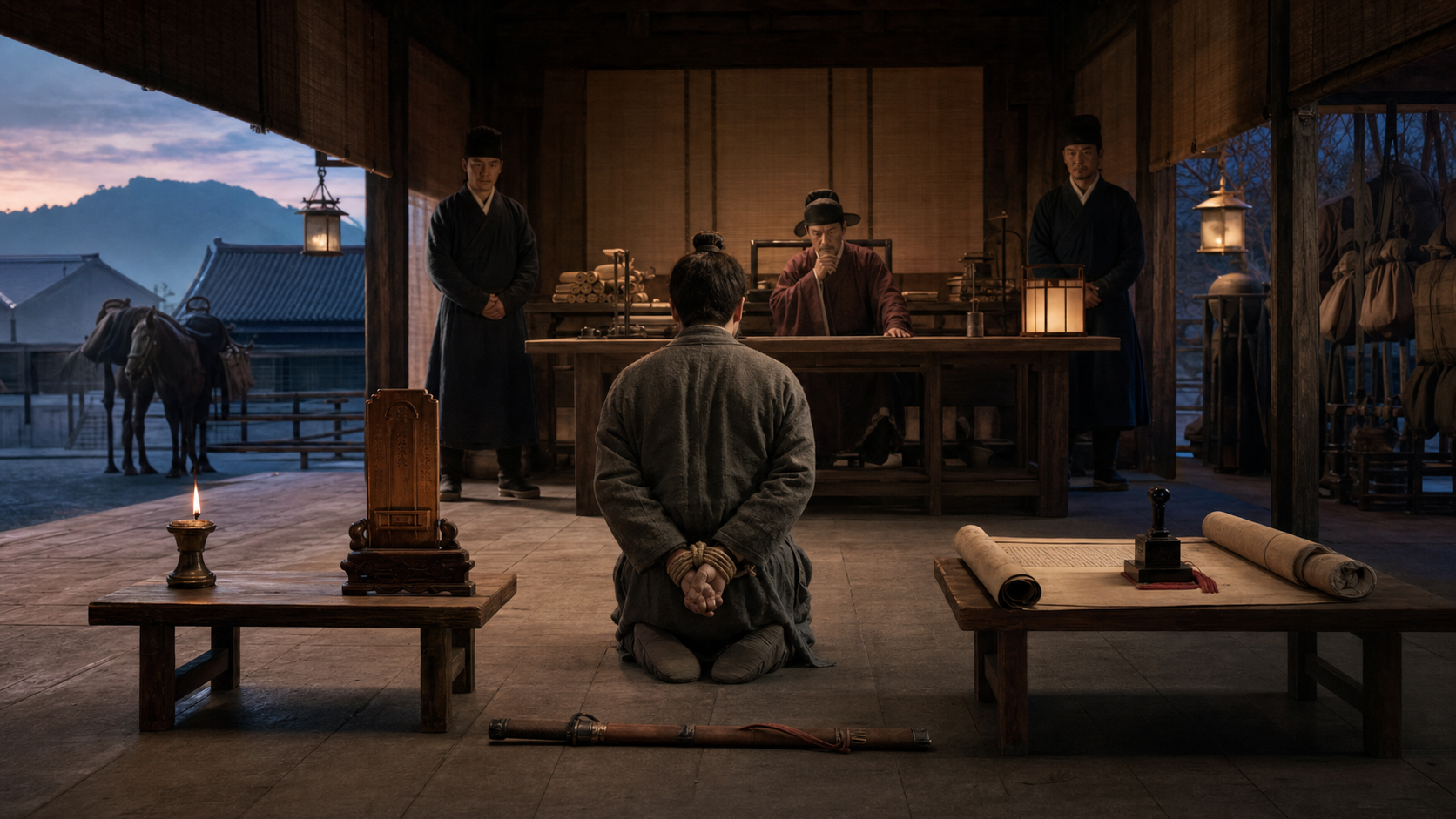
Xu did not flee. He tied his own hands and surrendered to the authorities. The scene calls to mind the knight-errant of martial legend: his great vengeance complete, he calmly presents his neck for execution.
Law and Judicial Institutions under the Tang
Killing a court official was a grave crime. Under the Tang Code, Xu faced execution. The period from Emperor Gaozong through Wu Zetian and Emperor Zhongzong rested on a highly developed legal order. The Tang Code is among the earliest Chinese codes to survive in full. It began to take shape during the Zhenguan era and was formally promulgated during Gaozong’s Yonghui era. Its more than five hundred provisions were arranged in twelve sections, moving systematically from general principles of punishment to particular offenses.
The Code identified the “Ten Abominations”: plotting rebellion, plotting great sedition, plotting treason, depraved rebellion, depravity, great irreverence, lack of filial piety, discord, unrighteousness, and internal disorder. These offenses attacked the political, familial, and hierarchical order, and generally could not benefit from the privileges and forms of commutation otherwise available under Tang law. Killing an imperial censor was treated as “unrighteousness,” an offense against the hierarchy itself.
At the local level, particularly in prefectures and counties, judicial and administrative authority were usually combined. The county magistrate governed the county and judged its cases. He resolved civil disputes, heard criminal matters, and managed ordinary administration. When a crime occurred, he often served at once as investigator and judge, personally gathering evidence and questioning suspects.
The Tang Code regulated interrogation in detail. Officials were taught to use the “Five Hearings,” observing a suspect’s words, expression, breathing, responses, and gaze. When evidence was insufficient, an official could seek authorization from a superior to use judicial torture. Even that power was regulated: a suspect could be beaten no more than three times, with intervals of at least twenty days. If the suspect still refused to confess after three rounds, the accuser might instead be questioned under torture as a safeguard against false accusation. The practice reveals the brutality of ancient justice, but its procedural limits also show an effort to discover the truth and prevent wrongful conviction.
The Tang also had a hierarchy of appeals. A person dissatisfied with a county judgment could petition the prefecture, and then the central government. A particularly striking institution was the dengwen drum, hung outside the court so that people with grievances could beat it and demand official attention. The Tang Code required guards to report such petitions promptly and punished officials who refused to receive them. The mechanism resembled an ancient petition system designed to bring local injustice before higher authority. False accusation and abusive litigation were punishable, but the legal design nevertheless offered a path from the county all the way to the center.
The principal central judicial bodies were known collectively as the Three Judicial Offices: the Court of Judicial Review, the Ministry of Punishments, and the Censorate. The Court of Judicial Review was the highest tribunal for major criminal cases. The Ministry of Punishments administered law and reviewed judgments sent up from the provinces, particularly death sentences. The Censorate monitored officials and judicial procedure and could request that a wrongful conviction be reopened.
Death sentences were also subject to repeated memorials to the throne. Before an execution, the case had to be reported again for the emperor’s final decision. Xu Yuanqing’s case did not arise in a world without procedure. It entered a judicial system that was unusually elaborate for its time. That is precisely why its conflict between morality and law became so acute.
Chen Zi’ang: Execute Him, Then Honor His Filial Piety
When Xu Yuanqing’s case reached Wu Zetian, it created a dilemma. He had attacked a superior and committed a capital offense. Yet Confucian ethics regarded vengeance for one’s father as inherently justified.
Confucius’ disciple Zixia once asked about avenging a parent. Confucius replied that a child whose parents had been killed should sleep on a straw mat with a shield for a pillow, always ready to fight, and should not share the same sky with the murderer. If the child met the enemy in the marketplace or at court, he should not go home for a weapon but fight on the spot. Zheng Xuan later explained: “A father is his son’s Heaven. To share Heaven with the man who killed one’s Heaven is not the conduct of a filial son.” In Confucian ethics, vengeance for a father could be more than permissible; refusing to avenge him could mean abandoning a son’s most basic duty.
On one side stood the law as an expression of state power. On the other stood a moral claim deeply recognized by society. How could both be satisfied?
Wu Zetian initially leaned toward mercy and considered sparing Xu. His story was genuinely sympathetic. The empress also faced persistent doubts about the legitimacy of having taken the Li family’s throne, and a display of benevolence could help her appear a humane ruler.
The young remonstrating official Chen Zi’ang objected. This was the poet who would later write: “Before me, where are the sages of the past? Behind me, where are those still to come? I contemplate the vastness of heaven and earth, alone, and tears fall.” At Wu Zetian’s court he was known for speaking frankly. In Xu’s case he again challenged the sovereign openly.
Chen argued that if Xu’s filial motive justified setting aside the criminal law—and if that became a principle for future cases—the state would fall into disorder. Xu’s willingness to avenge his father and then submit to judgment was noble precisely because he was prepared to sacrifice his life. Sparing him would diminish the moral force of that sacrifice.
Chen therefore proposed an apparent compromise. Xu must be executed according to the Code, but a monument should be erected at his grave to honor his filial devotion. The first action would uphold the authority of law; the second would complete the work of moral instruction. Wu Zetian accepted the proposal. Xu was put to death, while the state formally commended his filial conduct in his home district. The sword of law fell, and the medal of morality followed.
The solution looked balanced, but it left an unavoidable question. If revenge was genuinely an act of loyalty and filial righteousness, why should the law punish the righteous man? Chen had not resolved the contradiction. He had merely tried to preserve both sides at once. That was precisely what Liu Zongyuan would reject a century later.
Liu Zongyuan: First Ask Whether the Father Deserved to Die
Around the Zhenyuan era of Emperor Dezong, Liu Zongyuan read Chen Zi’ang’s memorial on the case. Troubled by it, he wrote the celebrated “Refutation of the Argument on Revenge.”
Liu began with a simple proposition: praise and punishment cannot attach to the same act. Conduct worthy of praise should not be punished, and conduct worthy of punishment should not be praised. To punish what deserves praise is an abuse of penal power; to praise what deserves punishment violates ritual order. Chen’s solution committed both errors and damaged the seriousness of both rites and law.
For Liu, the real question was not how to preserve both systems at once, but whether Xu should have been executed. Drawing on ritual texts and the Gongyang Commentary, he argued that if the father had been punished unjustly—killed though innocent—the son’s revenge could vindicate justice. If the father had lawfully been executed for a crime, however, the son’s retaliation was no more than indiscriminate killing. It removed no evil and instead defied justice.
The facts of Xu Shuang’s death therefore had to be established before anyone could judge the morality of his son’s revenge.
If Zhao had wrongfully killed an innocent Xu Shuang and local officials had covered it up, leaving Xu Yuanqing without any legal remedy, then his revenge represented a desperate effort to enforce justice after public institutions failed. Liu argued that the authorities should not punish Xu; they should be ashamed of themselves. Local officials had betrayed their supposed role as “father-and-mother officials.” How could they then claim the moral standing to punish a filial son forced to seek justice on his own? In such a case, private self-help could at least be understood.
If, however, Xu Shuang had been guilty and Zhao had lawfully carried out a sentence, then he had died at the hands of state law, not a private enemy. Xu Yuanqing’s revenge would amount to hatred of the emperor’s law and the murder of an official who enforced it. The act would be more than ordinary homicide; it would directly challenge the authority of the legal order. In that case, the state should execute Xu without hesitation, and praise would be absurd.
Liu confined the Confucian ethic of revenge to situations in which a grave injustice had gone unremedied. It was not a general license for clan vendetta. His deeper claim was that rites and law should pursue the same end; their apparent conflict arose because the facts had not been established or the rules had been wrongly applied.
Yet Liu’s solution did not eliminate every difficulty. Even if Xu Shuang had been wrongfully killed, Xu Yuanqing’s premeditated homicide remained a serious offense under the written Code. Applying a statute is a positive legal question; motive and personal history belong to moral evaluation. By allowing private force when public remedies had completely failed, Liu ultimately gave greater weight to ethics. If state law no longer served justice, did the individual remain bound to obey it?
The Collision of State Power and the Rule of Law
The dispute arose from the Tang Code’s attempt to combine rites and law. “Rites” meant moral and social ethics; “law” meant the commands of the state. The Code tried to fuse them, but could not eliminate their underlying tension. Moral norms drew from ancestral reverence, blood revenge, and customary ideas of justice—a kind of natural law. State law drew from sovereign authority and the practical need to preserve public order. It was the extension of state power.
As discussed in the previous episode , Francis Fukuyama argues in The Origins of Political Order that the core of the rule of law is a set of abstract rules broadly recognized as legitimate and possessing authority beyond the current ruler. Such rules exist in natural tension with the state power produced by political centralization.
In Xu’s case, vengeance for a father was close to sacred in traditional moral judgment. Wu Zetian’s initial sympathy reflected respect for filial devotion and righteousness. Running parallel to that value, however, was the cold rule of the Tang Code: killing without public authority was a crime. Xu had deliberately killed an imperial official, and the written law demanded severe punishment.
That was the difficulty. Under the values associated with natural law, Xu’s act was righteous; under the legal framework created by state power, it was a capital crime. As later writers summarized the conflict: “In the rites, a son does not share the sky with his father’s enemy; in law, one who kills must die.”
If the state applied its criminal law without regard to traditional morality, the judgment might lose public acceptance and damage the dynasty’s standing among ordinary people and local officials. Yet if the state ignored written law in order to promote filial ethics, legal authority would also suffer. Once vengeance for a father received official approval, what would prevent others from killing private enemies under the same banner? Society could descend into an endless cycle of retaliation.
Two forces within the same political order had collided with unusual intensity. A misstep could upset the balance of the system and weaken the legitimacy and stability of rule.
China was, in this sense, a “precocious” civilization. It built a powerful state very early and stood far ahead in bureaucratic governance. A transcendent legal tradition capable of constraining that state, however, developed more slowly and remained weak. Xu Yuanqing’s case was one of the rare moments when the tension came fully into view. Most of the time, moral ethics could not move the authority of state law.
In a true rule-of-law order, even the state must submit to rules beyond any individual’s will. In Fukuyama’s formulation, the essence of the rule of law is that “even the king is bound by a body of law that he did not himself create.”
The final solution—“execute first, honor afterward”—is strikingly ironic. Law and morality each seemed to retreat a step, as in a carefully staged reconciliation. But the reconciliation was fragile because it established no common principle. Instead it sent a confused message: killing still required a life in return, yet the court might celebrate the killer if his motive was admirable. That compromise may have preserved order for a moment, but it could not resolve the deeper conflict.
Conclusion
The revenge of Xu Yuanqing is a vivid lesson in legal history. It reveals both the wisdom and the limits of imperial government when confronted by a fundamental social contradiction, and it shows how difficult the road toward the rule of law can be. In an ideal order, law promotes good values and morality is sustained through law. Reaching that point may require, as Liu Zongyuan hoped, the careful resolution of individual cases so that rites and law can recover their shared commitment to justice.
Western legal thought contains a comparable debate. Natural-law theory holds that “an unjust law is not law”: human enactments that violate morality lack binding authority. Legal positivism responds that “an unjust law is still law”: a rule validly enacted through the proper process remains legally binding regardless of its moral content. In the Xu Yuanqing dispute, Liu Zongyuan stands closer to natural law, while Chen Zi’ang resembles, in a limited sense, the positivist position.
More than a thousand years later, the case still has something to teach. Law is not only a set of cold provisions; it also carries the public’s expectations of justice and conscience. Officials must enforce law, but they must also consider its social effects and the values it communicates.
Key Figures
- Xu Yuanqing: Killed County Commandant Zhao Shiwen to avenge his father, becoming the central figure in a Tang debate over rites and law.
- Zhao Shiwen: The local official involved in the execution of Xu Yuanqing’s father and the direct target of the revenge.
- Chen Zi’ang: Argued that Xu should be executed under law while his filial piety should be honored.
- Liu Zongyuan: Criticized Chen’s solution and insisted that state law could not yield to private revenge.
- Wu Zetian: The supreme ruler of the era, embodying the tension between imperial justice and Confucian ethics.
Key Cases and Concepts
- The Xu Yuanqing revenge case: A classic Tang dispute over filial duty, revenge, and the state’s punitive power.
- Tang Code with Commentaries: The representative system of Tang written law and legal interpretation.
- Rites versus law: The question of how courts should choose when Confucian ethics conflict with state law.
- Revenge and public power: The central question of whether private justice may replace state adjudication.
Related Episodes
- Podcast 07|The Republican-Era Swordswoman and the Clash of Rites and Law: Shi Jianqiao’s Assassination of Sun Chuanfang : Also examines revenge, filial duty, and modern criminal law.