This is the transcript of episode 03 of my podcast Reasoned Talk (议正言辞). Listen on Xiaoyuzhou or Apple Podcasts . The episode is in Chinese; this transcript has been translated into English.
Timing note: This episode was released on July 4, 2025. The body preserves the state of the litigation and the analysis at the time of publication. For later developments in the merits of the birthright-citizenship dispute, see the transcript of episode 06 .
The Supreme Court’s Procedural Ruling and the Challenge to Birthright Citizenship
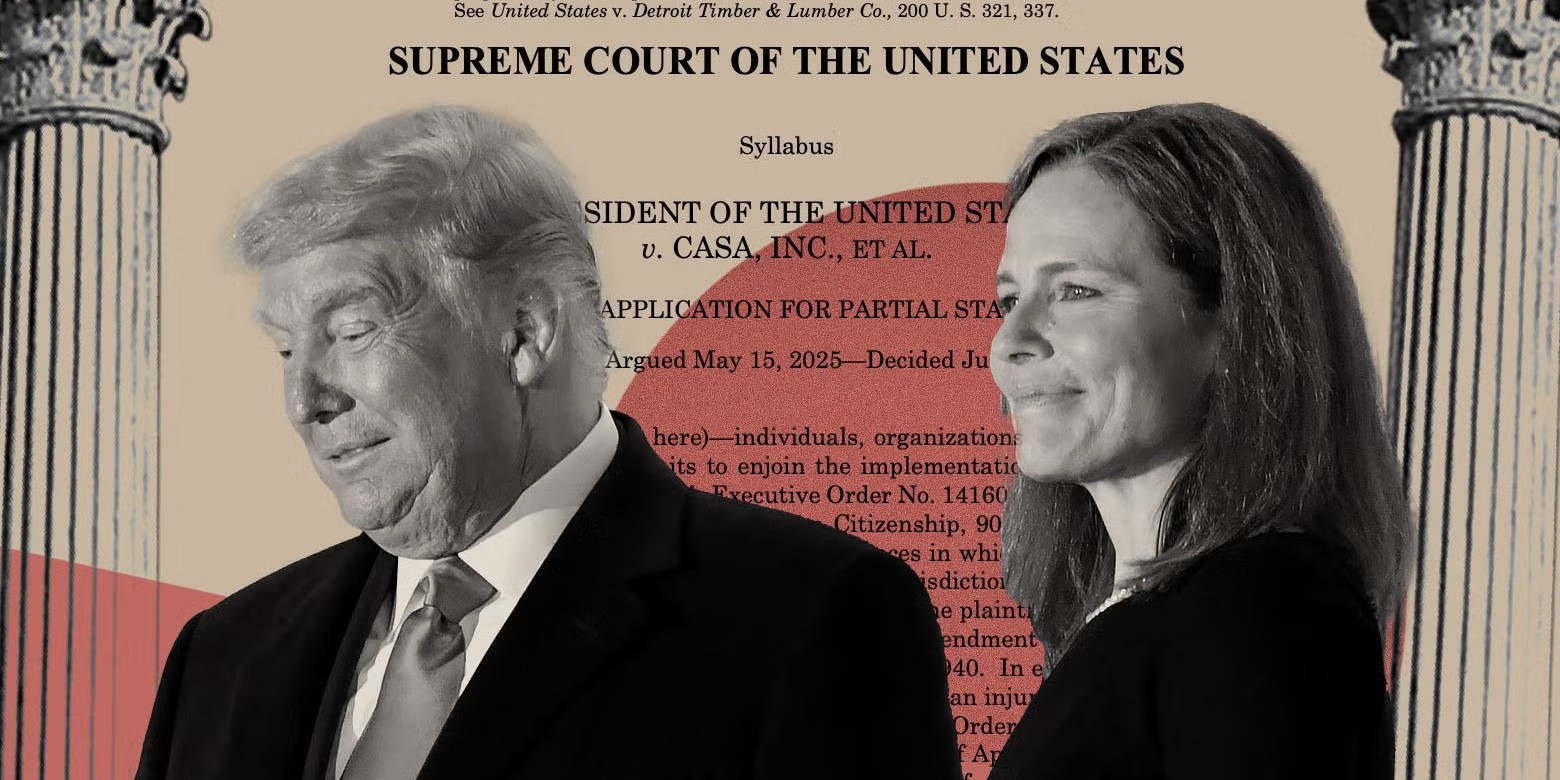
On June 27, 2025, the U.S. Supreme Court issued an important ruling in Trump v. CASA, Inc. It did not decide whether President Trump’s order restricting birthright citizenship was constitutional. Instead, it limited the scope of nationwide injunctions issued by federal district courts. For the Trump administration, it was a major procedural victory.
Birthright citizenship is the principle that a person born in the United States and subject to its jurisdiction is, as a rule, a citizen from birth. Trump has long opposed the current understanding of that principle. He argues that the children of undocumented immigrants should not automatically become citizens merely because they are born on U.S. soil, and that the rule encourages “birth tourism” and the use of childbirth to obtain future immigration benefits for a family.
On January 20, 2025—the first day of his second term—Trump signed the executive order “Protecting the Meaning and Value of American Citizenship.” It directed federal agencies not to recognize citizenship for two categories of people born in the United States: first, those whose mothers were unlawfully present and whose fathers were neither U.S. citizens nor lawful permanent residents at the time of birth; second, those whose mothers were lawfully but temporarily present and whose fathers likewise were neither citizens nor lawful permanent residents.
The order immediately provoked challenges across the country. Attorneys general from twenty-two states, immigrant-rights organizations, and individual plaintiffs filed suit in federal court. Judges in Maryland, Massachusetts, Washington, and elsewhere issued injunctions preventing the government from enforcing the order while litigation continued. They concluded that the policy was likely inconsistent with the Citizenship Clause of the Fourteenth Amendment.
The administration asked the Supreme Court to intervene, but it adopted a carefully designed strategy. It did not ask the Court to decide the order’s constitutionality. Instead, it argued that lower courts lacked authority to provide relief to everyone who was not a party to the cases before them. A federal injunction, in other words, should extend no further than necessary to resolve the concrete dispute.
The Court heard argument on nationwide injunctions in May 2025 and ultimately ruled for the administration by six votes to three. The majority concluded that injunctions protecting everyone in the country likely exceeded the traditional equitable authority of federal courts. Lower courts could issue relief only as broadly as necessary to provide the actual plaintiffs with “complete relief.” The Supreme Court returned the cases for reconsideration under that standard and delayed the effect of its ruling for thirty days.
Writing for the majority, Justice Amy Coney Barrett warned that “imperial” judicial power could disrupt the separation of powers. The government’s obligation to obey the law did not mean that a court possessed unlimited authority to supervise the government in every case. Courts must resolve concrete disputes, she argued, and cannot exceed their own power in the name of correcting executive illegality.
Justice Sonia Sotomayor wrote a forceful dissent for the liberal justices. In her view, the President had challenged a right expressly protected by the Constitution, while the majority focused narrowly on remedial authority and avoided the order’s apparent unconstitutionality. When a policy changes citizenship rules nationwide, she argued, nationwide relief may be both necessary and proper; otherwise, the same constitutional right could vary according to geography and a person’s status in litigation.
The ruling did not mean that the executive order could automatically take full effect in the remaining states, much less that birthright citizenship had ended there. Once the cases returned to the lower courts, the permissible scope of the injunctions would depend on what “complete relief” required for state, individual, and organizational plaintiffs, as well as on the development of class actions. What is clear is that the administration won on procedure while leaving behind enormous constitutional uncertainty.
Trump described the ruling as a “giant win for the Constitution, the separation of powers, and the rule of law.” Supporters said it corrected the practice of a single lower-court judge freezing a national policy and prevented unelected judges from too easily frustrating an elected president. Critics answered that the decision might allow the executive branch to implement a policy in fragments while its constitutionality remained unresolved, making judicial review slower and less coherent.
The legal battle over birthright citizenship was far from over. The Supreme Court had removed one procedural obstacle without answering the basic question: could a president, through an executive order, change an interpretation of the Fourteenth Amendment that had endured for more than a century?
The Fourteenth Amendment and Birthright Citizenship
To understand the dispute, we must return to the history of the Fourteenth Amendment. The Civil War ended in 1865 and slavery was abolished, but Southern states soon enacted “Black Codes” that continued to deny basic rights to Black Americans. Radical Republicans in Congress recognized that only a constitutional guarantee of citizenship and equality could prevent states from rebuilding a racial caste system through legislation.
The Thirteenth, Fourteenth, and Fifteenth Amendments are collectively known as the Reconstruction Amendments. The Thirteenth abolished slavery. The Fourteenth addressed citizenship, due process, and equal protection. The Fifteenth prohibited denying the vote on the basis of race, color, or previous condition of servitude.
The Fourteenth Amendment encountered fierce resistance. President Andrew Johnson opposed Congress’s Reconstruction program, and every former Confederate state except Tennessee initially rejected the amendment. Congress passed the Reconstruction Acts in 1867, imposing federal military administration as part of the process of rebuilding Southern governments. In 1868, enough states ratified the Fourteenth Amendment for it to become part of the Constitution.
Its Citizenship Clause provides:
All persons born or naturalized in the United States, and subject to the jurisdiction thereof, are citizens of the United States and of the State wherein they reside.
For the first time, the Constitution expressly defined national citizenship. In Dred Scott v. Sandford (1857), the Supreme Court had declared that people of African descent and their descendants could not be U.S. citizens. The Fourteenth Amendment repudiated that racist decision and guaranteed citizenship to formerly enslaved people and to others born in the United States who came within the Clause.
The words “subject to the jurisdiction thereof” preserve a narrow set of traditional exceptions. The U.S.-born children of foreign diplomats are not generally citizens because their parents possess diplomatic immunity. The same principle excludes children born to an occupying enemy force. At the time of Reconstruction, Native Americans who remained within separate tribal political relations were also excluded. Congress later conferred citizenship broadly on Native Americans through the Indian Citizenship Act of 1924.
Apart from those exceptional categories, the Fourteenth Amendment does not impose a general restriction based on a parent’s race or nationality. The Civil Rights Act of 1866 had already made birth and jurisdiction central to national citizenship. The congressional debates over the Amendment also considered the U.S.-born children of foreigners without excluding ordinary immigrant families.
The Fourteenth Amendment had consequences far beyond citizenship. It constitutionalized equal protection and authorized Congress to enforce its guarantees. The federal government acquired an affirmative role in protecting civil rights, and the relationship between national and state power was transformed.
For birthright citizenship specifically, the principle established after 1868 gradually became a foundation of America’s immigrant society. Whether parents came from Europe, Asia, or Latin America, a child born in the United States and subject to its jurisdiction began from the same legal position. Immigrant families did not have to pass uncertainty over national membership from one generation to the next.
The debate never disappeared completely. Critics argued that the rule could be exploited through “birth tourism” and that the Reconstruction Congress did not confront undocumented immigration in its modern form. Supporters replied that the text, the inherited common-law rule, and longstanding judicial practice did not exclude the U.S.-born children of ordinary undocumented immigrants. Against that historical background, the attempt to change the system by executive order produced an unusually intense constitutional dispute.
The Principle Established in Wong Kim Ark
After the Fourteenth Amendment, courts defined the reach of birthright citizenship through a series of cases. The most important was United States v. Wong Kim Ark (1898).
Wong Kim Ark was born in San Francisco in 1873 to Chinese immigrant parents. By the time of his case, the Chinese Exclusion Acts sharply restricted Chinese immigration and naturalization. Wong traveled to China and, on his return to the United States in 1895, was denied entry. The government argued that because his parents were subjects of the Qing emperor, Wong did not acquire U.S. nationality. Wong answered that he had been born in the United States, subject to its laws, and could not be excluded from the Fourteenth Amendment because of his parents’ nationality.
The Supreme Court ruled for Wong by six votes to two. The majority held that the United States had inherited the English common-law principle of jus soli: a person born in the country and subject to its law was generally a citizen from birth. Wong’s parents could not themselves become naturalized U.S. citizens, but they were domiciled in the United States, subject to American law, and were neither diplomats nor members of an occupying enemy force. Wong therefore fell squarely within the Citizenship Clause.
The decision clarified the Amendment’s reach. It protected not only the U.S.-born children of Chinese immigrants, but the children of immigrants from any other country. Unless one of the narrow exceptions such as diplomatic immunity or enemy occupation applied, citizenship could not be denied because of a parent’s place of origin.
The decision was a watershed. It secured constitutional citizenship for Chinese Americans and other Asian Americans who faced intense discrimination, and it confirmed the status of millions of later immigrant descendants. Some state courts had already recognized the citizenship of Chinese Americans born in the United States, but Wong Kim Ark supplied an authoritative federal constitutional rule.
Other cases helped define the boundaries of the Amendment. Elk v. Wilkins (1884) involved a Native American born into a tribal political community. The Court held that he had not been born completely subject to U.S. political jurisdiction and did not automatically become a citizen merely by later leaving his tribe. Congress ultimately addressed that historical exclusion through the Indian Citizenship Act.
Plyler v. Doe (1982) did not decide citizenship. It concerned access to public education for the children of undocumented immigrants. The Court held that states could not deny those children a public education because the Equal Protection Clause protects every “person” within a state’s jurisdiction. At a minimum, the case confirmed that undocumented immigrants and their children remain subject to, and protected by, U.S. law.
Since Wong Kim Ark, the mainstream legal understanding has been that a person born in the United States becomes a citizen unless one of a few exceptional categories applies. Because that consensus endured for more than a century, the administration’s attempt to change it through executive action caused such an upheaval.
Jus Soli and Jus Sanguinis
At bottom, the controversy reflects a collision between two principles of nationality: jus soli and jus sanguinis.
Jus soli, the law of the soil, grants nationality according to place of birth. Jus sanguinis, the law of blood, determines nationality through a parent’s citizenship or descent. U.S. law inherited the English common-law rule of birth within the territory, and the Fourteenth Amendment constitutionalized that tradition.
Most countries combine the two principles in different proportions. The United States relies heavily on place of birth but recognizes exceptions for diplomats and enemy occupation. Countries that historically emphasized descent have gradually introduced ways for children of immigrants born and raised there to acquire nationality.
Jus soli tends to give people born in the same territory an equal legal starting point and makes nationality depend on an objective event. Jus sanguinis emphasizes the state’s connection to ancestry, culture, or parental status, but can also leave people who spend their entire lives in a country with incomplete rights from birth.
Trump’s order required at least one parent to be a U.S. citizen or lawful permanent resident before the federal government would recognize citizenship for the covered categories of U.S.-born children. It therefore represented a marked shift toward jus sanguinis. The administration’s legal theory focused on the phrase “subject to the jurisdiction thereof” and on language in Wong Kim Ark describing the parents’ permanent domicile. It argued that citizenship should require a more durable political connection between the family and the United States.
Many constitutional scholars responded that the Fourteenth Amendment contains no language requiring “permanent residence,” and that Wong Kim Ark did not confine citizenship to the children of citizens or green-card holders. Wong’s parents were legally ineligible for naturalization, yet the Court still recognized him as a citizen from birth. That result suggests that a parent’s ability to become a citizen and a child’s citizenship by birth are distinct questions.
The Constitutional Consequences after Nationwide Injunctions
The Supreme Court’s June 27 decision avoided the merits but changed the rules of judicial relief. By restricting a district court’s ability to stop federal policy through a nationwide injunction, it strengthened the executive branch, to some degree, relative to the lower federal judiciary.
In recent years, immigration policies under Trump and executive actions under earlier administrations alike had been blocked by nationwide injunctions. Supporters of the remedy said it prevented unlawful policies from causing irreparable harm throughout the country and made judicial review an effective check on the executive. Critics argued that it gave a single judge excessive power, encouraged litigants to select a favorable court, and drew the judiciary too deeply into administration.
In the short term, the decision gave the Trump administration time and tactical leverage. It also risked regional or party-specific differences in relief: the same executive order might occupy different legal positions for different plaintiffs and in different places, weakening the uniformity normally expected of federal policy.
Most importantly, procedure could not permanently avoid the merits. When the episode was released, the birthright-citizenship cases were still moving through the lower courts. It was widely expected that the Supreme Court would eventually have to interpret “subject to the jurisdiction thereof” directly. Upholding the executive order would rewrite an understanding that had endured for more than a century. Striking it down would reaffirm the established tradition of birthright citizenship.
Litigants would also adapt. Class actions, coalitions of states, and broad relief tailored to specific affected groups would become more important when a single universal injunction was no longer readily available. Congress might also revisit the remedial power of lower courts.
Whatever the outcome, the ruling marked a new stage in the struggle between courts and the executive. Federal judges would find it harder to freeze presidential policy nationwide through one lawsuit, while policies burdened by serious constitutional doubt might take effect in a fragmented and complicated form before final judgment.
In American democracy, constitutional principles are continually tested through the pull of politics and adjudication. Birthright citizenship is a central legacy of the Fourteenth Amendment and a statement about how the nation defines civic equality and membership. Every attempt to reinterpret it tests the promise in the Declaration of Independence that all people are created equal.
Key Figures
- Donald Trump: Tried to challenge birthright citizenship through an executive order.
- Wong Kim Ark and Wong Si Ping: The family behind United States v. Wong Kim Ark, whose citizenship dispute led the Supreme Court to confirm birthright citizenship.
- Horace Gray: The justice who wrote the majority opinion in Wong Kim Ark.
- John Roberts: Spoke for the Supreme Court majority on the nationwide-injunction issue.
Key Cases and Concepts
- United States v. Wong Kim Ark: The 1898 landmark decision confirming citizenship for people born in the United States and subject to its jurisdiction.
- The Fourteenth Amendment: The constitutional textual basis for birthright citizenship.
- Jus soli and jus sanguinis: Citizenship by place of birth and citizenship by descent.
- Nationwide injunction: A remedy by which a federal district court blocks a government policy across the country.
Related Episodes
- Podcast 06|U.S. Birthright Citizenship: Total Victory or Temporary Truce? : Follows the final judgment and remaining risks in the birthright-citizenship dispute.