This is the transcript of Episode 04 of my podcast Reasoned Talk . You can listen on Xiaoyuzhou or Apple Podcasts . The episode itself is in Chinese.
Three Ways of Remembering Defeat
Japan’s prime minister, Sanae Takaichi, enjoys strong domestic support, while her hard-right statements have once again sent Sino-Japanese relations toward a low point. This is not entirely new. Far-right forces were never completely uprooted after the Second World War, and Japan has long struggled to reach a consensus on war and history. Irreconcilable currents coexist within the country, while the government’s position shifts with public opinion. As a result, relations with China and South Korea periodically become tense.
In The Long Defeat, Japanese American sociologist Akiko Hashimoto identifies three narratives through which postwar Japan remembers the war.
The first is the narrative of the “heroic fallen.” Favored by the right, it portrays soldiers killed in the war as heroes whose sacrifice made Japan’s future possible. Responsibility recedes: war criminals become heroes and aggression is repackaged as national defense. Politicians’ visits to Yasukuni Shrine and attempts to sanitize textbooks belong to this narrative.
The second is the narrative of the “innocent victim,” the dominant form of postwar memory. It emphasizes the suffering of Japanese civilians—the bombing of Tokyo and Osaka and the atomic destruction of Hiroshima and Nagasaki. This memory is grounded in real catastrophe, but it can evade Japan’s aggression and the suffering it inflicted abroad. Japan did not experience attacks on its home islands until the closing phase of the war; that cannot simply be equated with the destruction endured by invaded countries from the outset.
The third is the “perpetrator” narrative. It faces Japan’s identity as an aggressor, acknowledges its war crimes, and argues that the country must expose its past, break with militarism, and seek reconciliation. Japanese society, in this account, must confront the Nanjing Massacre, the “comfort women” system, Unit 731, and other brutal truths.
Because people remember the past differently, Japan has never agreed on what defeat meant. Official discourse has usually favored a victim narrative. Postwar pacifism has often centered on preventing another war, rather than remorse for a war Japan initiated. Family silence as the wartime generation aged strengthened this tendency, while the more recent rise of right-wing nationalism has narrowed the space for discussing responsibility.
Yet the perpetrator narrative never disappeared. Courageous individuals kept it alive. One of the most representative was historian Saburō Ienaga. For 32 years, he fought the state in court to defend historical truth and force Japanese society to face the crimes of war.
Saburō Ienaga and an “Inconvenient” Textbook
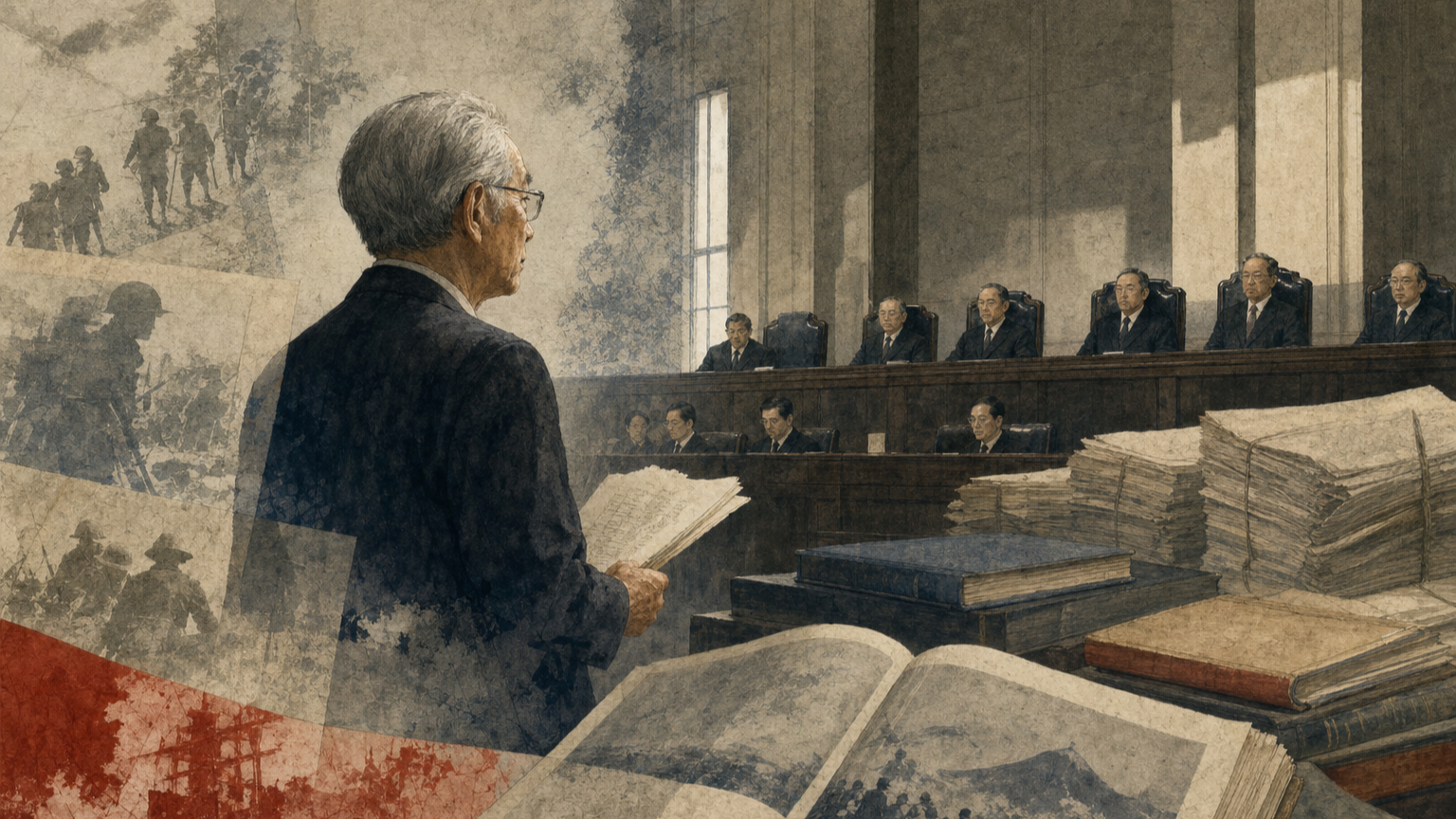
Ienaga was a prominent postwar historian and educator who taught at the institution now known as the University of Tsukuba. He became famous, however, not simply for scholarship but for a high-school history textbook. Outraged by government efforts to alter its account, he began the litigation collectively known as the Ienaga textbook lawsuits. From 1965 to 1997, he sued the Japanese government three times over textbook screening.
The controversy grew out of Japan’s postwar textbook system. Private publishers prepared textbooks, but the Ministry of Education screened them before schools could use them. The system, introduced during the Allied occupation, was meant to prevent a return to state-directed ultranationalist education and to protect quality. In practice, it also allowed officials to filter historical interpretations they disliked, especially accounts of wartime aggression.
Ienaga had worked on textbooks since 1947. His New Japanese History was already in classrooms in the 1950s, but official pressure mounted during the 1960s. Its descriptions of the Nanjing Massacre, Unit 731, the comfort women, and other sensitive subjects repeatedly angered examiners. The third edition was rejected in 1957; the fifth was initially rejected in 1963 and passed only conditionally after revision. Officials issued more than 300 comments, many complaining that the account was too graphic or placed excessive emphasis on Japanese atrocities.
Ienaga concluded that screening had become ideological control and violated academic freedom. In June 1965, then nearly fifty, he sued the state and the Ministry of Education, arguing that the system amounted to prior censorship forbidden by Article 21 of the Constitution.
The First Lawsuit: A Constitutional System, but Potentially Illegal Decisions
In the first suit, Ienaga sought both a declaration that the screening system was unconstitutional and compensation for damage caused by the review of his fifth edition. He argued that many comments intervened in his interpretation rather than correcting errors. Examiners objected to calling Japan’s war in China an “invasion” and challenged specific figures for victims of the Nanjing Massacre. When he rejected revisions he considered false, the book failed screening until substantially cut.
The Tokyo District Court delivered judgment in July 1974. It found eight comments unsupported and unlawful and awarded Ienaga a symbolic 100,000 yen. For the first time, a court had explicitly found particular textbook interventions illegal. But it refused to invalidate the system itself, holding that limited intervention could be justified to preserve neutrality and accuracy.
In 1986, the Tokyo High Court overturned even the damages award. On 16 March 1993, the Supreme Court also held the system constitutional. National standards, it reasoned, protected educational equality; moreover, a rejected textbook could still be published as an ordinary book, so screening classroom eligibility was not the same as prohibiting publication.
At the same time, the Court articulated an important limit: if an examiner’s understanding of historical fact or scholarship was clearly mistaken, the decision could be an unlawful abuse of discretion. It found no such error in the disputed items and rejected Ienaga’s appeal. After 28 years, he had failed to overturn the system, but the judgment supplied a legal standard that would matter later.
The Second Lawsuit: The Brief Triumph of the Sugimoto Judgment
Ienaga filed his second lawsuit in June 1967, while the first was pending. When revising the sixth edition, he tried to restore wording previously changed under official pressure. The Ministry rejected the book again. Unlike the first claim for damages, this administrative suit asked the court to cancel the rejection itself.
The case produced a sensational victory. On 17 July 1970, the Tokyo District Court, presided over by Judge Sugimoto, held that the rejection amounted to advance scrutiny of the author’s ideas and violated Article 21’s ban on censorship. It also found improper control of education under the Basic Act on Education and revoked the Ministry’s decision.
Ienaga called it a magnificent judgment beyond anything he had expected. But the government appealed. In 1975, the Tokyo High Court avoided the constitutional question while still finding an abuse of authority and leaving the revocation intact.
On 8 April 1982, the Supreme Court did not squarely decide who was right. It remanded the case because curriculum standards had changed and the old book could no longer return to use even if approved. In 1989, the High Court dismissed the claim for lack of a continuing legal interest. Formally, Ienaga lost.
The Sugimoto judgment nevertheless mattered. It was the first postwar judgment explicitly to declare textbook screening unconstitutional. Its emphasis on the people’s right to education, students’ right to learn, and teachers’ freedom to select materials influenced public debate and showed that an individual could force the state to defend its conduct in open court.
The Third Lawsuit: Four Illegal Decisions and 400,000 Yen
By the 1980s, disputes over war memory had intensified. Right-wing groups promoted sanitized accounts, while China and South Korea watched Japanese textbooks more closely. In 1982, Japanese media reported that the Ministry had required “invasion” to be replaced with the milder “advance” and had challenged accounts of the Nanjing Massacre. The reports triggered major diplomatic protests. Later research showed that the famous word change had not actually occurred in that year’s screening, though similar guidance had existed before. The controversy nevertheless led the government to promise that screening would take relations with Asian neighbors into account.
Now in his seventies, Ienaga returned to court. Editions submitted in 1980 and 1983 again received demands concerning Japan’s wars, the Nanjing Massacre, Unit 731, and the Battle of Okinawa. In January 1984, he filed his third suit, seeking compensation for unlawful screening and focusing on eight representative interventions.
On 3 October 1989, the Tokyo District Court upheld the system but found one comment unlawful and awarded 100,000 yen. On 20 October 1993, the Tokyo High Court expanded the number of unlawful comments to three and damages to 300,000 yen. The additional findings concerned the Nanjing Massacre and rape committed by Japanese troops there. The demands to alter those passages, the court held, lacked proper grounds.
The Supreme Court delivered the final judgment on 29 August 1997. It again upheld the system and retained the “clear error” standard, but tightened the boundary of official discretion: correction could be required when a manuscript had a serious defect that made it unsuitable as a textbook, not merely because an examiner preferred different wording. The Court found a fourth illegal intervention—the order to remove a reference to Unit 731’s human experiments—and raised damages to 400,000 yen.
The 32-year struggle was over. Ienaga had not abolished screening, but he forced the courts and public to confront its abuses. The final judgment confirmed unlawful efforts to suppress the Nanjing Massacre, Japanese military sexual violence, and Unit 731. One person had fought the machinery of state for more than three decades and won a small but precious measure of legal recognition for historical truth.
What the Three Lawsuits Left Behind
The lawsuits were more than legal disputes. They were a prolonged battle over historical memory and the meaning of education.
First, they awakened public attention. Screening had largely taken place behind bureaucratic doors. Litigation put disputed words and official reasoning into the public record. Parents, teachers, and students learned that the history printed in schoolbooks was shaped by political choices.
Second, the litigation helped constrain the screening system. After the Sugimoto judgment, officials had reason to avoid overtly ideological interventions. The 1982 controversy produced the “neighboring countries clause,” instructing screeners to show consideration for Japan’s Asian neighbors when treating modern history. The 1997 judgment further clarified that officials could not demand changes merely because another wording was possible.
Third, Ienaga inspired a wider community committed to historical truth. Teachers, lawyers, scholars, and civic groups supported him. Younger educators inherited his concerns, and later plaintiffs brought related challenges. His willingness to confront power became an expression of what many called “Japan’s conscience.”
There was tragedy too. Ienaga died in 2002 without seeing the government fully accept responsibility for aggression. In court he partly won and partly lost; in the broader contest over memory, he remained in the minority. The textbook problem did not disappear. In the early twenty-first century, right-wing groups again promoted books that minimized the comfort women system and the Nanjing Massacre. Ienaga reportedly described his record late in life as “three lawsuits, three defeats,” because he had not transformed mainstream attitudes at their roots.
Epilogue: Accepting Defeat Is the Beginning of Moving Forward
Ienaga’s story tells us first that an individual is not powerless against the distortion of history. He spent more than thirty years proving that even someone in a minority can speak and sometimes move an entire society. Historical truth survives only because people continue to state it publicly.
Second, a mature country must face its past. Japan’s postwar constitutional pacifism prevented another war and deserves to be valued. But peace means more than refusing to fight again; it also requires acknowledging the war one once began. The perpetrator narrative advanced by Ienaga and his supporters was not an attempt to denigrate Japan. A nation willing to admit wrongdoing is more likely to earn lasting trust.
The lesson extends beyond Japan. How a people understands defeat shapes its future. Denial may preserve pride for a moment but plants dangers for later. Facing failure and admitting wrongdoing is painful, yet it can lay the foundation for peace.
A history textbook is never merely a few pages of paper. It represents how a nation remembers its past and teaches the next generation. More than eighty years after the end of the Second World War, old wounds still ache. There is no shame in accepting defeat. The shame lies in refusing to acknowledge wrongdoing and allowing tragedy the chance to return.
Ienaga’s lonely courage offered Japan and the world an example. Only by facing history can a country truly move toward the future. By remembering honestly and reflecting sincerely, we honor the dead and protect those who come after us.
Key Figures
- Saburō Ienaga: Japanese historian who fought the textbook-screening system and the Japanese government for 32 years.
- Ryōkichi Sugimoto: The Tokyo District Court judge who issued the important judgment in the second lawsuit.
- Japan’s Ministry of Education: The agency responsible for textbook screening and the central defendant in the lawsuits.
Key Cases and Concepts
- The Ienaga textbook lawsuits: Three rounds of administrative and state-compensation litigation over textbook screening, academic freedom, and war memory.
- Textbook screening: A system through which the state influences historical narrative by reviewing teaching materials.
- Academic and educational freedom: Constitutional questions about whether research, writing, and teaching can resist state censorship.
- War responsibility: How Japanese society confronts the history of aggression, the Nanjing Massacre, and Unit 731.
Related Episodes
- Podcast 09|The End of the Chinese Legal Tradition: How Late-Qing Reforms Reshaped the Rule of Law : Also observes law and historical memory through institutional transformation.