This is the transcript of episode 05 of my podcast Reasoned Talk (议正言辞). Listen on Xiaoyuzhou or Apple Podcast . The episode is in Chinese; this transcript has been translated into English.
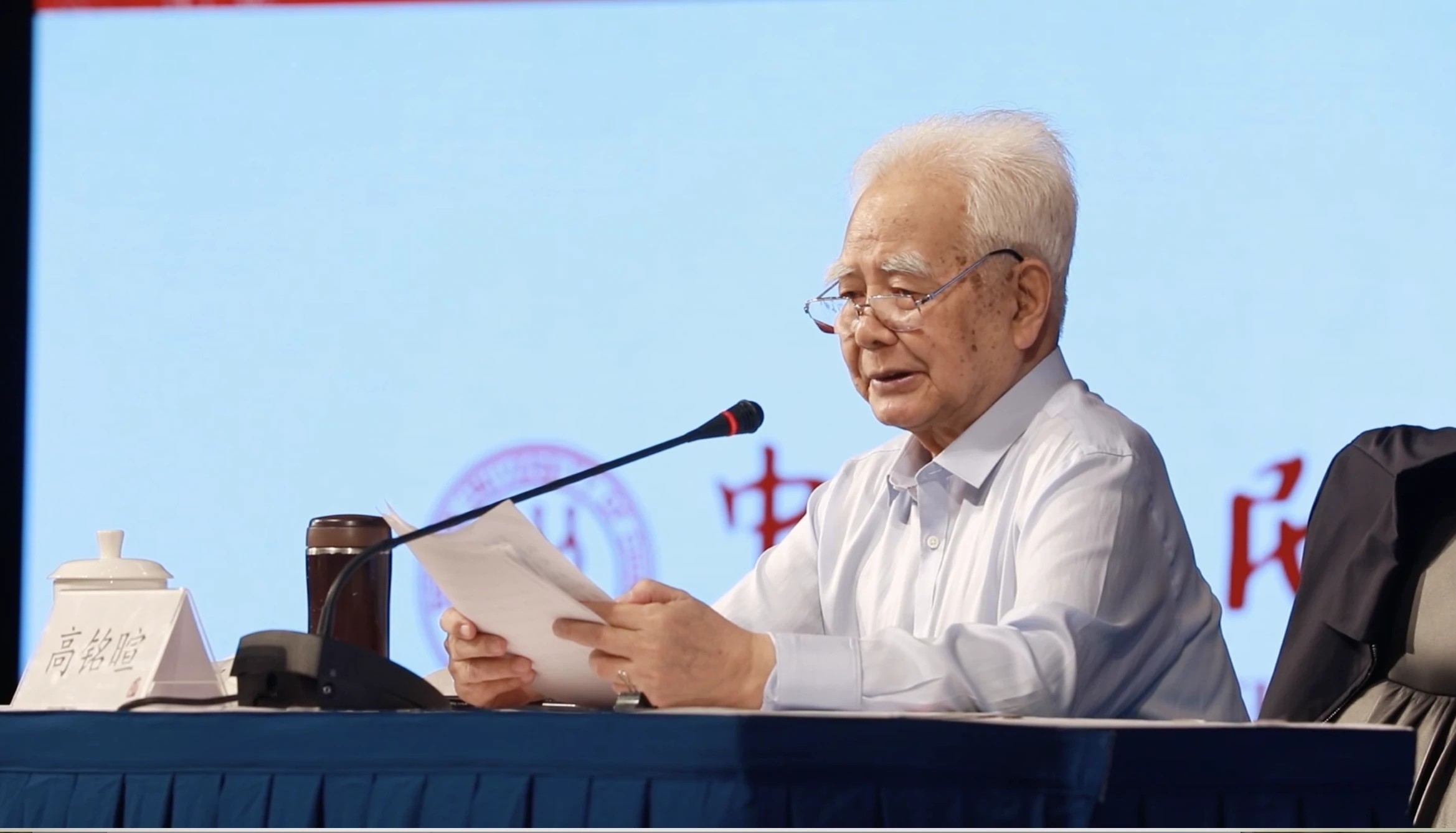
On February 26, 2026, the renowned jurist Gao Mingxuan, often called a grand master of Chinese criminal law, died of illness at the age of ninety-eight.
As one of the first generation of legal scholars trained after the founding of the People’s Republic of China, Gao’s life was almost a living history of Chinese criminal law. He was the only scholar who participated throughout the drafting of the PRC’s first Criminal Law. He was China’s first doctoral supervisor in criminal law. He wrote the first legal monograph published after reform and opening up, and co-edited the first nationally unified criminal law textbook.
It is no exaggeration to say that behind every criminal judgment issued in China today, there is a theoretical foundation that Gao helped lay.
But the life of any discipline lies in reflection and renewal. Law is no exception. As we remember Gao’s historical contributions, Chinese criminal law is also standing at a point of deep transformation. In recent years, scholars have fought a long and consequential debate over two systems for understanding crime: the “four-element” theory and the “three-step” theory. On the surface, this is an argument among scholars in their studies. At its core, it concerns something much larger: how the state’s power to punish should be exercised, and how the rights of ordinary citizens should be protected.
Gao Mingxuan: A Living History of Chinese Criminal Law
To understand Gao Mingxuan’s contribution, we need to begin in May 1928 in Xiandie, a small fishing village in Yuhuan County, Zhejiang. Gao was born there into a family with both scholarly and legal traditions. During the Nationalist period, his father served as a judge in the Hangzhou District Court and later as a judge of the Zhejiang High Court. His uncle and elder brother also worked in law.
In that atmosphere, Gao developed a strong interest in law from childhood. When he was nine, the full-scale War of Resistance against Japan broke out. His father refused to serve the Japanese occupiers, resigned angrily, and returned home. During that period, he strictly supervised Gao’s studies.
After junior high school, Gao entered the prestigious Wenzhou High School. The school’s principal, the educator Jin Rongxuan, held a campus essay competition on the topic “How to Build a New Wenzhou High School.” The young Gao won first prize with his strong writing, making his name known across the school.
When Gao graduated from high school in 1947, his talent was already obvious. He was admitted to Fudan University, Wuhan University, and Zhejiang University at the same time. He chose Zhejiang University’s law department. Later, because of historical changes and university restructuring, he transferred to the law department of Peking University, and in 1951 entered the criminal law graduate program at Renmin University of China.
At Renmin, he met the Soviet legal experts who would influence him for life, including Bestrova and Damaheng, and received systematic training in criminal law. In 1953, Gao graduated with top marks and stayed on as a teacher. That was the beginning of more than seventy years in legal education.
The Long Road to Legislation: From Draft 22 to Draft 38
On the eve of the founding of the PRC, the central leadership decided, for political reasons, to completely abolish the old Nationalist legal system known as the “Six Codes” and build a socialist legal system from scratch. The decision broke with the old order, but it also meant that in the early years of the new state, punishment of crime often took place in a vacuum where there was no comprehensive criminal code to rely on. Courts handled cases largely through policy or through scattered special regulations such as rules on counterrevolutionary crimes and corruption.
In September 1954, the PRC’s first Constitution was promulgated, and the creation of a unified Criminal Law finally went onto the agenda. In October, the General Office of the Standing Committee of the National People’s Congress formed a criminal law drafting group under the direct leadership of the Party Secretariat. Gao, who had been teaching for only a year, was selected for the team because of his academic strength. He was only twenty-six, the youngest member of the group.
He could not have known that the work would take twenty-five years.
The drafting process was a long and exhausting journey. The team worked day and night, collected cases widely, and studied domestic and foreign legislation. By June 1957, it had produced Draft 22. In October 1963, it completed Draft 33. That draft had even been reviewed and approved by the Politburo Standing Committee, and final enactment seemed close.
Then came the Cultural Revolution, and China’s legal construction fell into more than a decade of stagnation. Drafting was halted. Renmin University itself stopped operating for a time. Gao was sent down for labor and was later assigned to Beijing Medical College, where he remained for eight years. Through those long, bitter years, he preserved the materials and documents from the criminal law drafting process, waiting for the return of legal order.
At last, in October 1978, as the Third Plenum of the Eleventh Central Committee approached, the state put forward the principle that laws must be available, obeyed, strictly enforced, and violations punished. Criminal law legislation entered its third launch. The drafting group quickly restarted work based on Draft 33. After repeated revisions and intense debate, the historic Draft 38 took shape.
On July 1, 1979, the Second Session of the Fifth National People’s Congress adopted the Criminal Law of the People’s Republic of China. Gao was overwhelmed with emotion. He later recalled that this ended the PRC’s thirty-year history without a criminal code, and that criminal judgments without cited legal provisions had finally become a thing of the past.
From a twenty-six-year-old young scholar to a middle-aged man with gray at his temples, Gao poured the best years of his life into those thirty-eight drafts.
To preserve that precious historical memory, Gao published The Gestation and Birth of the Criminal Law in 1981. The book recorded in detail the disputes and revisions from Draft 22 to Draft 38. It was also China’s first legal academic monograph after reform and opening up, and it sold out in less than a month.
The Establishment of the Four-Element Theory
Once China had a criminal code, the next question was practical and fundamental: what logic should courts use to decide whether a person has committed a crime? This brings us to the most central and contested theory in criminal law: the theory of the constitution of crime.
As mentioned above, the early PRC abolished the old legal order and built legal education along a path of learning from the Soviet Union. In the early 1950s, Soviet experts such as Bestrova came to Chinese law schools. What they brought with them was the four-element theory, then dominant in Soviet criminal law.
To help people quickly grasp the logic of conviction during that formative period, the criminal law teaching and research section at Renmin University’s law department collectively wrote Lectures on the General Part of Criminal Law in 1957. The book introduced the four-element theory and marked its landing in China.
By 1982, in order to meet the needs of the restored college entrance examination and the rebuilding of legal institutions, the Ministry of Justice organized leading scholars to write a unified national textbook. Gao Mingxuan and Professor Ma Kechang of Wuhan University, then known together as “Gao in the North and Ma in the South,” co-edited the first national textbook on criminal law. With a total circulation of nearly two million copies, it firmly established the four-element theory as the basic framework of Chinese criminal law.
So what is the four-element theory? It holds that for conduct to constitute a crime, four puzzle pieces must all be present at the same time:
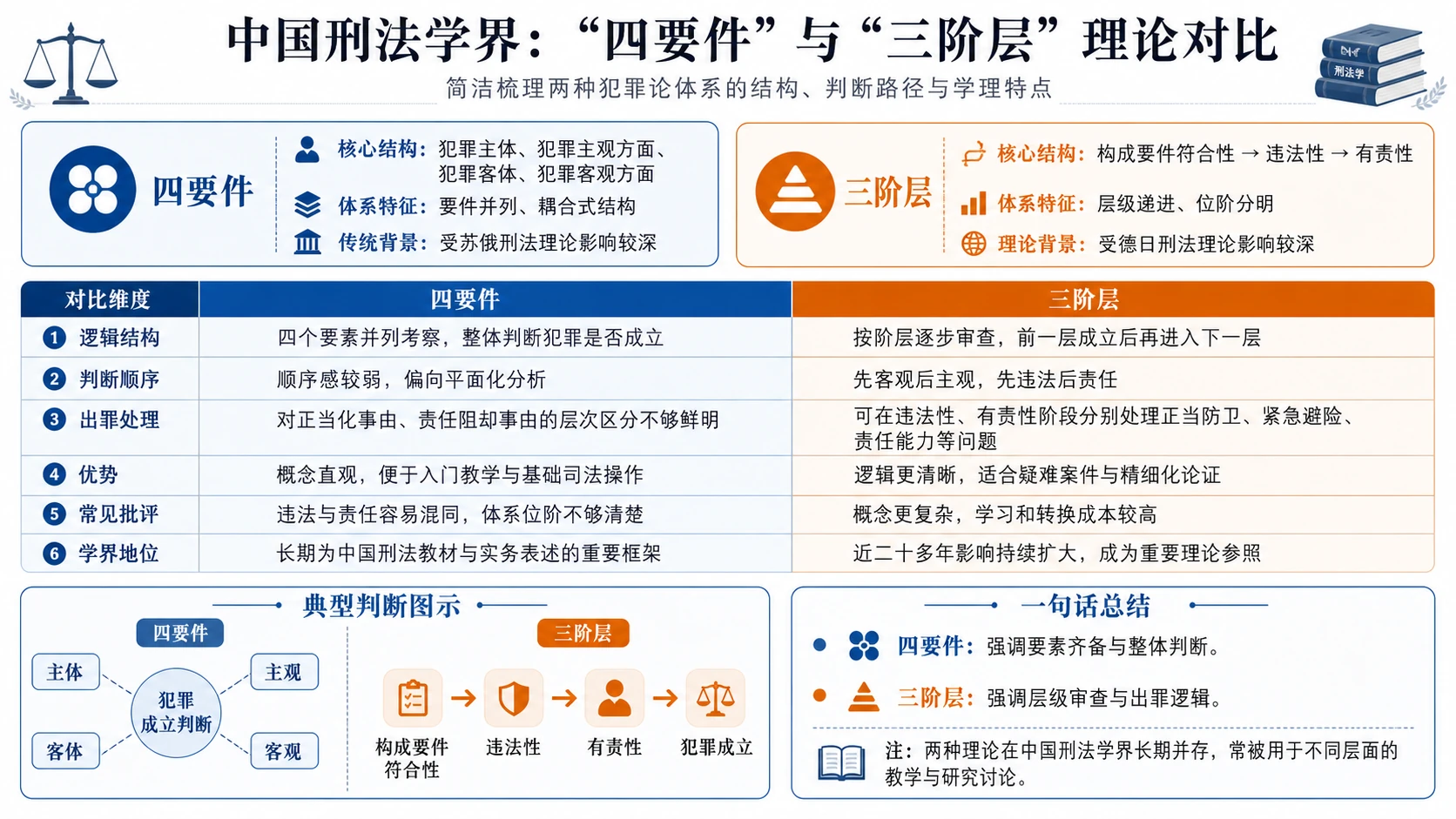
First, the object of the crime: what social relation the act infringes. A homicide violates another person’s right to life; theft violates property rights.
Second, the objective aspect of the crime: the external manifestation of the criminal activity. What did the actor do? What result occurred? Was there causation between act and result?
Third, the subject of the crime: whether the person who committed the act has reached the legal age of criminal responsibility and has normal mental capacity.
Fourth, the subjective aspect of the crime: the actor’s mental state. Was the act intentional or negligent?
Under this theory, the four elements stand or fall together. In deciding a case, the judge effectively draws a cross in the mind and fills in each element. Only when all four are complete and fit together tightly can a crime be established.
This way of thinking, emphasizing the unity of subjective and objective elements, is intuitive, clear, and easy to learn. At a time when many judicial workers had limited legal training, the four-element theory worked like a sharp and efficient knife. It helped Chinese courts sort out facts and punish crime, and it made a real historical contribution.
From Four Elements to Three Steps: A Century-Level Debate
After reform and opening up began in 1978, China’s social structure, economic model, and intellectual life all changed dramatically. The planned economy gradually gave way to a market economy. Social conflicts and forms of crime became more complex, including new kinds of economic and financial crime.
In that context, the 1979 Criminal Law, with only 130 crimes, began to look inadequate. Between 1981 and 1996, the Standing Committee of the National People’s Congress issued more than twenty separate criminal laws and accessory criminal provisions to patch the gaps. In 1997, the state decided to comprehensively revise the Criminal Law. Gao participated throughout that revision as a legislative expert.
The 1997 Criminal Law greatly expanded the list of crimes and adjusted the structure of punishment. More importantly, it expressly established three basic principles: legality, equality before criminal law, and proportionality between crime, responsibility, and punishment. Gao spent his life defending the principle of legality: no crime by analogy, and no crime without an express legal provision. The final establishment of that principle marked the true modernization of Chinese criminal law and gave Chinese criminal law a stronger basis for engagement with the world.
Improved legislation created fertile ground for theory. In the 1990s, as Chinese legal education opened up, many younger scholars, including Chen Xingliang, Zhou Guangquan, and Zhang Mingkai, studied in Germany, Japan, and other major civil law jurisdictions. They translated and introduced a large body of German and Japanese criminal law literature.
These scholars brought back a very different logic of conviction: the German-derived three-step theory. Under this theory, a judge’s reasoning should not be a flat puzzle, as in the four-element model. It should be more like a funnel with three strict filters.
The three steps are:
First, fulfillment of the statutory elements: this is a factual judgment. The judge asks only whether the actor’s conduct and result match the description in the criminal statute. If you stab someone to death with a knife, your conduct satisfies the statutory description of intentional homicide.
Second, unlawfulness: this is an objective legal value judgment. Even if the conduct fits the statutory description, does the overall legal order provide a justification? If there is a justification, such as self-defense or necessity, the conduct is legally permitted and therefore not unlawful.
Third, culpability: this asks whether the actor can be personally blamed. If the conduct fits the statute and lacks justification, the judge must still ask whether moral and legal blame can be attached to the actor. A person with severe mental illness who lacks capacity, or a person acting under coercion, may not be culpable and therefore may not be criminally liable.
The introduction of the three-step theory landed in Chinese criminal law like a depth charge. Scholars such as Chen Xingliang argued openly for a transformation of criminal law knowledge: a move away from the Soviet model and toward the German-Japanese layered system. They criticized the four-element model for failing to distinguish clearly between “unlawfulness” and “responsibility.” In their view, without a progressive filtering structure, judges facing difficult cases are left to make life-and-death decisions through an inexpressible kind of intuition.
Traditional scholars struck back. They argued that the four-element theory had been refined through decades of Chinese judicial practice and had developed deep institutional fit. Starting over would confuse grassroots judicial workers. They also argued that it is absurd to blame the four-element theory alone for weak human rights protection. Human rights depend on fair criminal procedure and concrete institutional implementation, not merely on conceptual games.
The debate reached a peak in the 2009 National Judicial Examination. Some of that year’s criminal law questions clearly leaned toward three-step reasoning in classifying cases. The legal academy was shaken. Some scholars even joked that it was a “war of the gods” in Chinese criminal law.
Four Elements vs. Three Steps: A Deeper Look at the Logic
At this point, a reader may ask: are the four-element and three-step theories not both just ways of breaking down the conditions of crime? One has four baskets, the other has three filters. What is the real difference? Why are so many leading younger scholars so convinced that the three-step model is logically tighter?
To answer that technical question, we need to look at the logic more closely.
In simple cases, any theory looks smooth. To test whether a theory is rigorous, we need to pressure it with hard borderline cases. That is exactly how Chen Xingliang and others exposed what they saw as the logical weaknesses of the four-element model.
Scenario One: The Problem of Self-Defense
Suppose you are walking down the street and an attacker tries to kill you with a knife. To save yourself, you seize the knife and kill him. In law, this is self-defense and does not constitute a crime.
Under the four-element theory, the case feels awkward. If the judge says you are not guilty, which element is missing? Objectively, someone died. You are a normal adult. Subjectively, you intended to kill him in order to survive. So what is absent? Traditional textbooks can only explain this by saying that social harmfulness is excluded, then build a separate house next to the four-element structure called “grounds excluding crime” and place self-defense there. Logically, the structure is broken.
Under the three-step theory, the reasoning is much smoother. Your act satisfies the statutory elements of homicide. Factually, the killing occurred. But at the second step, unlawfulness, the law asks whether there is a justification. Because you were defending yourself against an unlawful attack, the legal order encourages and permits your act. Unlawfulness is blocked. Because there is no unlawfulness, there is no crime. The loop closes cleanly.
Scenario Two: Instigation and Juvenile Offenders
Another classic example shows the precision of the three-step model. Suppose an adult, Zhang San, instigates a thirteen-year-old, Li Si, to commit burglary.
Under the four-element theory, a person must satisfy the object, objective aspect, subject, and subjective aspect of a crime all at once. But Li Si is thirteen and has not reached the legal age of criminal responsibility, so he lacks the proper criminal subject element. He therefore does not constitute a crime.
Here comes the problem: if Li Si has not committed a crime, to whom is Zhang San’s status as instigator attached? To convict Zhang San, traditional theory often has to bypass joint crime and introduce the concept of an indirect principal offender, treating Li Si as Zhang San’s tool without independent agency. That patch feels cramped. The deeper reason is that in the four-element theory, all elements are mixed together to explain social harmfulness. Unlawfulness and responsibility are not separated, which creates a classification problem.
The three-step theory solves this neatly because it clearly separates unlawfulness from culpability.
Li Si committed burglary in the factual sense and satisfied the first step: the statutory elements. He had no lawful justification such as self-defense, so the second step, unlawfulness, is also satisfied. In legal evaluation, what Li Si did was unlawful and wrong.
For accomplice liability, the three-step theory holds that it is enough for the instigated person to commit an unlawful act. The instigated person does not have to be punishable in the end. Since Li Si’s conduct has crossed the first two steps and is unlawful, Zhang San, as the instigator, can naturally be held liable.
Only at the third step does the judge examine Li Si’s personal responsibility. Because Li Si is only thirteen and lacks mature capacity, the law does not blame him subjectively. Li Si is not punished, but Zhang San, as an adult with full responsibility, must bear criminal liability for instigation.
This is the point. The three-step theory separates “the act is wrong” from “this person can be blamed.” The act is wrong, so the instigator is punished. The child who performed the act may be excused, so the child is not punished. That layered movement from objective unlawfulness to subjective culpability is why many criminal law scholars argue for the three-step model.
A Historical Monument That Cannot Be Erased
Still, when discussing theoretical change, we must not fall into historical nihilism. Whatever criticism the four-element theory faces today, the historical monument built by Gao Mingxuan and the first generation of Chinese criminal law scholars cannot be erased by anyone or any era.
In the early PRC, when legal resources were desperately scarce and legal nihilism was widespread, Gao’s generation built the first shelter for China’s criminal justice system. The four-element theory has logical flaws, but over decades it guided millions of cases through its simplicity and usability. It contributed greatly to maintaining social order and building legal authority.
Gao’s lifetime of work also won him the highest recognition at home and abroad. In April 2015, for his outstanding contribution to criminal law, he received the Cesare Beccaria Award from the International Society of Social Defence, an honor often called the Nobel Prize of criminal law. Gao became the first Asian scholar to receive it. In 2019, on the eve of the seventieth anniversary of the PRC, the state awarded him the national honorary title of People’s Educator, making him the only representative from the legal academy to hold that honor so far.
Academic progress is possible because the shoulders of earlier generations are broad enough. What is most admirable about Gao is not only his body of work, but also his openness as a scholar and his humane spirit as an educator.
Since becoming China’s first doctoral supervisor in criminal law in 1984, he trained more than sixty doctoral students. Many leading scholars who later criticized the four-element theory and called for a transformation of legal knowledge, including Chen Xingliang, were Gao’s own students.
Facing fundamental challenges from younger scholars, Gao never used authority to suppress them. He once advised young teachers: when teaching undergraduates, focus on the basics and avoid controversial issues at first; when teaching graduate students, explain both sides of the debate fully; when teaching doctoral students, discuss the most advanced questions and encourage them to think for themselves. He lived by the idea that students need not be inferior to the teacher. That tolerance for dissent and encouragement of innovation is one of the forces that has allowed Chinese legal scholarship to keep renewing itself.
Looking Ahead
From the historical moment of Gao Mingxuan’s death, the future direction of Chinese criminal law is already quite clear.
First, the theoretical system will move from closure toward broad compatibility. On reform of the theory of crime, scholars have proposed several paths: reordering the four elements, adding or subtracting elements from the existing model, or starting over with a full three-step structure. The future Chinese theory is unlikely to be a pure copy of the German-Japanese model, and it will not simply return to the old Soviet path. More likely, it will draw deeply on Chinese judicial practice, integrate the existing elements under the statutory-element analysis, and build a new layered model that combines logical rigor with Chinese institutional reality: fulfillment of elements, unlawfulness, and criminal punishability.
Gao himself advised younger scholars to value international cooperation and exchange in criminal law: learn from others’ strengths, but also have the courage to explain China’s own experience.
Second, the philosophy of punishment will complete its shift from social defense alone toward human rights protection. As legal civilization advances, criminal law should not only be the sword that punishes crime. It should also be a constitutional charter that limits state power and protects citizens. By introducing the strict logical filters of layered theory, future judgments can better prevent abuse of punishment and ensure that every decision affecting liberty and life can withstand serious logical and ethical scrutiny.
Finally, legislation and amendment will become more refined in the face of new challenges. As Gao pointed out in his later years, China’s criminal law should continue to be revised through criminal law amendments, steadily improving the coherence of the system and the technique of legislation. Whether dealing with complex cybercrime or legal gaps created by artificial intelligence, theory must provide more precise tools.
Gao Mingxuan has left us, taking with him an age of passion, hardship, and pioneering labor. But the first stone of the rule of law that he helped lay, and the scientific spirit with which he encouraged reform and pursued truth, will continue to guide later generations of Chinese legal professionals.
The best way to remember Gao is not to seal his doctrines in a shrine. It is to inherit his courage, keep pushing the transformation and improvement of Chinese rule of law, and build China’s legal structure more firmly with both rigorous logic and deep human concern.
Key Figures
- Gao Mingxuan: Chinese criminal-law scholar who helped draft the PRC’s first Criminal Law and long defended the four-element theory.
- Ma Kechang, Chen Xingliang, and Zhang Mingkai: Important Chinese criminal-law scholars associated with the discussion of the three-tier theory.
- Cesare Beccaria: A key source of modern criminal-law thought and the Enlightenment tradition of limiting state penal power.
Key Cases and Concepts
- The 1979 Criminal Law of the People’s Republic of China: The PRC’s first criminal code and the institutional background of this episode.
- Four-element theory of crime: The traditional framework judging crime through object, objective aspect, subject, and subjective aspect.
- Three-tier theory of crime: A layered analysis of Tatbestandsmäßigkeit, unlawfulness, and culpability.
- Legality and human-rights protection: The deeper issue of boundaries on state penal power.
Related Episodes
- Podcast 09|The End of the Chinese Legal Tradition: How Late-Qing Reforms Reshaped the Rule of Law : Adds historical context for the development of modern Chinese criminal law.