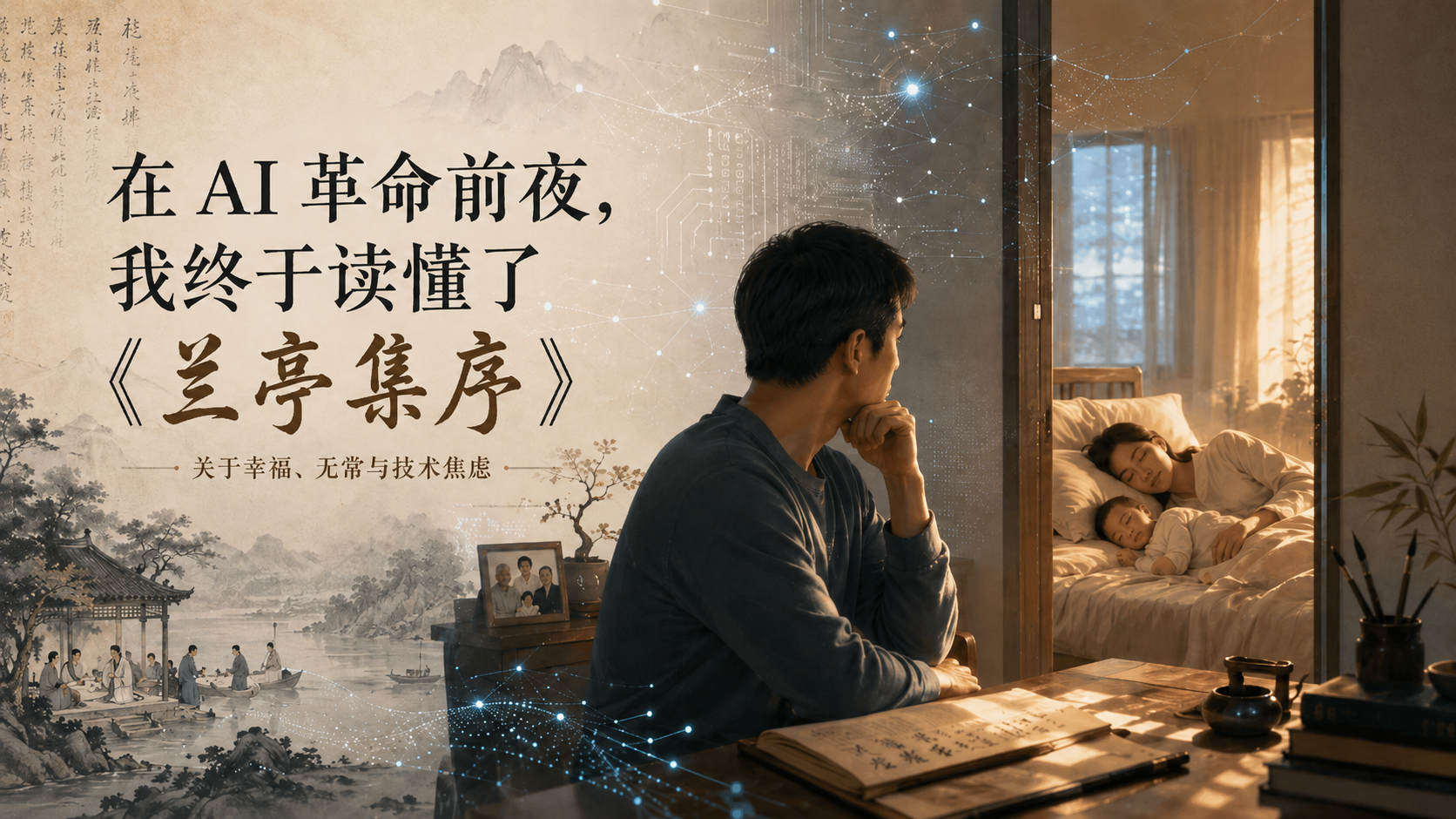
This afternoon, the house was very quiet. My wife and child were asleep in the bedroom. The child was born last year and is still very small; when asleep, there is a kind of completely unguarded peace on that little face. My parents are still healthy, too. Three generations of the family can still live together like this, safe and sound. There was nothing dramatic about the day. It was an ordinary weekend, so ordinary that if a certain feeling had not suddenly arrived, I might have forgotten it very soon.
But it was precisely on an afternoon like this that a very strong thought came to me: perhaps this is already the happiest moment of my life. The thought startled even me. Maybe it was because everything before my eyes was too happy that sadness slowly rose from inside it. I thought of my parents growing old, of my child growing up, of the impossibility of staying here forever. Many years from now, when I look back, this afternoon may have become a dream I can no longer return to. In that moment I understood very clearly: happiness is brief. It is something we happen to encounter only during certain stretches of life.
For some reason, this feeling made me think of the Preface to the Orchid Pavilion . I studied Wang Xizhi’s text in school and once memorized the whole thing: late spring, the worthy gathered, young and old together; wine cups floating down the winding stream, everyone seated along its banks. The teacher explained the words, and the textbook gave us a modern Chinese translation. But to be honest, I did not really understand why Wang Xizhi became sad halfway through writing it. In such a beautiful place, drinking and composing poems with friends should have been pure joy. Why suddenly write that “whether life is long or short, all will eventually end”? Why sigh that “what once delighted us becomes, in the briefest turn, a trace of the past”? When I read those lines as a child, I thought they were the usual ancient reflections on life, a feeling very far away from me.
Only today did I suddenly understand. Wang Xizhi was not sad because the Orchid Pavilion was not beautiful. He was sad precisely because it was too beautiful. At moments of extreme happiness, people are most likely to realize how brief happiness is. The more complete the present feels, the more clearly one senses that it cannot be kept. The joy taking place in front of us has almost already begun to disappear at the very moment it occurs.
What once delighted us becomes, in the briefest turn, a trace of the past.
In the past, I only remembered this sentence. Today I finally knew what it meant.
This feeling has become more obvious lately. Part of the reason is family life itself, but part of it also has to do with AI. I have been following and learning the latest AI tools. New models, new products, new concepts; they seem to appear almost every day. Just when I begin to understand how one tool works, something more efficient and more powerful seems to replace it. After a while, there is a deep sense of being unable to keep up.
That anxiety is the feeling of never being able to control the situation. No matter how hard you try to catch up, the road ahead keeps accelerating. You do not know how much value today’s knowledge will still have tomorrow. You do not know whether the skills you now rely on to make a living will become worthless within a few years. If it were only me, perhaps it would be easier. One can always tell oneself: at worst, I start over. But when I look at my parents, my wife, and my child, that anxiety becomes much heavier. What I truly fear is whether this hard-won, ordinary happiness in front of me will be swept into some larger wave of the times.
My parents, my wife, my child, a family living peacefully together. Because these things are so concrete, I fear losing them even more. People in the past, of course, also faced impermanence. Illness, aging, separation; these have always existed. But the sense of impermanence for our generation seems to have acquired another layer. We are not only facing the impermanence of life itself. We are also facing the impermanence of social structures. The AI revolution may already be arriving, and the changes it brings may be more drastic than many earlier technological shifts. Work, education, the distribution of wealth, the organization of society, even the way ordinary people understand and participate in the world, may all change.
So a classical sadness and a modern anxiety have overlapped. The classical sadness is this: even the happiest moment will eventually pass. The modern anxiety is this: even if I want to protect the life before my eyes, I do not know how to do it. When the two are layered together, they form a state that is difficult to describe. It is a deeper helplessness. You know life was never fully controllable, and at the same time you discover that the era itself is becoming even less controllable. You want the happiness in front of you to continue, but you do not know what you should hold on to.
It was in this state that I thought again of the Preface to the Orchid Pavilion. A modern person standing on the eve of the AI revolution could, on an ordinary weekend afternoon, in a bedroom where his wife and child were sleeping, feel the emotion of a man who lived more than a thousand years ago. The times are completely different, but the emotional ground beneath them is somehow connected. At one’s happiest, one suddenly realizes that happiness cannot be preserved forever. When one most wants to protect something, one suddenly feels that one’s strength is not so great after all.
Many pieces of writing cannot be understood when we are young because life has not yet brought us to the right place. Back then, we treated them as textbook passages, as material for exams. Then one day, when life itself carries you to a similar position, you suddenly discover that those sentences were not merely written in a book. They had been waiting somewhere inside your own life all along.
Perhaps this is what literature is for. Wang Xizhi did not solve impermanence. He had no way to make the gathering at the Orchid Pavilion last forever. All he could do was write down that moment. So the gathering disappeared, but not entirely. It became words. It became an emotion that later generations could still enter. The times change, and the ways we express ourselves change as well. But the most basic things in the human heart do not seem to change so easily. A person’s cherishing of happiness, fear of loss, helplessness before time, and impulse to preserve a moment through writing can still recognize one another across more than a thousand years.
Whenever I consider why people of the past were moved to such feelings, it is as if our experiences fit together like two halves of a tally. I cannot read their words without sighing in grief, unable to fully make sense of it in my heart. I know, then, that treating life and death as the same is empty nonsense, and equating a long life with an early death is false. Those who come after us will look upon us just as we now look upon those before us. How sad!
Maybe this is what I received from the Preface to the Orchid Pavilion today. It simply let me know that the unease I feel now is not isolated and unsupported. Long ago, someone else also saw impermanence in the midst of great joy, thought of disappearance amid beautiful scenery and good company, and wrote that feeling down. More than a thousand years later, an ordinary person on a weekend afternoon before the AI revolution sat at home, listened to the quiet breathing of his wife and child, and suddenly understood him. That fact alone gave me a little certainty.
So I have listed the people who were there and recorded what they wrote. Though times and circumstances may differ, what moves us to feeling is essentially the same. Later readers, too, will surely be moved by these words.
I did not expect that, after so many years, I would draw strength from the Preface to the Orchid Pavilion. Perhaps much of the time, people cannot stop happiness from becoming a trace of the past. But we can decide what kind of trace it becomes: one that passed by in haste and was regretted afterward, or one that was truly lived and carefully remembered.
This piece of writing also gradually took shape through a conversation between me and AI. That in itself is interesting. I worry about the future AI may bring, yet I also use AI to sort through my own feelings. It is as if everything has begun to connect with AI. Even thinking about impermanence, family, literature, and the self can no longer remain completely outside it.