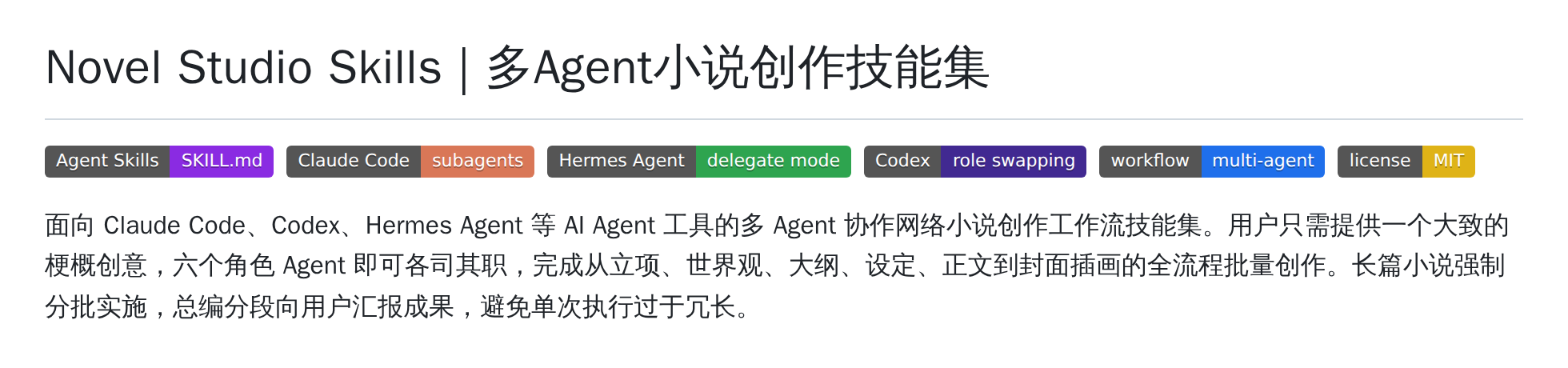
A while after open-sourcing Video Studio Skills , I put together a sister project: Novel Studio Skills .
It’s a multi-agent web-novel writing toolkit built for tools like Claude Code , Codex, and Hermes Agent . Simply put, it lets you form a virtual novel studio with six AI agents that take a story from project planning, worldbuilding, outlines, and setting cards all the way through to the manuscript, the final edit, and cover illustrations. You only need to hand it a rough concept.
Why Build a Pipeline for Writing Fiction
A pipeline for video makes intuitive sense: video is already a divided job—research, scripting, voiceover, editing. But writing a novel sounds like one holistic act. Why break it apart?
Because I’ve written long-form with a single large model myself, and I kept hitting the same potholes:
- It drifts the longer it goes. At the start it remembers the protagonist has a scar on their left hand; by chapter thirty that scar has vanished. Settings, names, places—they quietly start contradicting each other.
- It collapses when asked to write too much at once. Tell the model to “keep going,” and it either rushes through a few paragraphs to wrap up, or it starts forgetting earlier events once the context fills up.
- A strong “AI flavor.” Just like with video scripts, models love to pile on ornate parallelism and grandiose adjectives in prose, and it reads as fake.
All of these come down to one thing: a single brain trying to manage the global setting and the line-by-line writing at the same time. So I wanted to try the same trick as the video project—split novel creation into roles that each own one slice, and have them hand off through files rather than relying on one conversation’s context to carry everything.
Six Agents, Each Owning One Slice
In this project, I broke novel creation into six roles:
- Chief Editor: The studio’s general manager. Receives your concept, drafts the implementation plan, drives the workflow, reports back in stages, and signs off on final delivery.
- Architect: Lays the foundation. Worldbuilding, the synopsis, and chapter outlines all come from here.
- Lore Master: Turns abstract settings into concrete “cards”—character cards, location cards, key-item cards, key-plot cards—a dictionary the writer can look things up in.
- Writer: Drafts the manuscript in batches.
- Editor: Polishes the prose and checks it item by item against the synopsis and the setting cards for consistency.
- Designer: Produces text-to-image prompts and specs for the cover, character art, and key-scene illustrations.
Above all of them sits a shared “constitution”—the master skill novel-studio—which defines the pipeline’s state machine, the project directory layout, the batching rules, and the quality gates. All collaboration happens through files in the project workspace, with project.yaml tracking progress, so even if you write five chapters today and pick it back up next week, it can resume from where it left off.
The Iron Rule of “Mandatory Batching”
If “de-AI polishing” was what I cared about most in the video project, then in the novel project the thing I obsessed over was mandatory batching.
A long novel easily runs to dozens or hundreds of chapters. Let the model “write it all in one go” and the second half will fall off a quality cliff. So I baked in an iron rule: by default, only 5 chapters per batch. When a batch is done, it must stop, the Chief Editor sums up that batch’s results and reports back to you, and only after you confirm does the next batch begin.
This buys two things. First, it cuts the quality risk into small chunks—if a batch isn’t good, you re-run just that batch instead of starting over. Second, it fits the reality that agents “forget”: each batch ends by producing a rolling recap and a settings index, and the next batch starts by reading that compressed memory rather than wading through tens of thousands of words of raw text.
To fight the “drifts the longer it goes” problem, I also set up three consistency gates: once a name is frozen in a setting card it can’t be changed → the writer self-checks before submitting → the editor does two passes of cross-checking. Run that gauntlet, and that scar on the protagonist’s left hand isn’t going anywhere.
A Few Thoughts
Having built the video studio and then this one, I’m increasingly convinced that what multi-agent collaboration actually solves isn’t “making AI smarter”—it’s “keeping AI from tangling itself up over a long process.”
A single model’s ceiling is genuinely high, but ask it to carry a whole novel alone and it ping-pongs between the big picture and the fine details, losing one while tending the other. Split the task apart and use files as the handoff surface, and each agent only has to focus on one small thing at a time—which, counterintuitively, makes it steadier.
Of course, it can’t replace a genuinely good story. However self-consistent the settings or however smooth the pipeline, whether it moves anyone in the end still comes down to the concept you fed it at the start, and to whether you’re willing to stop when it veers off and steer it back by hand.
If you’d like to build your own novel studio, take a look at the code and try dropping it into your Claude Code or Hermes Agent.