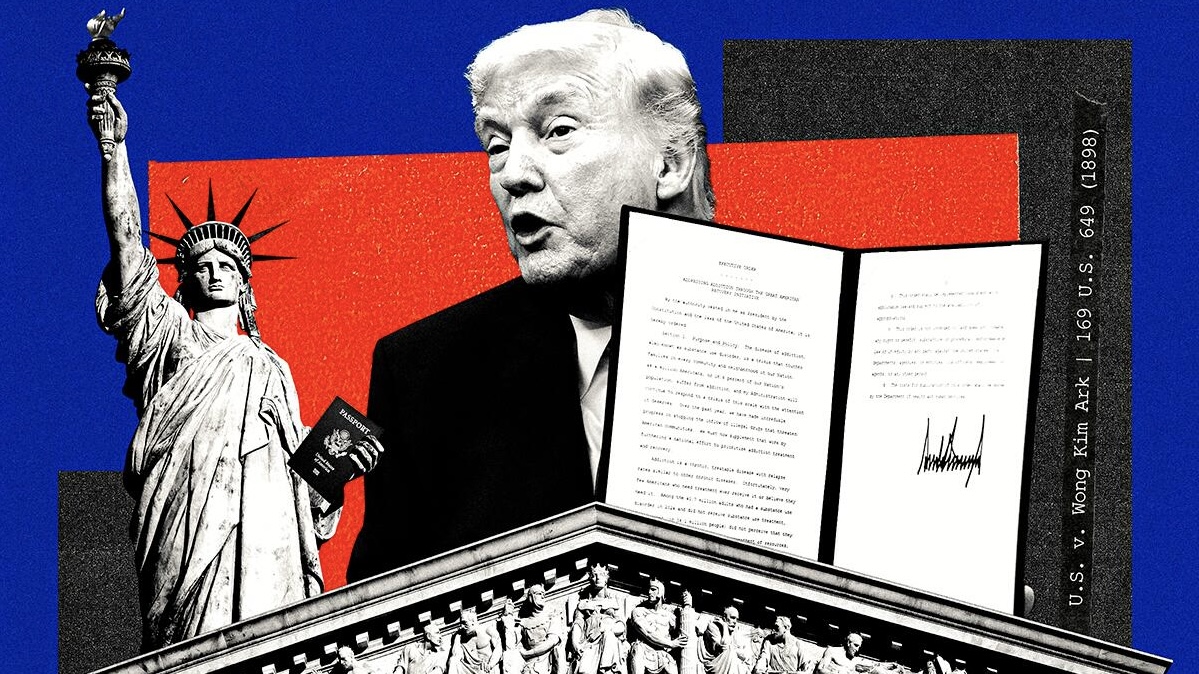
This is the transcript of episode 06 of my podcast Reasoned Talk (议正言辞). Listen on Xiaoyuzhou or Apple Podcast . The episode is in Chinese; this transcript has been translated into English.
On June 30, 2026, the U.S. Supreme Court handed down its final, substantive judgment on the question of birthright citizenship. By a 6-3 vote, the nine justices struck down the Trump administration’s Executive Order No. 14160, further cementing the birthright citizenship guaranteed by the Fourteenth Amendment. This is a judgment worthy of a place in the annals of American constitutional history.
Last year, the Court had already ruled once on this same matter. But that was a procedural ruling, and in its outcome it favored the Trump administration; this year’s judgment, by contrast, is exactly the opposite—a substantive rejection of the order itself. Over the course of more than a year, from the signing of the order, to the fight over nationwide injunctions, to a last-ditch counterattack through class action, and finally to the showdown at the Supreme Court, the whole saga rose and fell dramatically. In this piece, I want to tell that story from beginning to end, in careful detail.
The Starting Point: An Order Overturning a Century-Old Constitutional Principle
Let’s go back to where it all began.
On January 20, 2025, on the very first day of his second term, Trump signed Executive Order No. 14160, titled “Protecting the Meaning and Value of American Citizenship.” The name was grand, but what it sought to overturn was a constitutional principle more than a century old, one many regard as a foundation stone of the nation—birthright citizenship. That principle guarantees that any child born on U.S. soil, regardless of the parents’ status, automatically becomes a U.S. citizen. Trump’s order directed all federal agencies to stop granting this, to no longer automatically confer citizenship on certain babies born in the United States.
Which babies, exactly? The scope was very broad. It covered not only the children of illegal immigrants, but also the children of people who were here legally but only for a short stay—those on student visas, work visas, or tourist visas—whose children would likewise no longer automatically become U.S. citizens.
Here is a figure to give you a concrete sense of scale: if this order had actually taken effect, roughly 250,000 newborns per year would have been affected. About 150,000 of them from undocumented families, and about 100,000 from families here legally but on short-term stays.
The moment the order was signed, American society erupted. Democratic-led states—Massachusetts, Washington, Maryland, New Hampshire—together with a range of immigrant-rights organizations, filed suit almost overnight. Judges in several federal district courts quickly issued temporary injunctions.
CASA: The Blade of the Nationwide Injunction Is Snapped
A temporary injunction is a provisional measure meant to protect the plaintiffs in a case. Federal courts around the country found that Trump’s order abolishing birthright citizenship substantively violated the plaintiffs’ constitutional rights, and so, before the case reached final judgment, they temporarily blocked the order.
But here was the sticking point: these temporary injunctions were not limited to the plaintiffs in the case—they extended nationwide. The Trump administration seized on precisely this point and took the case straight to the Supreme Court. Their core demand was clever: not to argue whether the order was unconstitutional, but to challenge the legitimacy of the “nationwide injunction” as a judicial tool itself.
On June 27, 2025, the Supreme Court ruled 6-3, with Justice Barrett writing the majority opinion. The core logic was this: the relief a federal court can provide has, since time immemorial, been strictly limited to the parties to the litigation, and there is no such thing as a “universal remedy” benefiting the whole country. She advanced a concept she called the “complete-relief principle”—the scope of a court’s injunction need only be enough to provide complete relief to the plaintiff, and not one inch more.
In other words, if a pregnant mother sues as a plaintiff, the court need only enjoin the government from applying the order to her own child, and that already gives her “complete relief.” Extending the injunction to every other mother in the country would not make this plaintiff-mother’s relief any more “complete.”
So the Court’s conclusion was: dissolve the nationwide injunctions, and preserve only the protection for the named plaintiffs.
The direct consequence of this judgment was a serious disparity in enforcement between the states. A baby born in a plaintiff state like New Jersey, versus one born in a state like Texas that had not joined the litigation, would face completely different mechanisms for determining citizenship. For a single, unified federal constitutional right, this is unthinkable—you cannot have some children automatically becoming Americans and others not, simply because they were born in different states.
Class Action: The Counterattack
This judicial fracture forced the plaintiffs into a crucial strategic pivot—the class action.
On the very day the Supreme Court handed down its CASA ruling, the ACLU (American Civil Liberties Union) immediately filed a new suit, expressly seeking to have it certified as a nationwide class action.
It was a deft move. Because in her majority opinion, Barrett had in fact hinted that although the path of the “universal injunction” was now closed off, if you could satisfy the strict requirements of a class action—numerosity, commonality of legal questions, adequate representation—you could still seek relief covering the whole country.
And so, on July 10, 2025, a federal judge in New Hampshire granted preliminary certification of the class action, grouping every baby born after February 19, 2025 who was affected by the order, together with their parents, into a single class, and reissued a temporary injunction. This maneuver, at the eleventh hour, bridged the differences between the states, prevented the order from taking real effect, and paved the way for the eventual constitutional review.
Certiorari Before Judgment, and a Historic Oral Argument
In the second half of 2025, the litigation went through a series of procedural tugs-of-war. By December 2025, the Supreme Court made a rare move: it granted certiorari before judgment—skipping the circuit court of appeals and taking the case directly.
This is a fairly uncommon move for the Supreme Court. It meant the nine justices considered the case so important that they could not wait for the normal appellate process; they had to act now.
On April 1, 2026, the Court held oral argument. There is a historic detail here worth dwelling on: President Trump himself attended the oral argument in person. This was the first time in American history that a sitting president had personally sat in on a Supreme Court oral argument, and the image itself carried enormous symbolic weight.
At the argument, Deputy Solicitor General John Sauer, representing the government, tried to rewrite the history of the Citizenship Clause. His core argument was that people had long misread the Fourteenth Amendment. That phrase in the amendment, “subject to the jurisdiction thereof,” he said, was by no means merely geographic jurisdiction, but required the parents to have formed a permanent, exclusive relationship of allegiance to the United States—a lawful, domiciliary presence. On this logic, because illegal overstayers and short-term visa holders had not severed their allegiance to their home countries, their children ought not automatically become U.S. citizens.
The plaintiffs’ lawyer, Cecilia Wang, responded very directly. The order, she said, not only conflicted with the text of the Constitution, it was a flagrant defiance of more than a century of settled interpretation and precedent.
How intense were the two hours of argument? I read through the transcript that later circulated, and the justices’ questions came down like rain, barely giving counsel room to breathe. You could feel, viscerally, the weight of this case.
The Endgame: A 6-3 Victory, a 5-4 Anxiety
Now let’s turn to the very heart of the matter.
On June 30, 2026, the Supreme Court issued its final judgment. First, the vote: on the surface, the Court struck down Executive Order 14160 by 6-3, declaring the Trump administration’s ultimate defeat. But on the core question of whether the order was unconstitutional, the majority was in fact only five votes—an advantage of a single vote. That means there were very sharp divisions among the justices.
This subtle gap between “6-3” and “5-to-something” is the most intriguing feature of the whole judgment, and I’ll unpack it in detail below.
Roberts’s Majority Opinion: Three Historical Pillars
Let’s first read carefully the majority opinion written by Chief Justice Roberts. In my view, this is one of the best opinions Roberts has written in recent years—the logic is exceptionally clear, and it takes the government’s arguments apart cleanly. He built three historical pillars.
Pillar One: The Territoriality of English Common Law
Roberts takes us back several centuries to England. He cites a very famous case in English history—Calvin’s Case. That case established a principle:
A child born within the territory of the sovereign naturally owes “allegiance” to that sovereign and enjoys the sovereign’s protection, no matter how “transient and uncertain” the parents’ presence within that territory may be.
Roberts then says the American founding generation was deeply influenced by English common law, and especially by Chief Justice Marshall’s formulation: a sovereign nation holds “full and absolute power” over everything within its territory. Whatever status you entered the United States under, so long as your person is now on U.S. soil, you must obey U.S. law and are subject to the jurisdiction of U.S. courts and police. This jurisdiction has only one extremely narrow exception: only people enjoying extraterritoriality—like the children of foreign ambassadors to the United States, or the children of a hostile occupying army—fall outside U.S. jurisdiction. If you have a child in the United States, then geographically, territorially, you are subject to U.S. jurisdiction. You cannot escape it.
Pillar Two: The Total Repudiation of Dred Scott
In 1857, that infamous Dred Scott case—the Supreme Court then ruled that Black people were not citizens. The logical foundation of that judgment was to base citizenship on “blood,” rather than on “soil.”
Roberts states plainly in the judgment that the Reconstruction statutes passed after the Civil War, and the Fourteenth Amendment that followed, had as their very purpose the complete abolition of this exclusionary standard based on bloodline and race. To bring blood back into it now is to negate the very reason the Fourteenth Amendment exists.
Pillar Three: Reaffirming Wong Kim Ark
Wong Kim Ark was the son of a Chinese laborer, born in San Francisco; because of the Chinese Exclusion Act of the time, his parents could never be naturalized as U.S. citizens. Yet in 1898 the Supreme Court ruled clearly: he was born in the United States, therefore he was a U.S. citizen, and it had nothing to do with his parents’ immigration status.
Here the Trump administration mounted a very cunning defense. They argued that Wong Kim Ark’s parents had a “permanent domicile” in the United States at the time, and so the precedent did not apply to illegal overstayers or short-term visa holders.
How did Roberts respond? He dug out the historical records of the period, and concluded: the 1898 Supreme Court never treated “permanent domicile” as a precondition for birthright citizenship. That phrase simply is not part of the core logic of that judgment.
Then Roberts said something I particularly love. Executive Order 14160, he noted, is stuffed with qualifying words—“mother,” “father,” “lawful,” “temporary”—not one of which appears in the Constitution’s Citizenship Clause, for a simple reason: they are irrelevant.
Jackson’s Concurrence: An Anti-Caste, Anti-Subordination Reboot
Having covered Roberts, let’s turn to Justice Jackson’s concurrence. She is the youngest justice, nominated by Biden, and a member of the Court’s progressive wing. Her concurrence is, in my personal view, the most intellectually profound part of the entire judgment.
Jackson advanced a concept—she called the Reconstruction-era constitutional amendments the nation’s “anti-caste, anti-subordination reboot.” If you understand the Fourteenth Amendment merely as “a remedy for the particular evil of slavery,” she said, you have badly underestimated it. Its aim was far larger—to eliminate entirely any possibility of creating a permanent second-class caste within this country.
She issued a very forceful warning: if you allow the executive branch to strip particular children of birthright citizenship based on the status and lineage of their parents, you will manufacture within the United States a permanent, marginalized, second-class citizen caste. And that is precisely the social poison the Fourteenth Amendment was meant to eradicate for good.
It is a powerful passage. Because it pulls the question out of the dry debate over constitutional hermeneutics and places it in a grander sociological and political-philosophical dimension—behind the question of “who is an American” lies the question of how a nation defines itself and how it treats its most vulnerable.
The Time Bomb Kavanaugh Planted
Now let’s turn to Justice Kavanaugh.
Kavanaugh voted to strike down the order, and it was his vote that made the final margin 6-3. But when I read his opinion—concurring in part and dissenting in part—I genuinely gasped. Because buried inside it is an enormous time bomb.
He stressed two things.
First, he held that Trump’s order violated statutory law, not the Constitution. The statute he meant is the Immigration and Nationality Act—a law that has already codified broad territorial rules of citizenship in statutory form. So the order conflicts with existing law and should be struck down.
Second—and this is the crux—he went on immediately to say: the Fourteenth Amendment itself does not prohibit Congress from restricting birthright citizenship by legislation. In other words, Congress could, without violating the Constitution, pass a new law abolishing birthright citizenship for the children of illegal immigrants and short-term residents.
What Kavanaugh means is: though the president cannot decide this unilaterally, so long as you go through Congress, you can lawfully abolish birthright citizenship. The right itself is not protected by the Constitution; you can take it away by ordinary legislation.
This amounts to handing conservatives a road map.
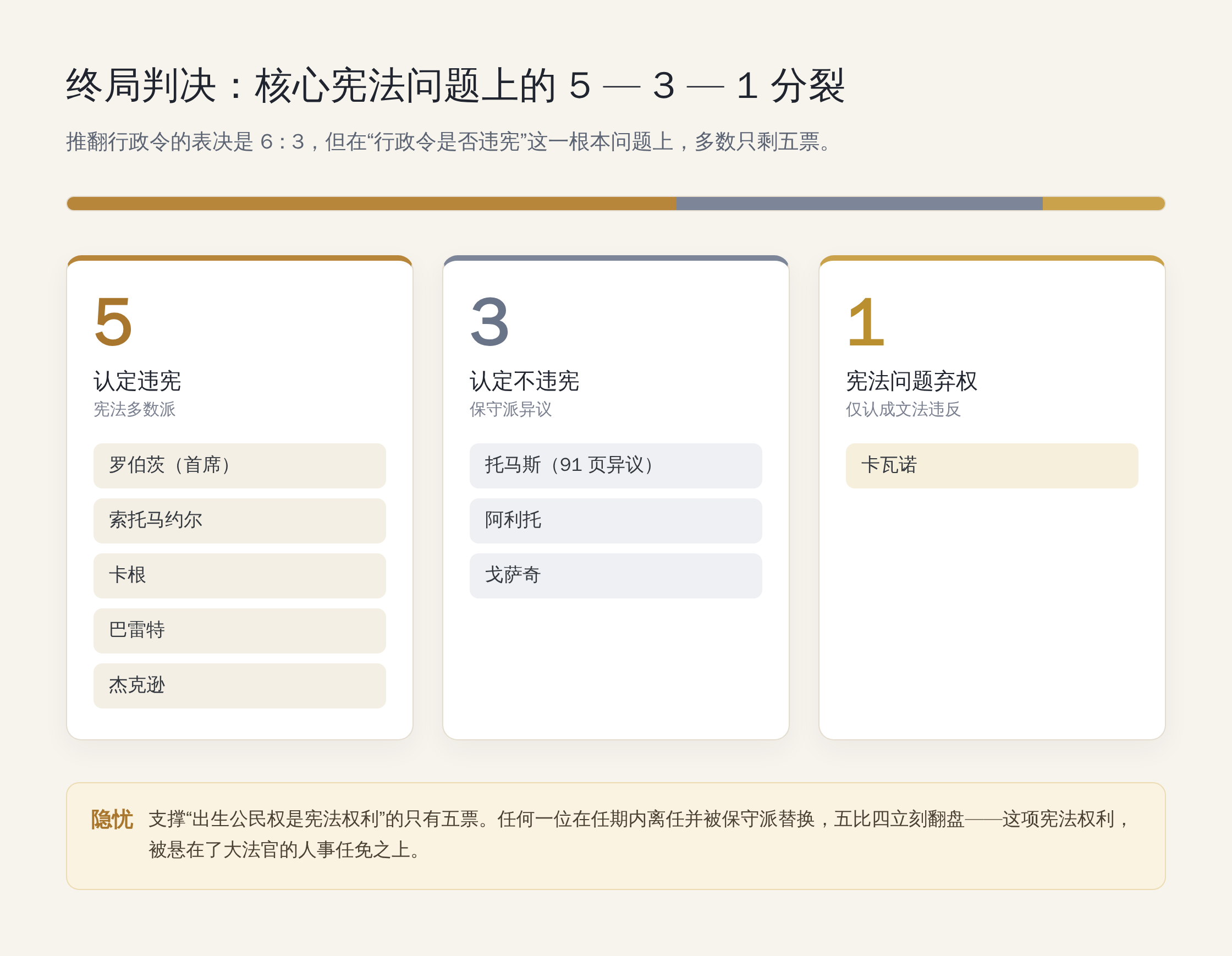
And because Kavanaugh declined to join Roberts’s majority opinion, on the fundamental question of whether the order itself is unconstitutional, the tally became 5-3-1:
- Five who found it unconstitutional: Roberts (Chief), Sotomayor, Kagan, Barrett, Jackson;
- Three who found it constitutional: Thomas, Alito, Gorsuch;
- Kavanaugh: finding only a statutory violation, abstaining on the constitutional question.
This means only five justices support the conclusion that “birthright citizenship is a constitutional right.” Should any one of them leave the bench in the coming years and be replaced by a conservative, this fragile majority would instantly flip to 5-4.
Demographically, Sotomayor is already in her seventies this year, and Roberts is seventy. If Trump gets one more nomination in his remaining term, this fragile majority will collapse in an instant. And at that point, birthright citizenship would no longer be a constitutionally guaranteed right.
For liberals, this is not a war already won. It is merely a position held for now.
Giving the Three Conservative Dissents a Fair Hearing
As a piece of commentary that tries to be responsible, I must also lay out the conservative minority’s voices clearly, and in as fair-minded a way as I can. Because these three justices’ arguments, too, rest on very serious, self-contained foundations of constitutional theory.
First, Justice Thomas, an exceptionally steadfast and diligent originalist. He wrote a 91-page dissent all on his own. His core argument is: you have all misread the phrase “subject to the jurisdiction thereof” in the Fourteenth Amendment. When Congress drafted the amendment in 1866, “subject to the jurisdiction” did not mean the simple, geographic, territorial jurisdiction the majority takes it to mean, but required a complete and exclusive political allegiance. In the common sense of the nineteenth century, he says, a citizen is not someone who happens to be passing through a piece of territory. A citizen is someone rooted there, who treats the place as a permanent home, who is willing to fight for it when war comes. Short-term visitors, foreign students, those who slip across the border—their political allegiance to their homelands has not been severed, so by what right do their children automatically become American citizens? Thomas also cites specific provisions of the Reconstruction statutes, which, in defining citizens, expressly excluded “persons subject to any foreign power.” This, he says, fully proves that the lawmakers of the day never intended to grant citizenship to temporary aliens who had not yet renounced their foreign allegiance.
I may disagree with Thomas’s conclusion, but I cannot deny that his reasoning is solid. The 91-page opinion draws on a vast body of nineteenth-century congressional debate records, contemporaneous legal dictionaries, and works of political philosophy. It furnishes ample ammunition to anyone who might, in the future, try to challenge birthright citizenship along originalist lines.
Next, Justice Alito, who wrote a separate dissent with a very specific focus: birth tourism. He offered a set of figures: each year some twenty thousand-plus foreign pregnant women fly to the United States specifically on tourist visas to give birth, precisely so that the child can obtain a U.S. passport. Alito argued that the majority’s judgment would greatly incentivize this behavior, and that this is a total departure from the framers’ original intent. He also raised the problem of dual nationality: if a baby automatically acquires the parents’ home-country nationality at birth, then where is his “exclusive allegiance” to the United States?
Finally, Justice Gorsuch, whose angle of dissent is more technical, resting on procedure. He argued that the plaintiffs had brought a “facial constitutional challenge,” and that under the standards of American constitutional litigation, for a facial challenge to succeed, you must prove that the statute is unconstitutional in all its applications. Gorsuch said that even granting the order is unconstitutional in some situations—say, for undocumented immigrants who have lived in the United States for a long time—can it nonetheless be lawfully applied to the children of people purely on tourist visas who stay two weeks and leave? If it can, then a facial challenge should not sweep away the entire order. He also criticized the majority for over-relying on the English common-law tradition, arguing that the American founding spirit has its own distinctive understanding of citizenship, and that you cannot simply import England’s tradition of territoriality and treat it as the interpretation of the U.S. Constitution.
Not the End, but Halftime
Having come this far, let me say something that may not be easy to hear: although the June 30 judgment was hailed by many as a “victory,” in my view it looks more like halftime. The fighting has merely shifted from the judicial battlefield to two others.
Battlefield one: peripheral strikes at the executive level.
After the judgment, Trump raged on Truth Social, calling it a “national disaster.” But the people around him reacted faster. Former border official Tom Homan immediately declared: since the Supreme Court won’t let us take the constitutional road, we’ll use executive means to hit birth tourism “double, triple.” How? For example, recommending that the State Department add a mandatory pregnancy-status review to the visa application form, requiring pregnant applicants to make an additional declaration; for example, sharply restricting the entry of pregnant women; some have even proposed limiting the “chain migration” quotas by which children who obtained citizenship by being born in the United States can later petition for green cards for relatives abroad. None of these touches the constitutional debate, but the effect is the same—they will make birth tourism extremely difficult.
Battlefield two: legislation.
This is the true significance of Kavanaugh’s time bomb. After the judgment came down, Trump quickly changed his tune, saying Congress “should begin today” legislating to abolish birthright citizenship. He stressed that this path requires neither a two-thirds majority in Congress nor ratification by three-quarters of the states—that is the path of a constitutional amendment—all you need is ordinary legislation. Conservative lawmakers like Senator Mike Lee and Representative Brian Babin have already stirred into motion; the birthright-citizenship bill they are pushing takes direct aim at amending that clause defining citizenship in the Immigration and Nationality Act.
But here lies an interesting legal predicament. As many constitutional scholars have pointed out: of the nine justices on the Supreme Court, five have already said clearly that birthright citizenship is a constitutional right guaranteed by the Fourteenth Amendment. If Congress passes an ordinary law to amend it, then once that law reaches the Supreme Court again, these five majority justices would in all likelihood still rule it unconstitutional.
So from a purely legal standpoint, the road Kavanaugh drew is actually a dead end—at least so long as the composition of the Supreme Court remains unchanged, it goes nowhere. But its real function is this: it tells conservatives that your enemy is not the Constitution itself, but these five people on the Supreme Court. Replace just one of them, and everything becomes possible.
And so a constitutional right—birthright citizenship—is transformed into a question of Supreme Court personnel.
Two Intertwined Threads
Here, let me offer a brief summary. Put all these cases together, and you can actually see two threads intertwining.
The first thread is the boundary of judicial power. CASA tells us that the power of a single federal district judge is being redefined—where once he could cover the entire country with a single injunction, now he cannot. To seek broad relief, you must go through the more complex procedure of a class action. This raising of the threshold is no accident; it is the carefully engineered result of the Supreme Court’s conservative majority—it markedly diminishes the ability of a single judge to block a president’s executive order.
The second thread is the nature of citizenship. The majority opinion in the final judgment held the line on the principle of territoriality established in 1866, and did not let this country return to an age defined by bloodline. But that fragile five-vote majority, hanging over everyone’s head, is a constant reminder of just how fragile this consensus is.
As I wrote this piece, I kept returning to the passage Justice Jackson wrote in her concurrence. The true aim of the Fourteenth Amendment, she said, is to forestall the creation of a permanent second-class citizen caste within American society. And if you allow a parent’s immigration status to draw a line through the child, you are burying that line in the very soil of this country.
Today, that line has been pulled out—for now. But whether it can be planted back in depends on every political choice yet to come, every judicial appointment, and every American’s answer to this question:
A child born on this land—by virtue of what, exactly, does he become an American?
Key Figures
- Donald Trump: Used Executive Order 14160 to try to restrict birthright citizenship.
- John Roberts: Wrote the majority opinion, confirming birthright citizenship while addressing the scope of relief.
- Sonia Sotomayor, Elena Kagan, and Ketanji Brown Jackson: Defended the Fourteenth Amendment principle from different angles.
- Brett Kavanaugh: Left room for later disputes over procedure and remedies.
Key Cases and Concepts
- Executive Order 14160: The direct policy instrument by which the Trump administration challenged birthright citizenship.
- CASA: A procedural dispute over nationwide injunctions and the scope of enforcing the order.
- Class action: An important path for broad relief after nationwide injunctions were limited.
- The Fourteenth Amendment and birthright citizenship: The core constitutional rule governing citizenship for those born in the United States.
Related Episodes
- Podcast 03|How Trump Challenges the Constitution: The Legal Battle over Birthright Citizenship : Introduces the background, Wong Kim Ark, and procedural starting point of the dispute.