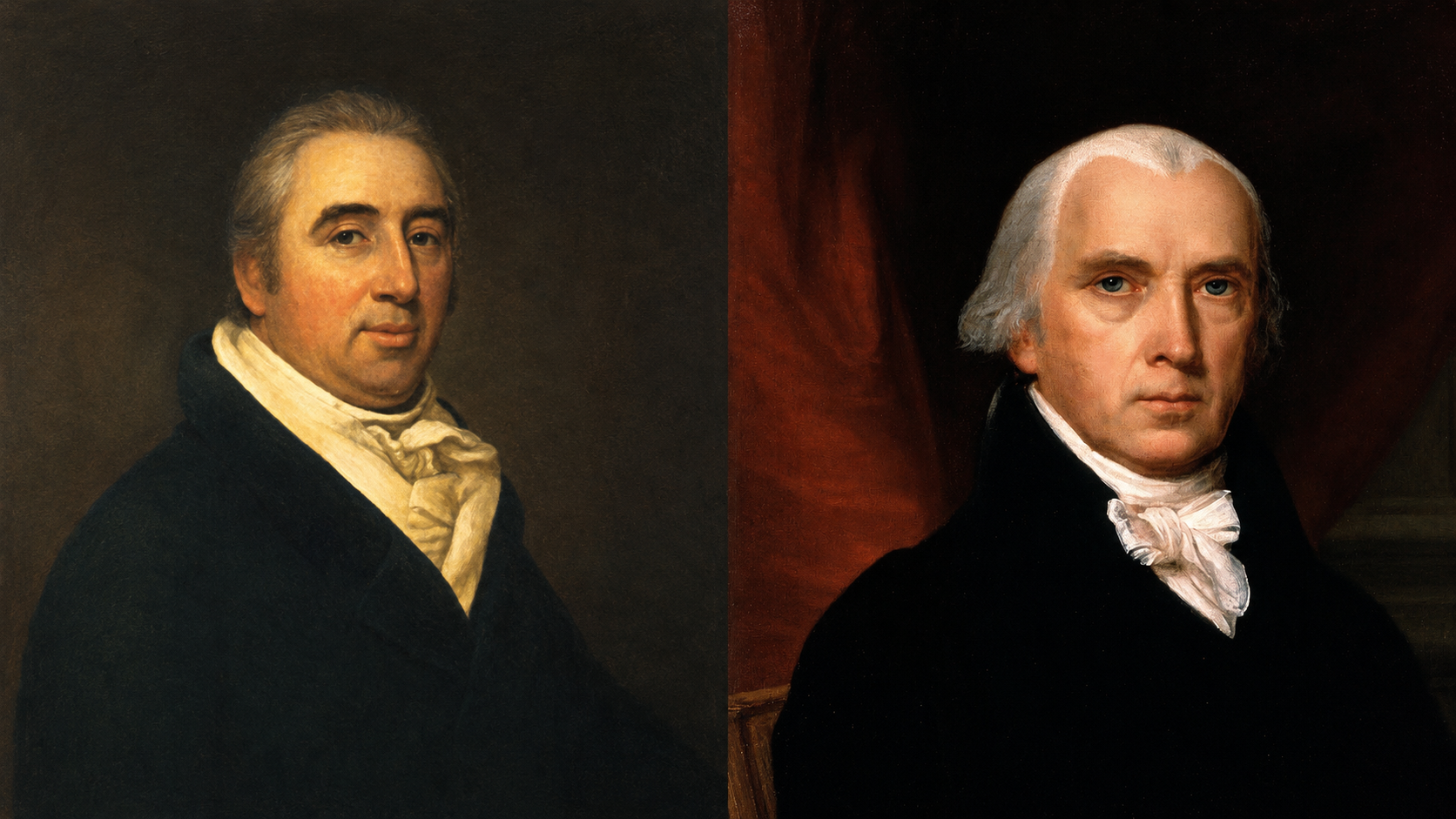
This is the transcript of episode 08 of my podcast Reasoned Talk (议正言辞). Listen on Xiaoyuzhou or Apple Podcast . The episode is in Chinese; this transcript has been translated into English.
In episodes 3 and 6, we talked about Trump and birthright citizenship. Both times we saw the U.S. Supreme Court playing the role of arbiter in contemporary constitutional disputes—it can interpret the Constitution, find the president in violation of it, and overturn acts of Congress. But by what right does the Supreme Court hold such power? Nothing in the text of the Constitution states that “the Supreme Court has the power to interpret the Constitution.” Where did this power come from?
The answer: the Court fought for it itself. Or, more precisely, it won it through a concrete case—a case that appears in virtually every course on American legal history and constitutional law. That case is Marbury v. Madison.
The Election of 1800 and the “Midnight Judges”
Let’s go back to where the story begins. In 1800, the United States held its third presidential election. The two great camps were the Federalists and the Democratic-Republicans, both parties founded by the nation’s Founding Fathers. The sitting president was the Federalist John Adams, one of the principal drafters of the Declaration of Independence and, after Washington, the second president of the United States. His rival for the presidency was the Democratic-Republican Thomas Jefferson—also a principal drafter of the Declaration of Independence, counted alongside Washington and Franklin among the three great founders of the republic.
The two men had been comrades in the War of Independence; now they were political enemies. The election was extraordinarily bitter, with both sides attacking each other throughout the campaign. The result was a landslide for Jefferson’s Democratic-Republicans—they took not only the presidency but both houses of Congress as well.
That meant the Federalists had lost the executive and legislative powers at the same time. So they turned their eyes to the third power: the judiciary. In the American system of separated powers, the judiciary is supposed to be a neutral referee that takes no part in the substance of governing. But precisely for that reason, it is the most stable branch. What the Federalists set out to do, before losing everything, was to turn the judiciary into their own stronghold.
They had to act during the transition period, before the new government took office, using the last of the power in their hands to rush their people into the judicial system. In January 1801, the Federalists appointed their own Secretary of State, John Marshall, as the new Chief Justice of the Supreme Court. That is, Marshall served as Secretary of State and Chief Justice at the same time—unthinkable today, but in the early republic holding two offices at once was not unusual. And this arrangement planted a subtle seed for what came later, which we will get to shortly.
On February 13, the Federalist-controlled Congress, with its term about to expire, passed a new Judiciary Act with three main provisions: first, it created sixteen new lifetime federal circuit judgeships, all filled by Federalists; second, it greatly expanded the jurisdiction of the federal courts, so that cases involving federal matters could be heard directly by federal courts without going through the state courts; third, it reduced the number of Supreme Court justices from six to five, to prevent the Democratic-Republicans from nominating a new justice once in office. Posterity mockingly called this law the “Midnight Judges Act.” Its purpose was transparent—to strengthen Federalist control over the judicial power—but objectively it also strengthened the judiciary itself and made the structure of separated powers more solid.
Two weeks later, on February 27, the Federalist Congress passed the District of Columbia Organic Act, formally creating Washington, D.C., and authorizing the president to appoint justices of the peace for the District—roughly equivalent to today’s magistrate judges, with jurisdiction over civil cases and minor criminal cases in their districts. On March 2, Adams signed an order nominating forty-two justices of the peace—all their own men, of course. On March 3, the Senate rushed to confirm the appointments. Why the hurry? Because the next day, March 4, the new Democratic-Republican president, Jefferson, would take office.
Under the custom of the time, Senate confirmation alone did not put the nominees in office. They had to receive commissions issued by the State Department before their appointments took effect. So from the evening of March 3, after Congress adjourned, Marshall sat in his State Department office signing commissions one by one. But there was not enough time. Marshall signed every commission and affixed every seal—but as dawn approached, seventeen of them had not been delivered to their recipients.
Among the seventeen who never received their commissions was a man named William Marbury, one of the leading figures of the Federalist Party. He was more than happy to accept the appointment. But even though Congress had confirmed it and the State Department had issued it, the commission simply never reached his hands.
At noon on March 4, the new president, Jefferson, was sworn in. He walked into the State Department office and saw the seventeen undelivered commissions on the desk. He told his new Secretary of State, James Madison, directly: hold these commissions—not one of them is to be delivered.
Jefferson simply abolished twelve of the seventeen posts and reassigned the remaining five to his own Democratic-Republicans. The commissions of Marbury and the other sixteen Federalists were thus nullified. And that was not all: Jefferson also replaced nearly half of the mid-level officials in the federal executive.
Meanwhile, in March 1802, the new Democratic-Republican Congress passed a law repealing the entire “Midnight Judges Act” of the year before. The sixteen newly seated federal circuit judges all lost their jobs. And to prevent the Federalist-controlled Supreme Court from declaring the repeal unconstitutional, Congress pushed the Court’s session, originally scheduled for June 1802, all the way back to February 1803—a delay of eight full months. This was open suppression of the judicial power by the legislative power.
Worse was still to come. Congress launched impeachment proceedings against federal judges. John Pickering, a district judge in New Hampshire, was removed. Then the spear of impeachment pointed straight at one of the Supreme Court’s own justices—Samuel Chase. In the final vote, he escaped removal by a single vote.
I recount all this so you can feel the real atmosphere the Supreme Court faced in February 1803. It was not a lofty, revered guardian of the Constitution. It was prey backed into a corner, trembling.
It was against this backdrop that Marbury—the justice-of-the-peace nominee whose appointment had been cancelled because his commission never arrived—filed suit against the new Secretary of State, Madison. This is the famous case of Marbury v. Madison. After working its way through the courts, the case finally reached the Supreme Court.
A Lawsuit Aimed at the Separation of Powers
Marbury’s claim was straightforward: he asked the Supreme Court to order Secretary of State Madison to hand over the commission that belonged to him. His legal basis was Section 13 of the Judiciary Act of 1789, which authorized the Supreme Court to issue writs of mandamus to sitting officers of the federal government.
The Jefferson administration at first refused to appear. Madison did not show up in person and did not even send counsel. Their reasoning: the courts have no power to interfere in the executive affairs of the government—after all, I am the elected government, representing the will of the people. You justices are appointed, not elected. On this point Jefferson’s political instincts were sharp. A challenge by the judicial power to the executive power had never happened in American history; this was an entirely new question.
From the very beginning, this case was aimed straight at the separation of powers. And now this hot potato landed in the hands of Chief Justice John Marshall—himself a Federalist. The separation of powers, the founding principle of the American republic, had arrived at a crossroads of history.
If Marshall ruled for Marbury and ordered Madison to hand over the commission, the Jefferson administration would, with absolute certainty, refuse to comply. That would create a deadlock—an order of the Supreme Court openly ignored by the government. And the Court commands no army; it has no power of enforcement. As Alexander Hamilton wrote in Federalist No. 78, the judiciary has neither purse nor sword. The Court’s authority rests on general acceptance—and once a Supreme Court judgment is ignored by the government, that authority collapses.
Conversely, if he ruled against Marbury and simply dismissed the case, that would amount to bowing to Jefferson. It would be an admission that the Court could not protect rights a citizen had already lawfully acquired—that the president could do as he pleased. The Court would lose all standing in the political system, the Federalists would lose decisively to the Democratic-Republicans, and America would slide toward one-party dominance.
To win was to invite humiliation; to lose was slow suicide. For the Supreme Court of that moment, this judgment was a walk on a tightrope.
Marshall’s Three Questions
How did Marshall break the deadlock? He split the opinion into three questions.
First question: did Marbury have a right to the commission?
Marshall’s answer: yes. His logic was perfectly clear: nomination by the president, consent of the Senate, signature and seal by the Secretary of State—at that point the appointment was complete. Delivery of the commission was a matter of convenience, not a condition of validity. Marbury therefore held a definite, vested legal right to the office of justice of the peace. For the Jefferson administration to withhold it was a violation of that right.
Second question: if the right was violated, does the law afford a remedy?
Marshall was equally emphatic: it does. Here he invoked a maxim from Roman law—“where there is a right, there is a remedy.” The maxim rests on a basic principle from Roman times: if a person enjoys a right under law, then the law must provide him a path to relief when that right is injured.
Then he wrote the sentence that has been quoted countless times since: the very essence of the United States is that it is a government of laws, and not of men. If a nation’s laws furnish no remedy for the violation of a vested legal right, that nation does not deserve the title of a government of laws.
But what if the party violating a citizen’s rights happens to be the government itself—the executive branch? How is a court to protect the right then? To answer this, Marshall divided the acts of executive officers into two categories.
The first category is acts of political discretion. When the president makes decisions in foreign affairs, national defense, and the other domains the Constitution commits exclusively to him, the Secretary of State and the department heads are merely the president’s agents, carrying out his political will. Such decisions are answerable only to the nation and to the voters; the courts have no standing to question them.
The second category is acts bound by law—where the law has already imposed on a particular officer a specific, definite, unquestionable legal duty, and that duty bears directly on the individual rights of particular citizens. In that situation, the officer is no longer the president’s agent—he is an instrument of the law. What he does is what the law commands him to do, not a matter of his own judgment of values. So if he fails to do it, the courts have the power to intervene. If you, the Secretary of State, will not deliver a commission already signed and sealed, of course the courts can act.
This distinction is enormously important. It is in fact a cornerstone of all modern administrative law. When we speak today of “citizens suing the government,” of bringing suit against official inaction—the origin of that idea traces in large part back to this passage of Marshall’s reasoning. And even as Marshall granted the courts jurisdiction over the government, he drew a red line the courts must not cross: politics to politics, law to law; political questions the courts must not touch, legal questions the courts must not shirk.
So Marshall answered the first two questions clearly: Marbury had the right; the right was violated; the courts could grant relief. And then?
Third question: does the Supreme Court have original jurisdiction over this case?
The air in the courtroom must have frozen at that moment. Because Marshall suddenly swung his gun around—not at the Jefferson administration, but at a law passed by Congress. Section 13 of the Judiciary Act of 1789 plainly authorized the Supreme Court to issue writs of mandamus, and Marbury’s counsel had cited exactly that provision. But Marshall said: wait—let us look at the Constitution again.
Article III, Section 2 of the Constitution is perfectly clear: the Supreme Court’s original jurisdiction extends to only three kinds of cases—those affecting ambassadors, those affecting other public ministers and consuls, and those in which a state is a party. Marbury’s case, a dispute over the appointment of a local justice of the peace, is obviously not on that list.
So here is the problem: Section 13 of the Judiciary Act of 1789 says the Supreme Court may take the case; the Constitution says it may not. One is a statute enacted by Congress; the other is the supreme law of the land. They are in direct conflict. Which one governs?
Marshall’s answer: the Constitution governs.
Here he wrote the most famous syllogism in the history of American law: the Constitution is the supreme law of the nation, established precisely to limit the powers of every branch of government, and its authority is superior to any ordinary legislation; the Judiciary Act of 1789, by presuming to enlarge the Constitution’s limits on the Supreme Court’s original jurisdiction, is repugnant to the Constitution; and a law repugnant to the Constitution is not law—it is void from the beginning.
Then came the decisive conclusion—it is emphatically the province and duty of the judicial department to say what the law is and where its limits lie. When a judge deciding a concrete case faces a conflict between an act of Congress and the Constitution, he has only one choice: apply the Constitution, and declare the law that violates it void.
Not one word of this conclusion appears in the constitutional text. Marshall interpreted it into existence. But from that day forward, it became an unbreakable rule of American constitutional practice.
Defeating Your Opponent by Yielding
And so the Supreme Court’s final judgment: Marbury loses. The Supreme Court has no jurisdiction and therefore cannot issue the writ of mandamus. Case dismissed.
Let’s take apart exactly what makes this judgment so brilliant.
On the merits, it is a retreat. Marshall voluntarily declared that his Court lacked jurisdiction, which left Jefferson no ground whatsoever for attacking it. When a judge says he himself cannot take the case, can you accuse him of overreach?
Institutionally, it is a seizure of power. To arrive at the conclusion “I have no jurisdiction,” Marshall first had to decide whether Section 13 of the Judiciary Act of 1789 was unconstitutional. And to decide whether a statute is unconstitutional, he first had to establish that the courts possess the power to review acts of Congress for constitutionality. In other words: he said “I will not take this case”—but the premise of saying so was precisely “I have the power to review whether the laws you, Congress, enact violate the Constitution.”
This is what it means to defeat your opponent by yielding. That sense of proportion—knowing when to advance and when to retreat—is the most remarkable thing about Marshall. On the great questions, not an inch of ground; on the small ones, voluntary concession.
From that day on, the U.S. Supreme Court formally possessed its sharpest weapon: the power of constitutional review. The Court can interpret the Constitution, strike down laws passed by Congress, and nullify executive orders signed by the president. This power appears nowhere in the constitutional text; it went through no amendment process and no popular referendum. It was “invented” by a judge, in a judicial opinion, through a single act of legal reasoning.
And so the Supreme Court safely survived the most dangerous period of its founding. But the story of judicial review was only beginning.
From Horizontal to Vertical: The Expansion of Judicial Review
What Marbury established was horizontal review: the Supreme Court may review the federal government. But what about the states? Can the Supreme Court review state legislation, and the judgments of state courts?
That brings us to the next two milestones.
One is Martin v. Hunter’s Lessee (1816). The case concerned title to land in Virginia belonging to Loyalists after the War of Independence. The Supreme Court ruled, but the Virginia courts refused to comply. Justice Joseph Story wrote the opinion, holding that under Article VI of the Constitution, federal law must be interpreted and applied uniformly throughout the nation, and that in all cases involving the Constitution and federal law, the federal judicial power extends to the judgments of the state courts.
The other is Cohens v. Virginia (1821). The case arose in Virginia, where a state court had convicted a man for selling federal lottery tickets. The defendant appealed to the Supreme Court. Virginia’s position: I am a sovereign state; the Supreme Court has no authority to re-examine my criminal judgments. Marshall wrote the opinion himself: in cases involving the Constitution and federal law, the United States is one nation. On matters touching federal questions, the states do not hold final sovereignty. The Supreme Court holds final appellate jurisdiction over such judgments.
Taken together, these two cases meant that the Supreme Court could henceforth review the legislative, executive, and judicial acts of the states. One Constitution, one standard, one court of final appeal. At the time, it was an institutional arrangement unique in the world.
Of course, power is a double-edged sword. Judicial review has been abused in history, at a staggering cost.
The most notorious counterexample is Dred Scott v. Sandford (1857)—a case we have mentioned repeatedly in earlier episodes. The Supreme Court used its power of constitutional review to hold that Black slaves were not citizens of the United States, and to declare the Missouri Compromise of 1820 unconstitutional. It was only the second time in the Court’s history that it had struck down an act of Congress. The decision inflamed the conflict between North and South and is regarded as one of the catalysts of the Civil War. The Court paid with its reputation, and it took a full generation to slowly rebuild its authority.
The lesson is a profound one, and it points to the deepest question of legitimacy in the institution of judicial review.
The Counter-Majoritarian Difficulty: The Fight over Legitimacy
In 1961, Alexander Bickel, a constitutional scholar at Harvard, coined a famous concept: the counter-majoritarian difficulty. Bickel’s point: the core of democracy is majority rule. Congress is elected by the majority of the people; so is the president. But the justices of the Supreme Court are not. They are nominated by the president and confirmed by the Senate, and once seated they serve for life—they neither court voters nor fear re-election. So by what right do nine unelected judges veto legislation that represents the will of the majority? Doesn’t that violate the fundamental principle of democracy at its root?
The challenge is in fact as old as the founding. Jefferson himself held that the three branches are equal in standing, each with its own independent power to interpret the Constitution; a court’s judgment binds only the parties in the particular case and has no general binding force on future legislation or governance. This position later developed into a theory known as departmentalism.
The most powerful scholarly rebuttal to the Supreme Court’s monopoly on constitutional review came from John Gibson, a judge of the Pennsylvania Supreme Court. In 1825, in Eakin v. Raub, Gibson wrote a dissent that remains required reading in American constitutional law courses to this day.
Gibson made three arguments:
First, no clause of the constitutional text expressly authorizes courts to declare acts of the legislature void. Marshall said the power is “implied” in the logic of the Constitution—but Gibson replied: that is not implication, that is inference. And an institutional arrangement of such magnitude cannot rest on inference; it requires express authorization.
Second, interpreting the Constitution is not the courts’ monopoly. Courts must of course interpret the Constitution when they adjudicate—but doesn’t Congress interpret the Constitution too, when it legislates so as to keep its laws constitutional? If both branches claim to be interpreting the Constitution, why must the courts’ interpretation prevail over Congress’s? That is “judicial supremacy,” not “constitutional supremacy.”
Third, democracy’s mechanism of self-correction. If legislation goes wrong, it is the people who should correct it—by voting the authors of bad laws out at the next election. To let unelected judges correct the errors of elected representatives is not a victory for the rule of law; it is “an extraordinary political power quietly grafted onto the ordinary judicial power.”
Each of these three arguments strikes at a joint of the institution of judicial review.
How did the defenders of constitutional review respond? The two most persuasive theories come from two twentieth-century scholars.
The first comes from John Hart Ely. In Democracy and Distrust (1980), he proposed the theory of representation reinforcement. The legitimacy of constitutional review, Ely argued, does not rest on judges being wiser than legislators or better at making value judgments. It rests on their capacity to safeguard the fair functioning of the democratic process itself. Judges should intervene in only two situations: first, when a political majority tries to monopolize the channels of politics—by suppressing civil rights, say, or manipulating electoral districts; second, when minority groups are systematically shut out of politics and will never have representation in the legislature—then the courts must step forward and hold an umbrella over them. In this framework, judicial review is not opposing democracy; it is patching democracy.
The second theory comes from Bickel himself—the Harvard professor of the “counter-majoritarian difficulty” we met above. Precisely because constitutional review carries a counter-majoritarian color, he argued, courts must exercise this power with extreme restraint. This is a kind of passive virtue. Courts should make full use of procedural devices to avoid ruling on the merits—not every case must be heard; of the seven or eight thousand petitions the Supreme Court receives each year, perhaps only a few dozen are granted. The Court’s political capital is finite: every use spends some of it, and the more it is used, the faster its legitimacy wears away. The best court is the one that seems to do nothing much all year—while the Constitution’s bottom line never retreats a single step.
Epilogue
And with that, our story of judicial review is told. This institution was not “designed”; it grew out of a crack in the Constitution—the product of political struggle, a political window of opportunity seized with judicial wisdom.
As for Marbury, the man who never received his commission: he went back to Maryland and carried on with his business. In 1810 he even ran for Congress, and lost. To the end of his life, he never obtained that piece of parchment that was rightfully his. Judged by the outcome, he lost. But judged by the institution—every citizen who walks into a U.S. federal court today because their constitutional rights have been violated owes a quiet debt of gratitude to this man who lost his case.
Key Figures
- John Marshall — Fourth Chief Justice of the United States and author of the Marbury opinion; served thirty-four years and laid the foundational architecture of federal judicial review
- William Marbury — Federalist merchant, nominated as justice of the peace for the District of Columbia, who brought his historic suit because his commission was never delivered
- John Adams — Second president of the United States, who launched the mass “midnight judges” appointments on his way out of office to preserve Federalist influence over the judiciary
- Thomas Jefferson — Third president of the United States, who ordered the undelivered commissions withheld and the posts abolished; a lifelong opponent of judicial supremacy
- James Madison — Jefferson’s Secretary of State and the nominal defendant, who refused to appear in court
- Joseph Story — Supreme Court justice, author of Martin v. Hunter’s Lessee, which established federal courts’ vertical review over state judiciaries
- Roger Taney — Fifth Chief Justice, Marshall’s successor, and author of the majority opinion in Dred Scott v. Sandford, which pushed constitutional review into catastrophic abuse
- John Gibson — Judge of the Pennsylvania Supreme Court whose dissent in Eakin v. Raub mounted the systematic scholarly rebuttal to Marshall’s reasoning
- Alexander Bickel — Twentieth-century constitutional scholar who named the “counter-majoritarian difficulty” and proposed the theory of “passive virtues”
- John Hart Ely — Constitutional scholar who proposed the “representation reinforcement” theory in defense of judicial review’s democratic legitimacy
Key Cases and Concepts
- Writ of mandamus — A judicial order compelling a government officer to perform a clear legal duty; rooted in the English common-law tradition
- Judicial review — The power of courts to review legislative and executive acts for constitutionality and declare unconstitutional ones void; nowhere written in the Constitution, created by the Marbury decision
- “Acts of political discretion” vs. “acts bound by law” — Marshall’s classic division of executive action: matters like foreign affairs and defense belong to the president’s exclusive discretion and are beyond the courts’ reach, while purely ministerial duties clearly fixed by law are subject to judicial supervision
- Departmentalism — The position of Jefferson and Madison: the three branches are equal, each with its own independent authority to interpret the Constitution
- Counter-majoritarian difficulty — Bickel’s name for the question of whether unelected justices striking down democratically enacted legislation violates the fundamental principle of democratic self-government
- Representation reinforcement — Ely’s claim that judicial review should focus on protecting the fairness and openness of the democratic process, not substitute for Congress’s substantive value judgments
- Passive virtues — Bickel’s claim that courts should use procedural techniques to avoid divisive questions, conserving their limited political capital and letting the political process digest substantive value conflicts
Related Episodes
- 03 How Trump Challenges the Constitution: The Legal Battle over Birthright Citizenship — the federal courts’ central role in a contemporary constitutional dispute (birthright citizenship)
- 06 U.S. Birthright Citizenship: Total Victory or Temporary Truce? — a contemporary case of federal district courts halting a presidential executive order