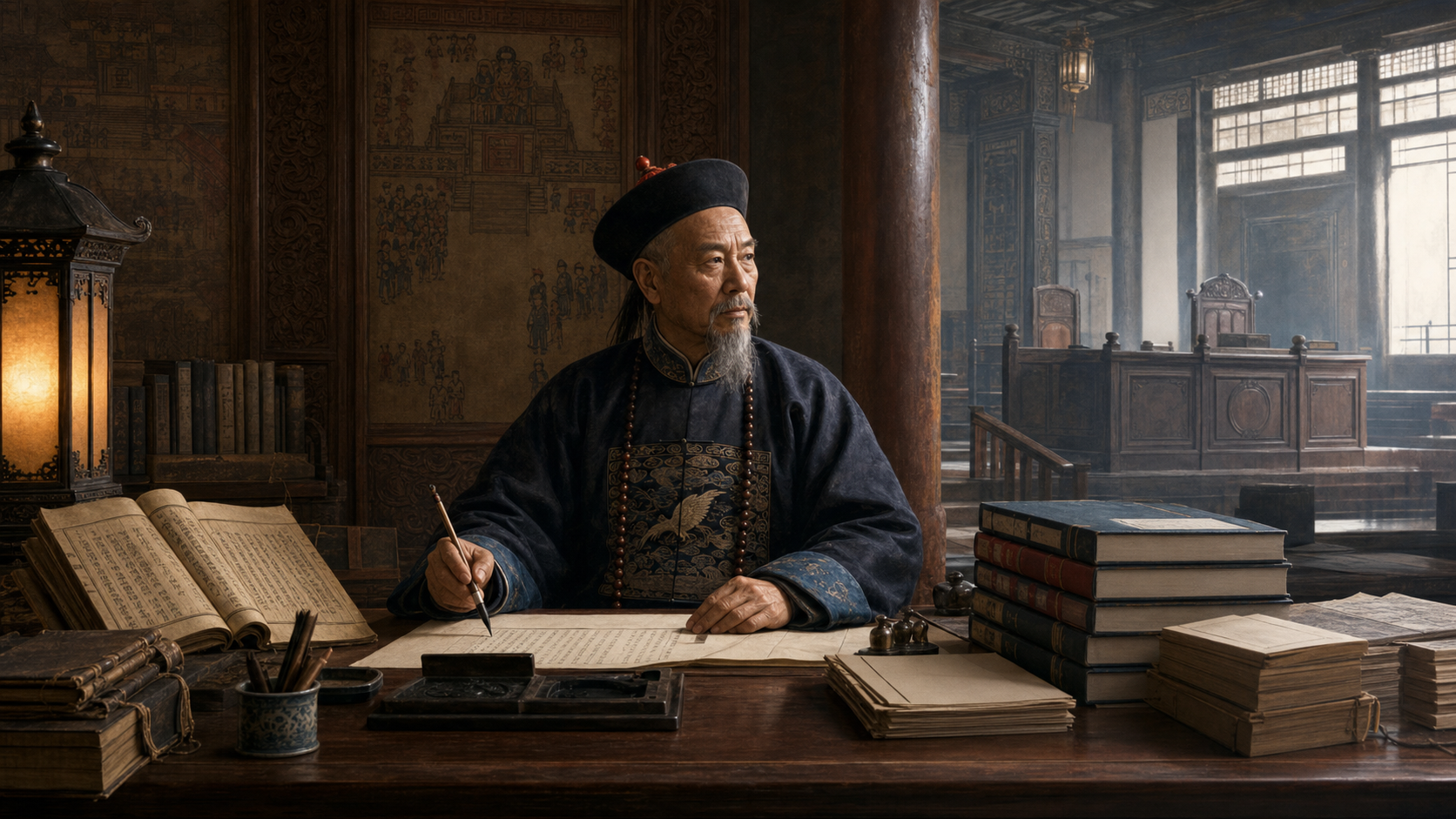
This is the transcript of episode 09 of my podcast Reasoned Talk (议正言辞). Listen on Xiaoyuzhou or Apple Podcasts . The episode is in Chinese; this transcript has been translated into English.
In the episode on Shi Jianqiao, I mentioned the “late-Qing legal reforms” as the foundation on which the Republic of China later built its Complete Book of the Six Codes. Today I want to look closely at this radical legal transformation in the Qing dynasty’s final years.
The subject receives surprisingly little attention on the Chinese internet. Yet its importance is seriously underestimated. In one stroke, the reforms ended more than two millennia of legal tradition and grafted a modern legal system onto the ruins of the classical Chinese legal order.
Trading Legal Reform for Sovereignty
Let us return to Wuchang in 1902. Zhang Zhidong, the governor-general of Huguang, was negotiating the renewal of a commercial treaty with Britain. On the final day, the talks stalled over extraterritoriality.
We tend to regard extraterritoriality simply as an instrument of Western aggression and proof of China’s semicolonial status. The reality was more complicated. Commerce between two countries required legal rules both sides trusted. When British and Chinese merchants disputed a transaction, which law and which court should decide the case? Britain considered Qing law “barbarous and backward,” unsuited to modern commerce, and demanded that British law govern its nationals. To the Qing government, this was an intolerable violation of sovereignty.
Why did Chinese law appear so backward to the British? The Qing’s central code, the Great Qing Code and Substatutes, combined criminal, civil, and administrative rules in one body and treated punishment as the answer to nearly every kind of dispute. Caning, beating, penal servitude, exile, and death could follow conduct ranging from unpaid debts and broken contracts to a son talking back to an elder. Its central purpose was not to protect individual rights or resolve disputes but to preserve order through obedience.
By the nineteenth century, Western systems had separated criminal, civil, commercial, and procedural law. They had also developed lawyers, public trials, and rules of evidence. Against that background, Western criticism was not merely arrogance. Qing officials sometimes tortured foreign suspects and confined them with convicted killers—practices intolerable to people accustomed to procedural safeguards.
At the decisive moment in the 1902 negotiations, Zhang proposed a clause: if China improved its laws and judicial system to Britain’s satisfaction, Britain would relinquish extraterritoriality. The British accepted; after all, they would decide what counted as satisfactory. The result was the Mackay Treaty. The United States and Japan soon signed similar provisions.
Histories often cite this promise as the starting point of late-Qing legal reform. Initially, however, Zhang hoped to placate Britain with the appearance of change. He later conceded that reform alone could not recover jurisdiction; ultimately, China needed national power.
Even so, the court adopted the proposal. The deeper cause lay in the Boxer crisis of 1900. After the allied armies entered Beijing, Empress Dowager Cixi fled to Xi’an and was nearly named personally responsible by the foreign powers. The shock convinced her that without fundamental change, the dynasty would not survive.
In 1901, while still in exile, Cixi issued an edict announcing reform. Liu Kunyi and Zhang Zhidong then submitted the Three Joint Memorials on Reform, the programmatic document of the New Policies. Legal reform became one of its central projects. After the Mackay Treaty was signed in 1902, the court appointed Shen Jiaben and Wu Tingfang as commissioners for the revision of the laws.
Shen Jiaben: Preserve the Old, but Admit the New
Shen Jiaben’s life was almost a miniature of the reform movement itself. Born in Zhejiang in 1840, he received a classical Confucian education and entered government through the examinations. He earned the jinshi degree in 1883 at forty-three, served as prefect of Tianjin and Baoding and as judicial commissioner of Shanxi, and was already sixty-two when appointed to revise the laws.
Shortly before that appointment, imprisonment had transformed him. During the Boxer crisis, a French missionary with a grievance over an old case accused Shen of colluding with the Boxers. Allied forces detained him for four months before releasing him for lack of evidence. The records say little about what he endured, but afterward his intellectual direction changed completely.
Previously a conventional scholar of statutes and precedents, Shen began to study Western law systematically. Yan Fu’s translation of Montesquieu’s The Spirit of the Laws showed him a mode of abstract legal reasoning missing from the Chinese tradition of rules and decided cases. That discovery shaped the reforms he later led.
Shen supervised translations of thirty-three foreign codes and legal works, invited Japanese jurists to Beijing, and founded China’s first modern law school. His guiding maxim was: “The old need not all be discarded; the new must also be consulted.”
From Commercial Law to a New Criminal Code
The speed of the project was extraordinary. From its formal launch in 1902 to the dynasty’s fall in 1911, Shen’s team attempted to reconstruct a legal order two thousand years in the making.
They began with commerce. The 1904 Imperially Sanctioned Great Qing Commercial Code, modeled partly on Japanese and German law, contained nine general provisions on merchants and 131 articles on companies. Although spare by modern standards, it introduced the limited-liability company to Chinese law. A company became a legal person and shareholders were liable only to the extent of their investment. Behind that rule was a revolutionary premise: individuals and organizations met as equal legal subjects rather than through personal dependency.
Commercial law was only the beginning. Criminal reform reached much deeper. In 1905 the court abolished lingchi, exposure of the severed head, mutilation of corpses, tattooing, and collective liability. Beheading and strangulation remained the only forms of capital punishment. It also replaced beating and caning with fines. Punishment no longer had to be inflicted upon the body; it could attach to property, implicitly recognizing the offender as a property-owning legal subject rather than merely a body available for violence.
Shen then invited the Japanese jurist Okada Asatarō to help draft a new criminal code using Japan’s 1907 code as a model. Promulgated on January 25, 1911, the New Qing Criminal Code was China’s first specialized modern criminal code.
Its innovations were profound. First, it established legality: no act was a crime, and no punishment could be imposed, without a prior statutory provision. The written law, rather than an emperor’s command, became the standard.
Second, it modernized punishment. The principal penalties were death, imprisonment, detention, and fines; strangulation was the sole death penalty. Additional penalties included deprivation of civil rights and confiscation.
Third, it abolished privileges such as the “Eight Deliberations” and substitution of office for punishment, under which imperial relatives, high officials, and distinguished persons could escape or reduce a sentence. A hierarchy that had survived since the Han dynasty was formally removed.
Fourth, it treated children under twelve through protective education rather than criminal punishment—an advanced shift from retribution to rehabilitation.
The Civil Code Draft and the Rites-versus-Law Debate
Civil codification proceeded in parallel. In August 1911, the first independent Chinese civil-code draft was completed. Its five books and more than 1,500 articles followed German and Japanese models. The first three—General Principles, Obligations, and Property—were drafted by the Japanese jurist Matsuoka Yoshimasa and introduced legal persons, bona fide third parties, and limitation periods. The final two books, Family and Succession, retained older norms: parental consent to marriage, the husband’s control of marital property, and the exclusion of women from inheritance.
The text was therefore divided against itself. Its first half spoke the individualism of the late nineteenth century: the person as independent and equal. Its second half still spoke the language of patriarchal kinship: one was first a son, daughter, or wife and only then an individual. Classical and modern ideas confronted each other inside a single code.
The fiercest controversy surrounding the new criminal code became known as the “debate between rites and law.” Here the phrase refers not to the general historical tension between Confucian ethics and state law, but to two camps within the late-Qing codification project. The jurisprudential reformers, represented by Shen Jiaben and Yang Du, supported the new code. The ritual conservatives, represented by Zhang Zhidong and Lao Naixuan, opposed it.
Their disputes were highly concrete. Should consensual sex by an unmarried woman be a crime? Reformers placed it in the realm of morality and public opinion; conservatives believed decriminalization would corrupt social customs. Should relatives be permitted to conceal one another’s crimes? Reformers would preserve the principle without distinctions based on mourning grades; conservatives insisted that proximity, seniority, and kinship rank determined the duty. Could a younger relative defend himself against an elder’s unlawful assault? Reformers called self-defense a natural right; conservatives regarded striking an elder as an intolerable inversion. Even the age of criminal responsibility was contested: Shen initially proposed sixteen but was forced down to twelve.
The conservatives believed China’s agrarian order rested on the family. If the law treated every offender alike and refused heavier penalties for insubordination, the ethical structure of the family—and with it political order—would collapse.
The reformers argued the opposite. China was weak because individuals owed loyalty through the family rather than directly to the state; family rules displaced national law and patriarchs displaced officials. A modern state required law centered on the individual. As Yang Du put it, the spirit of the new criminal code was both nationalism and constitutionalism.
The result was an awkward compromise. The code retained the reformers’ framework, but a Provisional Charter appended rules preserving the old law for offenses against the imperial house, rebellion, foreign aggression, and offenses by juniors against seniors. Beheading survived, and younger relatives could not claim self-defense against elders. The main text promised equality before the law; the appendix declared some people more equal than others.
From Statutes to Judicial Institutions
The movement reformed more than statutes. It also attempted to restructure judicial power. Traditionally, administration and adjudication were united: the county magistrate was both local executive and judge, while at the center the Board of Punishments, Court of Judicial Review, and Censorate had overlapping authority.
The 1906 institutional reform transformed the Board of Punishments into a Ministry of Law responsible for judicial administration and the Court of Judicial Review into the Supreme Court responsible for adjudication. For the first time, judicial power was formally separated from administration.
Implementation met resistance. The ministry and court quickly fought over personnel and authority. The ministry sought to preserve bureaucratic control, while the court asserted judicial independence. An even sharper conflict set the central government against provincial governors. Creating independent trial courts throughout the country meant taking a core power from provincial officials whose military, fiscal, and judicial authority had expanded enormously since the Taiping and Nian rebellions.
Provincial governors and the governor of Shuntian resisted plans for local courts, disputing jurisdiction, judicial independence, and professional qualifications. By then the center was too weak to prevail. It conceded step by step, and local judicial reform was shelved. The episode anticipated a recurring problem in modern China: a beautiful institutional blueprint on paper cannot survive unchanged when the underlying distribution of power remains intact.
By 1911 the movement had alienated interests from the center to the provinces. Conservative officials repeatedly impeached Shen for betraying orthodoxy. The court quietly removed him from leadership by ordering him back to his former ministry post. That same year the Revolution of 1911 began; within months the Qing emperor abdicated.
Three Legacies of a Failed Reform
Did the late-Qing reforms succeed? In their immediate aims, clearly not. They did not save the dynasty, nor did they recover extraterritorial jurisdiction. China achieved that only in 1943 through new treaties with its wartime allies.
Historically, however, their consequences were immense.
Their first legacy was the formal transformation of Chinese law: from a unified code dominated by punishment to separate branches and distinct substantive and procedural rules. The Republic inherited these forms. It revised the unimplemented Qing criminal code, removed the Provisional Charter, and promulgated it as the national criminal law. The Qing civil draft directly informed the Nationalist civil code. Even the structure and concepts of today’s Chinese Civil Code can trace part of their lineage to that draft.
Their second legacy was the problem of decontextualized legal transplantation. In a few years, the drafters imported doctrines accumulated over centuries in the West into a society still dominated by agriculture and deeply rooted kinship structures. Many ordinary people—and many local officials—could scarcely understand the new provisions. Lao Naixuan mocked the criminal code as something written for foreigners. The criticism was not entirely wrong: demonstrating reform to the foreign powers was a primary motive, and foreign rules were copied before they could be adapted locally. Advanced texts and social reality diverged, leaving many provisions suspended in midair.
Yet a law perfectly fitted to existing society cannot help move that society forward. Shen and his colleagues planted a measuring rod in the ground of the twentieth century and waited for China to reach its height.
The third, and perhaps most important, legacy was a new conception of law. Ideas that once looked heretical took root in Chinese legal thought. For the first time, ethical conventions with millennia of authority could be declared legally invalid.
When news of the Wuchang Uprising reached Beijing in the autumn of 1911, the seventy-one-year-old Shen had been out of office for months. He returned to his old ministry room, surrounded by unfinished drafts and translations. He knew the dynasty would not last, and that his decade of codes would probably never take effect under the Qing banner.
But he did not stop. He worked until the day the emperor abdicated. Asked later whether he regretted it, Shen answered indirectly: “Law is the pattern of all under heaven and the measure of all affairs.” Law supplies the rules and standards of the world, no matter who sits upon the throne.
Key Figures
- Shen Jiaben: The central figure in late-Qing legal reform, arguing for modern legal institutions while preserving parts of tradition.
- Wu Tingfang: An important legal and political figure involved in the late-Qing reforms.
- Lao Naixuan: A conservative voice in the rites-versus-law debate who opposed the New Criminal Code’s departure from traditional ethics.
- Zhang Zhidong: A late-Qing statesman whose position reflected tensions between local and central power, tradition and reform.
Key Cases and Concepts
- Late-Qing legal reform: The 1902–1911 reform effort to recover legal sovereignty and save the dynasty.
- Consular jurisdiction: Foreign powers’ judicial privileges in China, a major external pressure behind reform.
- Great Qing New Criminal Code: A major product of China’s transition toward modern criminal law.
- Rites versus law: Institutional conflict over kinship ethics, marriage and family, and principles of punishment.
- Dali Yuan and new-style courts: Key institutions in the modernization of the late-Qing judiciary.
Related Episodes
- Podcast 01|From the First Emperor to the Revival of Roman Law: State-Building Meets the Rule of Law : Provides a longer view of the relation between state power and the rule of law.
- Podcast 05|Gao Mingxuan and Chinese Criminal Law: Four Elements vs. Three Tiers : Extends the story into modern Chinese criminal-law theory.