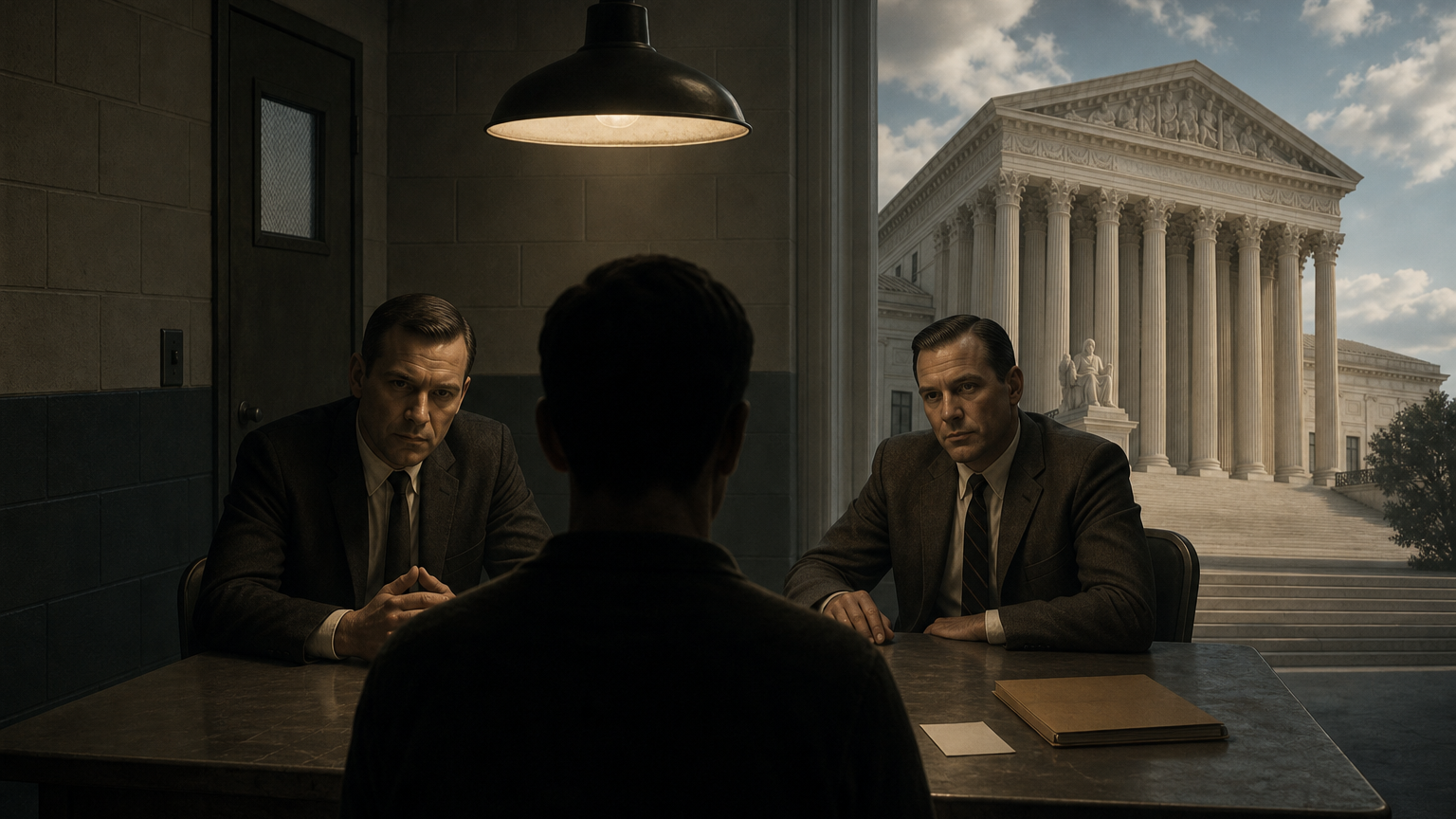
This is the transcript of episode 10 of my podcast Reasoned Talk (议正言辞). Listen on Xiaoyuzhou or Apple Podcasts . The episode is in Chinese; this transcript has been translated into English.
On the evening of January 31, 1976, smoke hung thick in a corner bar in Phoenix, Arizona. Several Mexican American laborers were playing poker around a greasy wooden table. An argument broke out over a three-dollar wager. Beer bottles shattered, a knife flashed in the dim light, and one of the men fell. He clutched his chest as the ambulance raced away, but died before reaching the hospital. He was thirty-four years old.
Police found several unsold cards in the dead man’s pocket. A few lines were printed on each:
You have the right to remain silent. Anything you say can be used against you in court. You have the right to an attorney. If you cannot afford one, the government will appoint one for you.
At the top was a name: Ernesto Miranda.
The destitute man who had just been stabbed in a bar fight was one of the most consequential litigants in American constitutional history. He was the defendant in Miranda v. Arizona, the case that placed “you have the right to remain silent” in police dramas around the world.
Police soon detained a suspect in the fight. With a complicated expression, a young officer took out a card identical to those in Miranda’s pocket and read it slowly: “You have the right to remain silent…” The suspect listened without expression and then stopped talking altogether. Without a direct confession, prosecutors ultimately declined to charge him. The man who had actually wielded the knife crossed the border amid the confusion and disappeared into the Mexican night.
It was an absurd ending: the constitutional shield Miranda had helped create protected the men implicated in his own death ten years later.
In an earlier episode, I discussed Marbury v. Madison—the political struggle through which the Supreme Court claimed the power to interpret the Constitution. Once it had acquired that power, how would the Court use it? There are many possible answers, but few are as dramatic as the case we are about to examine.
From a Confession to the Supreme Court
Turn the clock back to March 3, 1963, again in Phoenix. An eighteen-year-old woman stepped off a city bus after a long day at work. The suburban street was dim and silent except for the sound of her shoes. A battered Packard pulled up beside her. Its door flew open, hands reached out from the darkness, and she was dragged inside.
Her hands were bound and she was raped in the desert. The assailant later drove her back downtown and left. She told police that he was a Hispanic man who wore glasses and that a rope had been tied across the back seat of his car.
Ten days later, two officers traced the description to a Packard owned by a twenty-three-year-old Hispanic man. He had served in the Army, had a criminal record, and worked loading produce. His name was Ernesto Miranda.
Officers brought Miranda from his home to the station and arranged a lineup—the familiar scene in which several men stand behind glass while a witness tries to identify one of them. The victim was anxious and afraid and would not make a positive identification. That did not stop the investigation. Officer Cooley entered the interrogation room, looked Miranda in the eye, and spoke with the calm confidence of someone who had already won: give it up. The victim just identified you. We know it was you.
The claim broke Miranda’s last psychological defense.
He was taken into a windowless interrogation room cut off from the outside world. Two experienced officers questioned him continuously for two hours. At last he broke down. He confessed to rape and kidnapping and signed his name to a paper bearing several preprinted clauses. In substance, they said:
I, Ernesto Miranda, swear that this statement has been made voluntarily and without threat or coercion; that I fully understand my legal rights; and that I understand any statement I make may be used against me in court.
Later investigation showed that Miranda had only a middle-school education. He was emotionally unstable and psychologically immature. His mother had died when he was young, his relationship with his father was poor, and he had been discharged from the Army for psychiatric reasons. In other words, a vulnerable man with limited intellectual ability and an unstable mental state confessed after two hours of isolated questioning and signed language the police had printed in advance.
His trial began three months later, in June 1963. Alvin Moore, a seventy-three-year-old veteran attorney, was appointed to represent the indigent Miranda without charge. Moore moved to exclude the confession—a claim with almost no chance of success at the time. The judge overruled him and admitted the preprinted confession in full. Miranda was sentenced to thirty years in prison, and the state supreme court affirmed.
Moore kept appealing. The case climbed the judicial ladder until it reached the highest seat of power in Washington.
Before Miranda: The Voluntariness Test
Before turning to the Supreme Court’s decision, we need to understand the rules governing American police interrogation before Miranda. Courts decided whether a confession could be used through the “voluntariness test.” A judge reviewed the circumstances surrounding the interrogation and asked whether the defendant had confessed of his own free will.
That may sound reasonable. The problem was that the standard was inconsistent. One judge could find a confession voluntary while another, faced with the same facts, could find it coerced. Police officers had no clear line telling them what they could and could not do.
Worse, interrogations took place behind closed doors. There were no recordings and no independent witnesses. In court, every dispute became a swearing contest between police and defendant. If a suspect alleged coercion, the officers would testify that the questioning had been calm and the confession entirely voluntary. Without a recording, judges almost invariably believed the police. Constitutional rights were hollowed out by an endless contest no defendant was likely to win.
The Supreme Court understood the problem. Over the three decades before Miranda, it had gradually tried to standardize interrogation law through a series of landmark cases.
In Brown v. Mississippi (1936), the Court established that confessions extracted through physical violence were categorically inadmissible. Sheriffs had hung the defendants from a tree and whipped them until they confessed. A unanimous Court held that such violence offended the most basic idea of justice.
Then came Gideon v. Wainwright (1963), which recognized the right of indigent defendants to appointed counsel. Legal representation became a foundation of a fair trial.
In Escobedo v. Illinois (1964), the Court extended the right to counsel backward from the courtroom to police interrogation. Once an investigation had focused on a particular suspect and police had taken him into custody for questioning, a confession obtained after officers refused his request for a lawyer had to be excluded.
But Escobedo left a large loophole: the suspect had to ask for counsel before the police were required to stop. If he did not know the right existed—or was too afraid to invoke it—officers could behave as though it did not exist.
That same year, in Malloy v. Hogan, the Court held that the Fifth Amendment privilege against compelled self-incrimination applied to the states. That decision cleared the way for Miranda to establish a national rule.
Is Closed-Door Interrogation Inherently Coercive?
Even after those decisions, the Court still faced a more fundamental question: could interrogation behind closed doors be coercive in itself? To answer it, we have to look beyond Ernesto Miranda to three other cases the justices considered alongside his.
The first was Vignera v. New York. Police arrested Vignera on suspicion of robbery and questioned him in shifts throughout the day. No one told him he could remain silent or consult an attorney. He confessed orally. Only at eleven that night did an assistant district attorney conduct a formal interview before a stenographer and turn the earlier admissions into a written record. Vignera was sentenced to sixty years in prison.
The second was Westover v. United States. Police arrested Westover on suspicion of robbery and held him in isolation for more than fourteen hours without explaining his rights. FBI agents then took over. Although they administered their own warning before questioning him, the Supreme Court later observed that the two interrogations formed an “uninterrupted chain” from the suspect’s perspective. After hours of intense, unwarned questioning had worn down his will, being told that he could remain silent had little practical meaning.
The third, and perhaps most disturbing, was California v. Stewart. Police arrested Stewart on suspicion of robbery and murder. To force him to talk, they also detained his wife. He was isolated in a cell for five days and questioned nine separate times. He maintained his innocence through the first eight sessions. During the ninth, after hearing his wife crying nearby, he finally broke down and confessed. The police file contained no record that officers had ever told him about his constitutional rights.
The Birth of the Miranda Rule
When the Supreme Court considered the four cases together, Chief Justice Earl Warren understood these tactics better than most. He had spent years as a California prosecutor and sent many serious offenders to prison. He knew the methods because he had once used the same kind of psychological strategy. During the 1966 oral argument, Warren held up not a passage from the Constitution but interrogation manuals circulated internally by police departments in major American cities. They catalogued standardized techniques for isolation, deception, psychological pressure, and manipulation.
On June 13, 1966, the Court ruled by a narrow vote of 5–4. Warren wrote the majority opinion. He began from the pressures inherent in custodial interrogation:
When police take a person into an interrogation room and cut him off from the outside world, they place him in a strange setting he cannot understand. Each new psychological pressure can erode his freedom of choice. To protect the Fifth Amendment privilege against compelled self-incrimination, that fear must be dispelled through a clear and explicit warning of rights.
The Miranda rule was born.
The Court did not prescribe a single fixed script. Instead, it required police to convey four essential points completely and accurately: first, you have the right to remain silent and refuse to answer questions; second, anything you say can be used against you; third, you have the right to consult an attorney and have counsel present; and fourth, if you cannot afford an attorney, the government will appoint one for you.
Only after a suspect understands these rights and voluntarily waives them may questioning begin and the resulting statement be used in court. The Miranda rule is therefore, at its core, an exclusionary rule for unwarned confessions. If police question a suspect without clearly explaining these rights, the resulting statement is inadmissible. The rule forces law enforcement to respect a suspect’s basic rights instead of treating a confession as something to be obtained at any cost.
The 5–4 vote matters. The four dissenters argued, first, that the Constitution had never authorized the Supreme Court to write such detailed operating procedures for every police department in the country. In their view, the Court had exceeded the judicial role and engaged in legislation. Second, they believed that moderate psychological pressure was legitimate so long as officers did not use violence or deprivation, such as denying food or sleep. Miranda, they warned, would shackle police and allow dangerous criminals to escape punishment.
Although the dissent did not carry the day, opposition to the rule never disappeared. In 1968, two years after the decision, Congress enacted 18 U.S.C. § 3501 in an effort to overrule Miranda. It provided that a confession could be admitted whenever it was voluntary, even if police had not administered the warning. For critics, it was an opportunity to reclaim authority from an overreaching Court.
The issue reached the justices again in June 2000 in Dickerson v. United States. By a decisive vote of 7–2, the Court held § 3501 unconstitutional. Chief Justice William Rehnquist wrote that Miranda was no longer an ordinary evidentiary rule Congress could change at will. It was a constitutional rule. Over more than three decades, it had become embedded in routine policing and in the public understanding of legal rights.
The shift from 5–4 in Miranda to 7–2 in Dickerson showed how firmly the warning had taken root. Reading Miranda rights became a standard feature of American policing.
Does Miranda Let Criminals Go Free?
What about the dissenters’ fear that the rule would allow large numbers of offenders to escape justice?
Consider Miranda’s own case. After the Supreme Court excluded his confession, prosecutors had to find another way to prove guilt. They turned to his girlfriend. After Miranda’s first arrest in 1963, she had visited him in jail. With no officer present and in an entirely private conversation, Miranda told her the details of the kidnapping and rape. He asked for forgiveness and begged her to help cover up the crime.
At the retrial, she took the stand and repeated what he had told her. The defense objected, but the judge overruled it for a straightforward reason: Miranda had confessed to her in a private setting independent of the government. There had been no official compulsion. His statement was voluntary.
In March 1967, without using the unlawful confession, a jury again found Miranda guilty of kidnapping and rape on the basis of witness testimony, the victim’s account, and physical evidence. He was again sentenced to thirty years in prison.
The result was instructive. The Miranda rule was not a device for excusing crime. It required law enforcement to follow lawful procedures. If police gathered enough admissible evidence, they could still convict without a confession.
What did the numbers show about its effect on law enforcement?
New York University professor Stephen Schulhofer conducted a detailed study and estimated that excluding unwarned confessions caused a substantive loss in only about 0.78 percent of criminal prosecutions. Research by Richard Leo likewise found that more than 80 percent of suspects waived their rights and continued answering questions after hearing the warning. Rather than paralyzing interrogation, Miranda helped professionalize policing and pushed investigators away from crude psychological pressure toward more sophisticated methods.
Exceptions and Adjustments
Since 1966, the Supreme Court has also qualified the Miranda rule through a series of decisions.
First came Harris v. New York (1971), which established the impeachment exception. A statement obtained in violation of Miranda cannot be used directly to prove guilt. But if a defendant chooses to testify and gives an account that sharply contradicts the earlier statement, prosecutors may use the statement on cross-examination to challenge his credibility. Miranda cannot become a shield for perjury in court.
Next came New York v. Quarles (1984), which recognized the public-safety exception. Police apprehended an armed suspect in a supermarket and noticed an empty holster at his waist. Realizing that a gun had been hidden somewhere in the store, an officer immediately asked, “Where is the gun?” without first giving the warning. The suspect pointed toward a carton. The Supreme Court held that both his answer and the weapon were admissible. An urgent threat to public safety could temporarily take priority over the warning requirement.
Then came Oregon v. Elstad (1985). Police obtained one statement before administering the warning and a second, identical confession after providing it. Was the later statement “fruit of the poisonous tree” and therefore inadmissible because the first one had been obtained unlawfully? The Court said no. Miranda is a “prophylactic rule”; a technical failure to warn is not itself the same kind of constitutional violation as a coerced confession. If the initial statement was not produced by torture or some other form of compulsion, a later voluntary confession following a proper warning is not poisonous fruit and may be admitted.
The Miranda rule has never been static. Over six decades, the Court has patched and qualified it repeatedly. Yet it has never overturned the rule itself. Anyone who wants to do so must answer a basic question: if police may question people in custody without explaining these rights, how much practical meaning remains in the Fifth Amendment command that no person “shall be compelled in any criminal case to be a witness against himself”?
Epilogue
Return to the dim Phoenix bar. On January 31, 1976, the paroled Ernesto Miranda lay dying on the floor. In his pocket were cards bearing the warning that carried his name. Selling them earned him a little spare change.
Ten years earlier, his confession had rewritten American criminal procedure. Ten years later, a card bearing his name protected those implicated in his death.
The absurd ending offers a reminder: law protects everyone equally. Even a criminal—even the person you most want to make speak—does not lose his constitutional rights at an officer’s whim. A society’s commitment to civilization is measured not by how it treats the law-abiding, but by how it treats those it regards as the worst among us.
The next time you hear the famous Miranda warning in a police drama, remember that it carries nearly two centuries of American constitutional history. It traveled outward from the country’s highest court until it reached every windowless interrogation room.
Key Figures
- Ernesto Miranda — The defendant in Miranda v. Arizona. A school dropout with a history of mental instability, he was arrested for kidnapping and rape in 1963 and confessed without first being told his constitutional rights. His case transformed American criminal procedure. Paroled in 1972, he was stabbed to death in a bar fight in 1976.
- Carroll Cooley — A Phoenix police officer and one of Miranda’s principal interrogators. At trial, he acknowledged that Miranda had not been informed of his right to silence or counsel.
- Alvin Moore — The seventy-three-year-old court-appointed lawyer who represented Miranda without charge, sought to exclude the confession at trial, and carried the case toward the U.S. Supreme Court.
- Earl Warren — The fourteenth chief justice of the United States (1953–1969) and author of the Miranda majority opinion. His years as a California prosecutor gave him extensive knowledge of police interrogation methods.
- William Rehnquist — The sixteenth chief justice of the United States (1986–2005). He wrote the 7–2 majority opinion in Dickerson confirming that Congress could not abolish the constitutional rule announced in Miranda.
- Twila Hoffman — Miranda’s girlfriend. At his 1967 retrial, she repeated his private jailhouse confession and became a key prosecution witness in his second conviction.
- Stephen Schulhofer — A professor at New York University whose empirical work estimated that Miranda caused an actual prosecution-loss rate of about 0.78 percent.
- Richard Leo — A professor at the University of San Francisco School of Law whose field research found that more than 80 percent of suspects waived their rights and continued answering questions after receiving the warning.
Key Cases and Concepts
- Miranda v. Arizona, 384 U.S. 436 (1966) — By a 5–4 vote, the Supreme Court held that suspects must be informed of the right to remain silent and the right to counsel before custodial interrogation; otherwise, their statements cannot be used in the prosecution’s case-in-chief.
- Voluntariness test — The principal pre-Miranda standard. Judges assessed the “totality of the circumstances” to decide whether a confession was voluntary, an uncertain inquiry highly dependent on case-by-case discretion.
- Brown v. Mississippi (1936) — A unanimous Court held that confessions extracted through physical violence violated basic fairness and were inadmissible.
- Gideon v. Wainwright (1963) — Established the right of indigent criminal defendants to court-appointed counsel, making legal assistance a foundation of a fair trial.
- Escobedo v. Illinois (1964) — Extended the right to counsel into pretrial interrogation but left the practical loophole that a suspect first had to request an attorney.
- Malloy v. Hogan (1964) — Applied the Fifth Amendment privilege against compelled self-incrimination to the states through the Fourteenth Amendment, preparing the way for a nationwide Miranda rule.
- Vignera v. New York / Westover v. United States / California v. Stewart — The other three cases decided with Miranda, involving all-day serial questioning, an uninterrupted chain of local and federal interrogation, and nine isolated sessions over five days. Together they exposed systemic problems in closed-door custodial questioning.
- Miranda rule — An exclusionary rule for unwarned statements: a statement obtained through custodial interrogation without a proper warning is generally inadmissible in the prosecution’s case-in-chief.
- 18 U.S.C. § 3501 (1968) — Congress’s attempt to supersede Miranda by making a confession admissible whenever it was voluntary, even if police had not administered the warning.
- Dickerson v. United States, 530 U.S. 428 (2000) — Held § 3501 unconstitutional by a 7–2 vote and confirmed that Miranda announced a constitutional rule Congress could not abolish.
- Harris v. New York, 401 U.S. 222 (1971) — Established the impeachment exception: an unwarned statement cannot directly prove guilt but may be used to challenge the credibility of a defendant who testifies inconsistently at trial.
- New York v. Quarles, 467 U.S. 649 (1984) — Established the public-safety exception, allowing officers to ask urgent questions without first giving the warning when an immediate danger exists.
- Oregon v. Elstad, 470 U.S. 298 (1985) — Held that a technical failure to warn does not automatically taint a later voluntary confession made after a proper warning.
- Prophylactic rules — Rules created by courts to safeguard constitutional rights before a direct violation occurs. Miranda warnings protect the Fifth Amendment privilege even though the precise script does not appear in the constitutional text.
Related Episodes
- 08 The Supreme Court in the Crevice: The Birth of American Judicial Review — How Marbury v. Madison gave the Supreme Court the power to interpret the Constitution. Miranda is a classic example of the Court using judicial review to impose a procedural rule on police throughout the country.