This is the transcript of episode 11 of my podcast Reasoned Talk (议正言辞). Listen on Xiaoyuzhou or Apple Podcasts . The episode is in Chinese; this transcript has been translated into English.
One day in November 1873, the twelfth year of the Tongzhi reign, Ge Pinlian, a worker in a tofu shop in Cangqian, Yuhang County, Zhejiang, died at home. His face had turned blue and foam gathered at his mouth. His wife, Bi Xiugu, gave him a bowl of American ginseng broth, but could not save him.
Ge had been sickly since childhood and suffered from an ailment known as “flowing fire.” Two days before his death, he was still working at the tofu shop despite red, swollen knees and bouts of violent shivering. Others urged him to rest at home, but he refused. On his final morning, he was seen staggering alone across Yuhang Bridge, his face blue and his feet dragging. It was the last image he left behind.
At first, no one thought a murder had occurred. His body remained at home awaiting burial. On the following evening, however, pale red fluid seeped from his mouth and nose. Modern forensic medicine would explain this as a consequence of decomposition in warm weather: gases forming inside the body can force residual blood from the nose and mouth. To people at the time, it looked like the mark of poisoning.
Suspicion turned toward his wife. Bi Xiugu had fair skin and liked to wear a white blouse with a green skirt, earning her the neighborhood nickname “Little Cabbage.” A recent rumor claimed that she was having an affair with their landlord, Yang Naiwu—a piece of gossip summed up by the phrase “the sheep eats the cabbage,” a pun on Yang’s surname. Ge’s mother already distrusted her daughter-in-law because of the rumor. When the corpse appeared to show signs of poisoning, she became convinced that Bi and Yang had committed adultery and poisoned her son. She reported them to the authorities.
This was the beginning of the famous Yang Naiwu and Little Cabbage case, later called the foremost of the “Four Great Strange Cases of the Late Qing.” With a single accusation from the dead man’s mother, the case began climbing the judicial hierarchy toward the emperor himself.
An earlier episode examined the late-Qing law reforms, the radical attempt to remake the legal system during the dynasty’s final decade. The Yang Naiwu case occurred more than twenty years before that reform movement and is often treated as a defining example of systemic failure in the traditional judicial order.
An Unwashed Silver Needle
The case began with a silver needle in the hands of a coroner.
After receiving Ge’s mother’s complaint, Liu Xitong, the Yuhang county magistrate, went to the Ge home with an official coroner and one of his own retainers. Their guide was The Washing Away of Wrongs, a traditional manual of forensic procedure. It listed blackened gums, bleeding from the body’s openings, split and everted lips, and blisters as signs of arsenic poisoning. But Ge’s body had already begun to decompose. His face was pale blue, bloody fluid ran from his nose, and fragile blisters had formed on his skin. Distinguishing poison from ordinary decay required exceptional care.
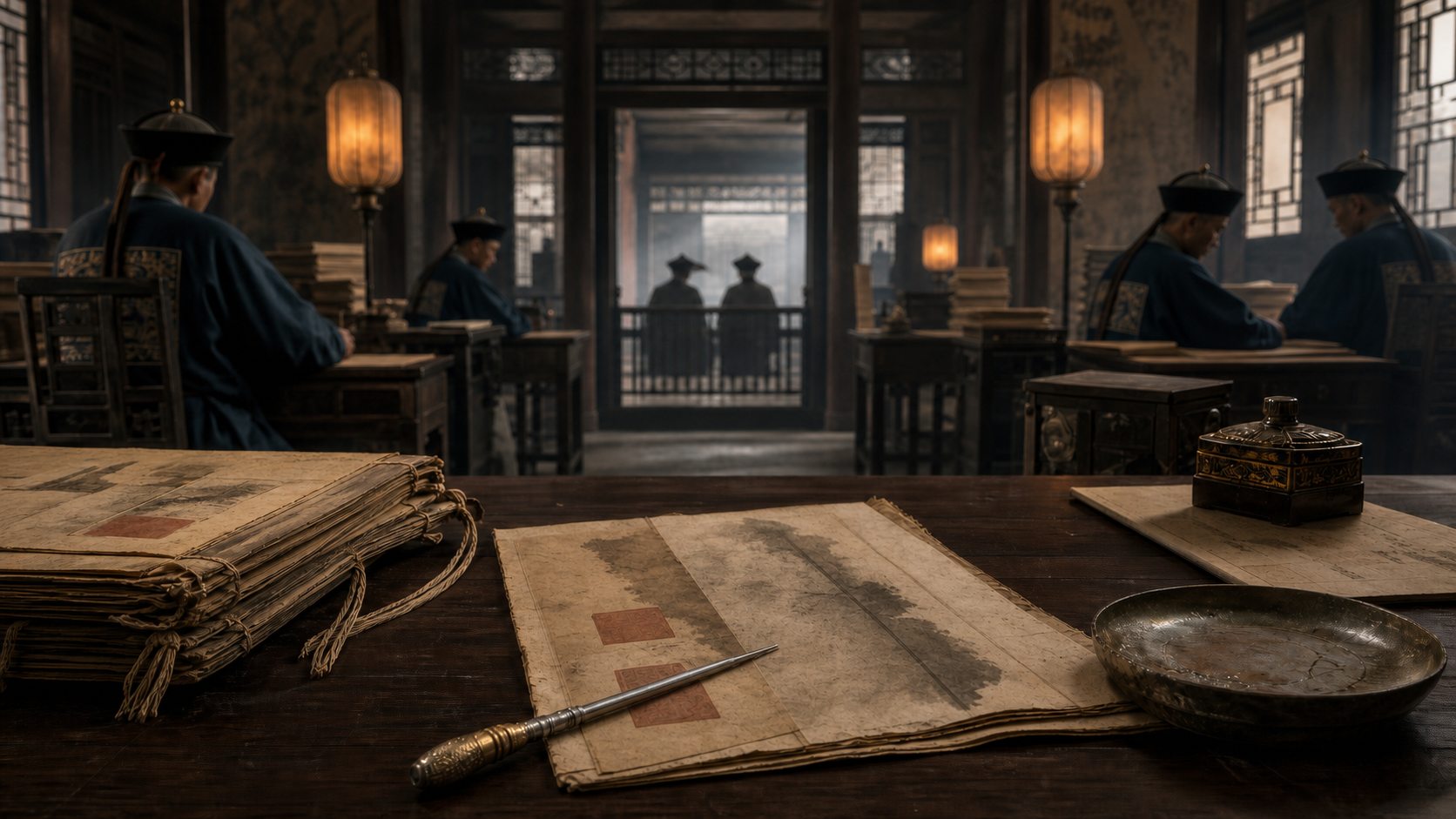
Then came the silver-needle test, familiar from historical dramas: insert a silver needle into the dead man’s throat, withdraw it, and examine the color. What those dramas often omit is an easily neglected preliminary step. The needle was supposed to be washed with soap-pod solution to reduce interference from decomposing matter. The coroner in this case skipped it. He inserted the unwashed needle directly into Ge’s throat and pulled it out dark blue-black. Unable to identify any specific poison, he reported only that Ge had “died after taking poison.”
The magistrate’s retainer, who had no forensic qualifications, immediately declared it arsenic. The coroner was the legally qualified examiner, but coroners belonged to a stigmatized “mean” social category and occupied an extremely low status. He did not dare contradict the magistrate’s man. Liu Xitong had also heard the adultery rumor before the inspection began. He accepted the retainer’s opinion and ordered the coroner to write “death by poison” into the autopsy report.
A procedural failure, interference by an unqualified outsider, and widely circulated gossip had converged. The case already had its conclusion.
Confession, Torture, and a Manufactured Chain of Evidence
Taken to the county yamen, Bi Xiugu initially insisted that she knew nothing about her husband’s death. Under modern criminal procedure, an ambiguous autopsy and neighborhood rumor would not be enough to identify a suspect, much less force her to incriminate herself. Qing justice, however, was built around the centrality of confession and the legal use of judicial torture. A defendant’s confession carried the greatest evidentiary weight. With few effective investigative techniques, torture offered the most direct route to obtaining one. Once “no beating, no confession” became conventional wisdom, confession ceased to be a means of adjudication and became an end in itself.
The Great Qing Code authorized an instrument called the zan, a wooden finger press used on female prisoners. In practice, county and prefectural officials also resorted to punishments the law did not authorize. A later Shenbao report described Bi’s torture in horrific terms, including red-hot wire applied to her breasts and boiling water poured over her back. Scholars continue to dispute these claims; some believe the newspaper embellished them to arouse sympathy and denounce judicial darkness. One point is beyond doubt: Bi endured physical torment severe enough to break a person psychologically.
Under that torment, she finally confessed. Following the magistrate’s suggestions, she invented a complete story: she had begun an affair with Yang the previous April, received a packet of arsenic from him a few days before Ge’s death, and poured it into the ginseng broth that killed her husband.
The case’s other suspect, Yang Naiwu, was born in 1841. Shortly before the case, he had passed the provincial civil-service examination and attended the celebratory Luming banquet. Later newspaper accounts said that Yang avoided cultivating officials, wrote petitions for aggrieved commoners, and turned stories of official-gentry collusion and abuse into songs for the public, thereby offending local authorities. Those reports are not especially reliable, however, and do not prove that the officials acted out of personal revenge.
As soon as Bi confessed, the county yamen summoned Yang. He invoked the procedural privilege attached to his new status as a provincial graduate. Local officials could not torture a degree-holder unless the court first stripped him of his rank. Yang withstood the first interrogation. His advantage did not last. Liu reported through the Hangzhou prefect and Zhejiang governor, seeking revocation of Yang’s degree. The Tongzhi emperor approved the request.
Once stripped of status, Yang lost his protection. The case moved to Hangzhou Prefecture, where Prefect Chen Lu tortured him with leg presses and other instruments. Yang lost consciousness twice, was revived with cold water, and was questioned again. He finally understood that rational denial in that courtroom would only purchase more meaningless pain. He surrendered. He confessed to adultery and poisoning, then invented a source for the poison under further questioning: he claimed to have bought the arsenic from a Cangqian apothecary named “Qian Baosheng.”
Chen Lu instructed Liu Xitong to trace the poison. Yet no druggist named Qian Baosheng existed in Cangqian. There was only a man named Qian Tan. Liu had his legal secretary write to Qian Tan and pressure him to cooperate. A nonexistent “Qian Baosheng” was forced into the record.
The paper chain was now complete: the autopsy report, two confessions, and witness testimony. On the page, every link appeared to close. Chen Lu proposed that Bi Xiugu be executed by lingchi and that Yang Naiwu be decapitated immediately.
Why Five Levels of Review All Failed
This was still only a local recommendation, not a final sentence. The case had to proceed upward, and every level theoretically had a chance to find the errors. Important Qing homicide cases were subject to an elaborate system of successive adjudication, transmission, and review: initial adjudication by the county, a second hearing at the prefecture, a third before the provincial judicial commissioner, and final provincial review by the governor. Each autumn, the central Board of Punishments, joined by the Court of Judicial Review, the Censorate, and senior officials from the six boards, conducted the Autumn Assizes for death sentences submitted from across the empire. In principle, a condemned prisoner passed through five gates, and any one could reverse the case.
The difficulty was that higher officials seldom saw raw facts. They saw files already organized by their subordinates. The same documents were copied and checked again and again. Each additional tier made them look more thoroughly verified, even though no one had returned to the original evidence. The Yang Naiwu case passed upward without ever escaping the framework fixed at the beginning.
The Zhejiang judicial commissioner did personally question Yang and Bi. But he still organized the interrogation around their confessions. He did not ask whether Ge had actually been poisoned or determine that “Qian Baosheng” did not exist. Governor Yang Changjun later dispatched an acting county magistrate to conduct a supposed secret investigation in Yuhang. The investigator did no meaningful work and returned with a perfunctory report that nothing was wrong. Yang Changjun maintained the judgment and formally submitted it to the center.
Why were so many officials reluctant to overturn their subordinates? The Great Qing Code prescribed offenses for official failures such as wrongfully imposing a punishment, conducting a false inspection, and deciding a case carelessly. It also imposed a principle sometimes described as reversal liability for wrongful judgment: if a miscarriage of justice was uncovered, every official who had handled the case, from magistrate to governor, could be punished.
The rule was meant to discipline officials and prevent wrongful convictions. In practice, it created the opposite incentive. Rejecting a subordinate’s judgment meant rejecting the administrative credibility of the entire chain below. Every official became tied to the others. To avoid liability, each person signing a review had reason to preserve the original judgment. Accountability for error became a mechanism for concealing error. Officials had neither an incentive to correct the case nor the courage to do so.
That was the institutional cause of failure. A procedurally elaborate review system coexisted with confession-centered justice, which made torture routine, and reversal liability, which made correction politically suicidal. More layers solved nothing. Five levels of review became an empty journey for paperwork.
Capital Appeals, Gentry Networks, and the Press
The Qing legal order did contain an internal corrective mechanism known as the capital appeal, or jingkong. It allowed people in the provinces to petition central institutions such as the Censorate and the office of the Beijing gendarmerie directly.
Yang Naiwu’s elder sister, Yang Juzhen, believed completely in her brother’s innocence and spent the family’s resources organizing an appeal in Beijing. Her first petition was sent back to Zhejiang for retrial, where officials again affirmed the judgment. Yang’s wife, Madam Zhan, later filed a second capital appeal. Repeated petitions did not immediately change the result, but they kept the case in view at the center.
Sustained litigation required substantial money. The famous “red-topped merchant” Hu Xueyan financed the Yang family’s efforts. One of Yang Naiwu’s old classmates served on Hu’s staff and told him what had happened. Hu immediately agreed to cover all the family’s expenses in Beijing. He also used his own network to support the petitions, relieving the family’s financial burden and connecting it to much more powerful social resources.
A political network of Zhejiang officials in Beijing was equally important. As a newly successful examination candidate, Yang stood within a broader Zhejiang gentry community. Through provincial connections, Yang Juzhen reached Xia Tongshan, then vice minister of war. Xia read a petition Yang had written in blood from prison and erupted in anger: “If this case is not clarified, no one in Zhejiang will ever again devote himself to study and advancement.” He mobilized the political resources available in the capital and brought together eighteen Zhejiang officials to impeach Governor Yang Changjun before the Censorate. Their motive ultimately involved the honor of Zhejiang’s educated elite. Turning a new provincial graduate into a convicted murderer humiliated the entire province.
Another emerging force also mattered: the press, especially the Shanghai-based Shenbao. Beginning with its first report on January 6, 1874, the paper followed the case for more than three years. It published over seventy reports and commentaries, together with the full text of nearly twenty memorials and edicts. The coverage broke local officials’ monopoly over information and created a public sphere that crossed provincial boundaries.
An important qualification is necessary. Popular retellings often say that Shenbao reporting directly forced Empress Dowager Cixi to order a reversal. Scholars caution against giving the press so much power. An absolute monarchy was not going to change a judicial decision simply because a foreign-owned newspaper criticized it. The paper’s influence was indirect. It supplied public legitimacy to Zhejiang officials in Beijing as they impeached the provincial governor, allowing factional conflict to appear as a response to the judgment of the realm. It also gave Cixi a politically useful justification for reopening the case.
A deeper political logic was at work. The Taiping Rebellion had ended only recently, and the Xiang Army network represented by Yang Changjun remained exceptionally powerful in Jiangnan. Cixi had been looking for opportunities to weaken its control. The Yang Naiwu case offered an ideal opening. Collective failure throughout Zhejiang’s official hierarchy allowed the court, under the banner of public opinion, to bypass the judicial authority of provincial governors and bring the case to Beijing.
The Exhumation at Haihui Temple
In October 1875, the first year of the Guangxu reign, Cixi issued an edict ordering all witnesses and evidence transferred to Beijing for direct adjudication by the Board of Punishments. The method of review finally changed. The board did not merely reread the confessions. It confronted suspects, witnesses, and original officials with one another, pursued the source of the poison, reexamined the autopsy, and focused on contradictions throughout the file. It then made the decisive choice to exhume and reexamine Ge Pinlian’s remains.
On January 23, 1877, thousands gathered at Haihui Temple outside Beijing’s Chaoyang Gate; foreign journalists were among them. Sang Chunrong, president of the Board of Punishments, and Vice President Weng Tonghe personally supervised the examination. Liu Xitong and the original coroner were ordered to attend. The seals on Ge’s coffin were broken and the lid opened before the crowd. The remaining soft tissue was removed, and coroners lifted out the bones and examined them one by one. At last, one called out: “All of Ge Pinlian’s bones are yellowish white. There was certainly no poison. He died of illness!”
Liu Xitong’s legs gave way and he fell to his knees. The original coroner signed a confession on the spot, acknowledging that he had failed to wash the needle with soap-pod solution and that the original finding of “death by poison” was false. A supposed “iron case” sustained for four years and through five levels of review collapsed before a skeleton.
Two months later, the Board of Punishments submitted its final memorial to the Guangxu emperor. Yang Naiwu and Bi Xiugu were declared innocent of murder. Bi was nevertheless sentenced to eighty strokes for “failure to observe womanly propriety,” later commuted to a monetary redemption. Yang was assigned one hundred strokes for failing to avoid the appearance of impropriety and for falsely accusing others while imprisoned. Because his degree had already been revoked, the corporal sentence was waived, but his status was never restored. More than thirty Zhejiang officials—including Governor Yang Changjun, Prefect Chen Lu, and Magistrate Liu Xitong—were demoted, dismissed, or exiled.
The Cost After Exoneration
The case had been reversed. Exoneration did not restore what had been taken.
When Yang Naiwu left prison, the leg presses had left him permanently disabled and walking with a limp. His examination degree was gone, and the litigation had ruined his family. Back in Yuhang, he spent the rest of his life raising silkworms and selling silk to survive.
After her release, Bi Xiugu entered a Buddhist convent outside Yuhang’s south gate and took the religious name Huiding. Accounts of her later life dwell on the hands permanently twisted by the finger press.
Posterity has repeatedly told the exoneration as a classic example of late-Qing judicial self-correction. Look closely, however, and every force that made reversal possible came from outside the ordinary judicial process: Yang’s examination status, the provincial network of officials in Beijing, the money of a powerful merchant, and the public pressure generated by a newspaper in the foreign settlement. The five-tier review system prescribed by Qing law accomplished nothing.
Every effective effort also came from Yang Naiwu’s side. Bi Xiugu was a poor woman without degree, property, husband, or support from her husband’s family. She had no independent ability to appeal within the long judicial hierarchy. In an age without enforceable rights, she was rendered voiceless. Her words were swallowed and rewritten. Every attempt to retract her confession was treated as deceit. Every word forced from her under torture became evidence against her.
The case still deserves attention today. Can institutions escape the trap of treating confession as supreme? Can accountability be designed without creating incentives to hide mistakes? Can every future Bi Xiugu be given a voice? These are questions every legal professional should take seriously.
Key Figures
- Yang Naiwu — A newly successful provincial examination candidate from Yuhang County, Zhejiang. Rumor drew him into the case, and torture by the Hangzhou prefect forced a false confession. After exoneration, he remained stripped of status and disabled in both legs, supporting himself through sericulture.
- Bi Xiugu (“Little Cabbage”) — Ge Pinlian’s wife and a commoner. Unable to withstand torture at the county yamen, she falsely confessed to adultery and murder. After exoneration, she became a Buddhist nun under the religious name Huiding.
- Ge Pinlian — A worker in a tofu shop in Cangqian, Yuhang, and the deceased in the case. He suffered from “flowing fire” and died of illness in November 1873, but officials misidentified his death as arsenic poisoning.
- Qian Tan (“Qian Baosheng”) — Proprietor of Cangqian’s Airentang apothecary. Liu Xitong intimidated him into supplying false evidence of an arsenic sale. He never appeared before the Hangzhou prefectural court and died during questioning before transfer to Beijing.
- Liu Xitong — The Yuhang county magistrate. He prejudged the case, falsified the autopsy record, tortured Bi Xiugu, and pressured Qian Tan to furnish false evidence.
- Chen Lu — The Hangzhou prefect. He used leg presses and other torture on Yang Naiwu, ordered officials to complete the false chain of evidence, and issued the first proposed death sentences.
- Yang Changjun — Governor of Zhejiang and a former Xiang Army commander. After the capital appeals began, he delayed review in an effort to preserve the credibility of the provincial administration.
- Hu Xueyan — A celebrated “red-topped merchant” and pharmaceutical magnate. He contributed 200 taels of silver to the Yang family’s second capital appeal and continued to provide financial backing.
- Xia Tongshan — Vice minister of war. He organized eighteen Zhejiang officials to impeach the provincial authorities and helped move the case to the Board of Punishments.
- Weng Tonghe — Vice president of the Board of Punishments. He took part in the central review and helped advance the exhumation at Haihui Temple.
Key Concepts
- Successive adjudication, transmission, and review — Qing death sentences passed through county, prefecture, provincial judicial commissioner, governor, and Board of Punishments. In this case, dependence on written files, the perverse incentive created by official liability, and confession-centered adjudication caused every level to fail.
- Confession-centered justice — A defendant’s confession was treated as decisive proof of guilt. The principle that “no case stands without a confession” reinforced the legal use of torture and became a root cause of wrongful conviction.
- Reversal liability for wrongful judgment — Qing law imposed severe consequences for erroneous capital cases. In bureaucratic practice, accountability became concealment: officials preserved one another’s decisions to avoid punishment.
- Capital appeal (jingkong) — A remedy allowing people in the provinces to petition central offices such as the Censorate directly. The two appeals organized by Yang Juzhen were essential to keeping the case before the central government.