This is the translated transcript of episode 12 of my podcast Reasoned Talk (议正言辞). Listen on Xiaoyuzhou or Apple Podcasts . The episode audio is in Chinese; this transcript has been translated into English.
On August 22, 1984, the Republican National Convention was under way in Dallas, Texas. President Ronald Reagan was about to receive his party’s nomination for a second term. Outside the convention, more than one hundred demonstrators protested the Reagan administration and the policies of several local corporations. Some lay down in the street to simulate the aftermath of nuclear war; others spray-painted walls and knocked over planters.
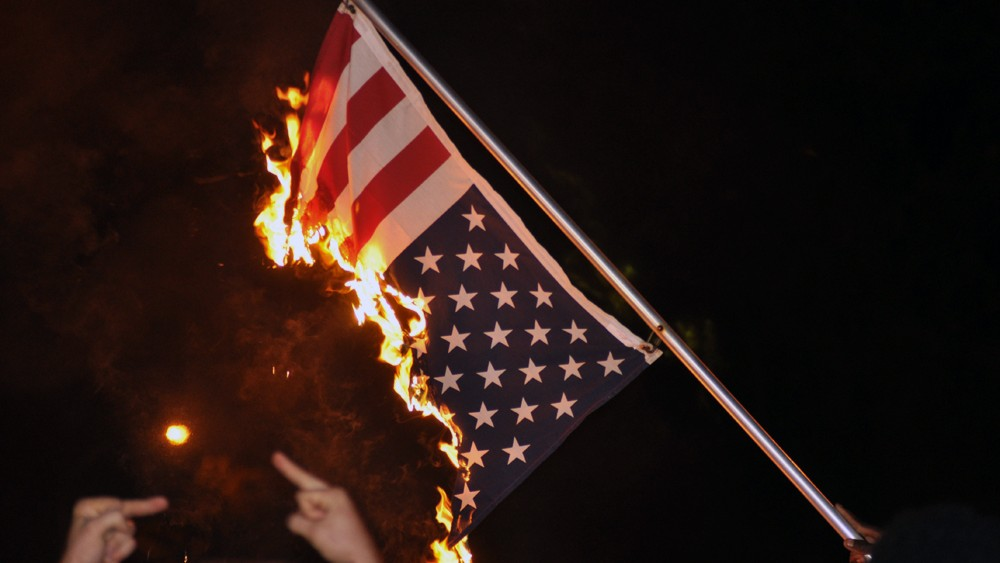
Among the demonstrators was a young man named Gregory Lee Johnson. He took an American flag from another protester. When the procession reached Dallas City Hall, Johnson unfurled the flag, soaked it in kerosene, and set it on fire.
As the flames rose, the demonstrators chanted: “America, the red, white, and blue—we spit on you.” No one was injured, although several witnesses later testified that the burning deeply offended them. After the protest ended, one witness quietly gathered the charred remains of the flag and buried them in his backyard.
Texas charged Johnson under section 42.09 of its penal code with desecration of a venerated object. He was sentenced to one year in prison and fined $2,000.
The case traveled all the way to the U.S. Supreme Court and became one of the most controversial decisions in American constitutional history: Texas v. Johnson.
Is Flag Burning “Speech”?
Thirty-seven years after the 1989 decision, the controversy remains unsettled. The political left and right continue to fight over it, and both Congress and the Supreme Court have been drawn into the struggle. As recently as 2025, President Donald Trump signed an executive order that sought a path around the ruling.
The central question is easy to state and extraordinarily difficult to answer: when someone burns a flag to express a political view, may the government imprison him because he has wounded public sentiment?
The question begins with the First Amendment to the U.S. Constitution:
Congress may not establish a religion or prohibit its free exercise; abridge freedom of speech or of the press; or deny the people the right to assemble peacefully and petition the government for redress.
Everything therefore turns on whether burning a flag falls within the amendment’s protection of “speech.”
During the 1984 demonstration in Dallas, Johnson damaged no property and caused no disorder apart from burning the flag. Other demonstrators painted walls and overturned planters, but Johnson alone was criminally charged, and his only charge was desecration of a venerated object. That detail matters. Texas did not prosecute him for disorderly conduct or arson. The sole issue was the nature of the act of flag burning itself.
Johnson’s conviction rested on section 42.09(a)(3) of the Texas Penal Code:
A person commits an offense if he intentionally or knowingly desecrates a state or national flag.
Subsection (b) further defined desecration:
“Desecrate” means to deface, damage, or otherwise physically mistreat the object in a way the actor knows will seriously offend one or more persons likely to observe or discover his action.
The law contained an unusual element: the actor had to know that the conduct would cause serious offense. Merely damaging a flag did not necessarily constitute the crime. The state also had to prove that the defendant knew his treatment of the flag would seriously offend someone likely to witness or discover it.
In other words, the law did not target the physical consequences of the act. It targeted the audience’s response to the message conveyed by the act: you expressed contempt for the flag, the audience was offended, and therefore you committed a crime. In substance, the statute imposed a content-based restriction. It punished the offensive message carried by the burning.
Two Decisions in the Texas Courts
The trial court convicted Johnson under this law. He appealed to the Texas Fifth Court of Appeals, which affirmed the conviction in 1986. The court acknowledged that Johnson intended a political message, but concluded that Texas’s interest in preserving the flag’s symbolic meaning outweighed his right to express it. The flag’s exceptional status, in the court’s view, justified a limit on expression.
Johnson appealed again. In 1988, the case reached the Texas Court of Criminal Appeals, the state’s highest criminal court. This time, the result changed.
The court held that Johnson’s burning of the flag was expression protected by the First Amendment. It relied on the Supreme Court’s 1943 decision in West Virginia State Board of Education v. Barnette. During the Second World War, West Virginia required all public-school students to salute the flag and recite the Pledge of Allegiance. Jehovah’s Witnesses refused because they regarded the salute as a form of idolatry forbidden by their faith. The students were expelled, and their parents faced criminal prosecution.
The Supreme Court ruled for the families by a vote of 6–3. One passage became a foundation of American free-speech law:
If there is any fixed star in our constitutional constellation, it is that no official, high or petty, may prescribe what is orthodox in politics, nationalism, religion, or other matters of opinion, or compel citizens to profess their faith by word or act.
The government, in other words, may not compel patriotism. Patriotism must be voluntary; loyalty manufactured by force is not genuine loyalty.
The Texas Court of Criminal Appeals built on Barnette. A law against desecrating venerated objects, it reasoned, prescribed the “correct” attitude toward the flag: a person could treat it only with respect, never with contempt. That amounted to compelling respect for the flag and declaring one approved belief about a national symbol.
The court also noted that no violence or disorder had actually occurred. No one was hurt or threatened with physical injury. Serious offense is not the same as incitement to violence. Texas already had public-order laws for genuine threats; it did not need to punish offensive expression to preserve the peace. In 1988, the Texas Court of Criminal Appeals reversed Johnson’s conviction.
The Supreme Court’s Three-Step Analysis
Texas petitioned the U.S. Supreme Court for review. The Court accepted the case in late 1988. On June 21, 1989, the justices voted 5–4 to affirm the Texas Court of Criminal Appeals’ judgment overturning Johnson’s conviction.
It was another sharply divided decision.
Two members of the majority were especially striking. Justices Antonin Scalia and Anthony Kennedy, both Reagan appointees commonly regarded as conservatives, did not side with the defense of national dignity. They instead joined the judgment protecting Johnson’s freedom of expression. Why?
Justice William Brennan wrote the majority opinion. Its central logic can be divided into three steps.
First: did Johnson’s act of burning the flag qualify as “speech”?
Speech under the First Amendment does not mean only words spoken aloud. The amendment protects expression, including conduct that communicates.
In the 1974 case Spence v. Washington, the Supreme Court articulated an important approach to expressive conduct. Did the actor intend to communicate a particular message? And, in the surrounding circumstances, was the audience likely to understand it? When conduct is meant to convey a message that observers can grasp, it can become symbolic speech protected by the First Amendment.
Johnson burned the flag during the Republican National Convention, in a demonstration against the Reagan administration. The political meaning of his action was unmistakable. He used conduct to communicate.
Second: what, precisely, did the Texas statute seek to punish?
The Court concluded that the statute punished the content of expression. Its critical element—knowledge that the act would seriously offend others—focused not on physical danger, but on how observers reacted to the message. Burning a worn-out flag for disposal could be lawful; burning the same flag to protest the government could be a crime. The law distinguished between the attitudes expressed by the two acts.
Put plainly, Texas was not protecting the flag’s physical integrity. It was protecting the flag’s symbolic dignity. That was exactly the kind of rule the First Amendment forbids. The government may not punish expression merely because it offends.
Third: could the flag’s symbolic importance outweigh an individual’s freedom of speech?
The Court held that the government could not imprison a speaker merely because his message might anger those who saw it. Otherwise, the most outraged audience would acquire a practical veto: by displaying enough anger, spectators could force the government to suppress a view they disliked.
Brennan’s answer was that the flag’s special place should be preserved by persuading those who disagreed, not by punishing them. The response to a bad idea was more speech, not compelled silence.
He went further. The government could not “consecrate” the flag through punishment, because doing so would weaken the freedom the flag represents. The flag deserves respect precisely because the country it symbolizes permits a person to burn it. If that country imprisons someone for burning the flag, it has betrayed the value the flag is supposed to embody.
The argument was powerful. It was also deeply uncomfortable.
Justice Kennedy understood this better than anyone. He wrote separately to explain why, despite hating flag desecration personally, he voted to protect it.
Sometimes judges must make decisions they do not like. They do so because those decisions are right: under their understanding of the Constitution and the law, no other conclusion is possible.
Kennedy acknowledged that the ruling would anger many Americans and appear to defy public feeling. That burden was part of a judge’s duty. Personal preference could not stand above the Constitution. Sometimes the Constitution requires us to accept the very thing we find most difficult to accept emotionally.
Why Four Justices Dissented
Chief Justice William Rehnquist wrote the principal dissent. His central claim was that the flag is not an ordinary prop for expression. Across more than two centuries, the American flag had carried the nation’s unity and common ideals. It was a unique national symbol, and the government was entitled to protect it from public desecration.
Burning the flag before a crowd while chanting insults, he argued, was different from publishing an article criticizing the government. The former was a direct attack on a national symbol, and the state could prohibit it.
Justice John Paul Stevens wrote a separate dissent comparing the flag to an “intangible national asset.” It represented the country’s history and unity and possessed exceptional value. The government therefore had reason to protect it against overt contempt. Stevens emphasized that the Texas law prohibited flag mistreatment of the most obvious kind, not every misuse or improper handling. Ordinary citizens, he thought, could understand the boundary: one could not deliberately burn the flag in public to humiliate the country.
Both dissents carried emotional force. Rehnquist appealed to history and sacrifice; Stevens to national symbolism and public feeling. They also explain why the case remains so divisive. The majority’s reasoning was internally coherent, but it demanded acceptance of a profoundly unsettling result.
Scalia and Kennedy, the two conservative justices in the majority, chose the Constitution over their personal reactions. That choice followed from what they understood judicial duty to require.
Congress Responds with Legislation and Amendment
When Johnson’s conviction was overturned, public opposition surged.
Polling after the decision suggested that most Americans rejected the result. Members of both parties in Congress denounced the Court. President George H. W. Bush called flag burning “dead wrong” and urged a constitutional amendment that would overturn the rule established by the decision.
Congress acted quickly. In 1989, only months after Johnson, it passed the Flag Protection Act by overwhelming majorities. The law made it a federal crime knowingly to mutilate, deface, physically defile, burn, or trample a flag, except when disposing of one that had become worn or soiled.
This time Congress omitted language such as “casts contempt” and avoided the Texas statute’s requirement that the actor know the conduct would cause serious offense. It attempted to prohibit the objective act of damaging a flag and thereby make the law content neutral.
The Supreme Court was not persuaded.
Soon after the Flag Protection Act took effect, protesters in Washington, D.C., and Seattle burned flags to challenge it. One group set several American flags alight on the steps of the U.S. Capitol. The cases reached the Supreme Court together, most famously as United States v. Eichman.
On June 11, 1990, the Court again voted 5–4, holding the Flag Protection Act unconstitutional. Congress argued that the statute no longer depended on the protester’s political viewpoint and was therefore content neutral. The Court found the same defect that had doomed the Texas law: the act permitted burning a worn or soiled flag, yet prohibited burning a flag to communicate political dissatisfaction.
What the government truly protected was not the flag’s physical integrity in every setting. It protected the flag from an insulting message. That distinction showed that the law cared not about the objective act of burning, but about what the burning communicated. A statute that punished conduct expressing disrespect while permitting conduct expressing respect remained a content-based restriction.
Brennan restated the governing principle in Eichman:
The government may not prohibit an idea merely because society finds the idea itself offensive.
Congress did not give up. If ordinary legislation could not overcome the First Amendment, it would try to amend the Constitution.
Congress repeatedly proposed amendments authorizing a ban on flag desecration. Amending the U.S. Constitution requires a two-thirds vote in each house of Congress followed by ratification in three-fourths of the states. No flag-protection amendment has crossed that threshold.
The closest attempt came in 2006. The Senate voted 66 in favor and 34 against—one vote short of the required two-thirds majority. Almost every Republican senator supported the amendment, while Democrats divided. Since then, members of Congress have occasionally introduced similar proposals, but none has approached the same momentum.
The 2025 Executive Order and the Carey Case
On August 25, 2025, President Trump signed Executive Order 14341, directing the federal government to intensify investigation and prosecution connected to flag burning.
The order did not create a new crime. Instead, it instructed the Justice Department to prioritize enforcement of existing, content-neutral laws when flag burning accompanied some independent offense. Arson, property destruction, violence, or a separate hate crime could be prosecuted under the relevant statute. Possible violations of local open-burning rules, disorderly-conduct laws, or property protections could be referred to state or local authorities.
Another provision attracted even more attention. It directed the secretaries of state and homeland security and the attorney general, acting within existing law, to consider revoking visas, ending residence or naturalization proceedings, denying other immigration benefits, or removing foreign nationals who burned the flag. The order itself could not strip anyone of citizenship or immigration status. The government would still need a specific basis in existing law.
The order faced a direct challenge on the day it was signed. Jay Carey, an Army veteran, went to Lafayette Square near the White House, set an American flag on fire, and openly declared that he was protesting the new order.
Carey was arrested and later charged with two federal misdemeanors: lighting a fire in an undesignated area of a national park and damaging park property. Prosecutors did not charge the act of flag burning itself. They relied on a content-neutral National Park Service fire rule—the enforcement route contemplated by the executive order.
Carey argued that his conduct was a political protest protected by the First Amendment. In March 2026, the Justice Department dismissed both charges without publicly explaining why. Once the prosecution ended, the courts had no occasion to review the case, and this challenge would not carry the executive order to the Supreme Court.
The episode exposed the order’s legal dilemma. The government may punish an offense independent of a message without violating the First Amendment. But if conduct that ordinarily goes unenforced suddenly draws severe punishment only because the object burned is a flag, supposedly content-neutral enforcement may itself come under First Amendment scrutiny.
Why the Constitution Protects Uncomfortable Expression
Thirty-seven years later, many people still cannot accept the result. To them, a flag is not an ordinary piece of cloth. It carries national history, shared identity, and the meaning of countless sacrifices. Yet its importance is precisely why the Court had to answer a harder question: when collective reverence conflicts with individual expression, may the government use its power to suppress the latter in order to protect the former?
The Supreme Court’s answer was that the Constitution stands with freedom of expression. Once the government is permitted to create a speech exception for one “sacred” symbol, it may create another exception for the next sacred object.
Johnson’s decision to set fire to a flag was crude and profoundly offensive in virtually any cultural setting. You are free to think that Johnson was an asshole. The point of a constitution, however, is that it protects even an asshole’s right to speak.
If constitutional protection extended only to speech that made people comfortable, no constitution would be necessary. The First Amendment matters most for speech that leaves the majority angry, offended, or unsettled.
The closing thought of Brennan’s 5–4 opinion still echoes:
Painful though it may be, the flag protects those who hold it in contempt.
Key Figures
- Gregory Lee Johnson — The protester who burned an American flag during the 1984 Republican National Convention in Dallas. He was the criminal defendant and the respondent before the Supreme Court. Initially sentenced to one year in prison and fined $2,000, he ultimately prevailed.
- William Brennan — Associate justice of the U.S. Supreme Court from 1956 to 1990 and author of the majority opinion in Texas v. Johnson. He was known for his defense of freedom of expression.
- Antonin Scalia — Associate justice from 1986 to 2016, a Reagan-appointed conservative known for textualism and originalism. He joined Brennan’s majority opinion in Johnson without writing separately.
- Anthony Kennedy — Associate justice from 1988 to 2018, a Reagan appointee generally regarded as moderately conservative. He joined the majority and wrote a separate concurrence.
- William Rehnquist — The sixteenth chief justice of the United States, serving from 1986 to 2005. He wrote the principal dissent and argued that the flag was a unique national symbol.
- John Paul Stevens — Associate justice from 1975 to 2010. His separate dissent compared the flag to an intangible national asset.
Key Cases and Concepts
- Texas v. Johnson — The Supreme Court held 5–4 that politically motivated flag burning in this case was expression protected by the First Amendment. The government could not impose criminal punishment merely because the public found the message offensive.
- Symbolic speech — Conduct used to communicate a political or social message. The approach associated with Spence v. Washington considers the actor’s communicative purpose and the likelihood that observers will understand the message.
- Content-based restriction and neutral regulation — A law aimed at a message, such as one punishing offensive expression, faces the most demanding constitutional review. Rules governing fire, property, or the time, place, and manner of conduct without regard to a message may be treated differently.
- West Virginia State Board of Education v. Barnette — The decision establishing that government may not compel citizens to salute the flag or profess a prescribed political belief. It became a foundation of protection for symbolic expression.
- United States v. Eichman — The Supreme Court again voted 5–4 to invalidate the Flag Protection Act of 1989, reaffirming that the government could not use protection of the flag’s physical integrity as a pretext for suppressing a political message.
- Executive Order 14341 — The order directing the Justice Department to enforce existing content-neutral laws against independent offenses accompanying flag burning and instructing federal officials to consider immigration measures against foreign nationals where authorized by law.
- The Carey case — Jay Carey burned a flag near the White House to protest Executive Order 14341. Prosecutors charged two misdemeanors under National Park Service rules, then dismissed both charges in March 2026.