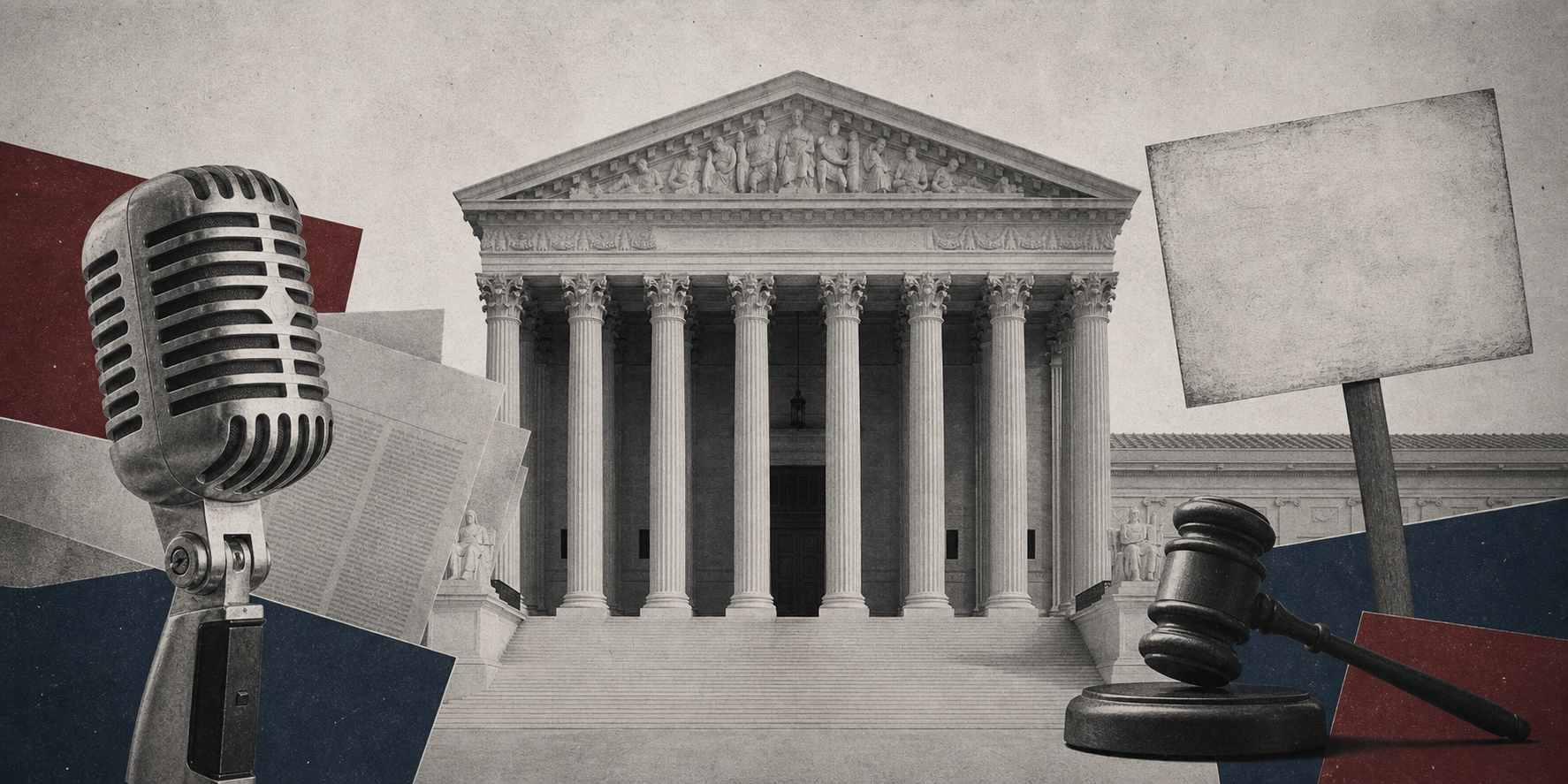
Episode 12 posed a question that can sound almost deliberately extreme: may someone publicly burn the American flag? In 1989, the Supreme Court answered in Texas v. Johnson that when flag burning is used to express a political position, the government may not imprison the speaker merely because most people find the message offensive.
That decision can easily create the impression that freedom of speech in the United States has no limits. Nothing could be further from the truth.
For more than a century, the Supreme Court has repeatedly confronted the same question: where are the limits of free speech? It has never drawn a single, bright line. Instead, case by case, it has gradually assembled a series of legal tests. This article traces the development of several of the most important ones.
The First Question: Who Is Restricting Speech?
The First Amendment’s protection of speech is stated in simple terms:
Congress shall make no law abridging the freedom of speech.
But an easily overlooked question comes first: whom does this rule bind?
The text of the First Amendment mentions only Congress, but through the Fourteenth Amendment it also applies to state and local governments. As a general rule, the Free Speech Clause restrains the government, not ordinary private actors. If a newspaper rejects your submission, a private employer dismisses you for something you said, or a social-media platform suspends your account for violating its rules, that ordinarily is not a First Amendment violation. Private actors may still be constrained by labor law, antidiscrimination law, contracts, or their own platform rules, but those are separate questions.
Only in limited circumstances can private conduct be attributed to the government—for example, when a private entity performs a function traditionally and exclusively reserved to the state, acts under government compulsion, or acts jointly with the government.
So the next time someone says, “My freedom of speech has been violated,” the first question should be: who is restricting the speech? And is the freedom being invoked one that the Constitution actually protects in this relationship?
Free Speech and Public Order
Once that basic point is clear, the next question is: what happens when speech may threaten public order? Here, one of the most famous sayings in American law is that you cannot falsely shout fire in a crowded theater.
The phrase comes from the Supreme Court’s 1919 decision in Schenck v. United States. During the First World War, socialist Charles Schenck mailed leaflets opposing the draft to men who had been called for military service. He was prosecuted under the Espionage Act, and his case reached the Supreme Court. The leaflets were plainly “speech” within the ordinary meaning of the First Amendment, so the natural question was whether opposition to the draft during wartime fell within the constitutional freedom of speech.
Justice Oliver Wendell Holmes proposed a test: whether speech is protected depends on whether, in its particular circumstances, it creates a “clear and present danger.” His reference to falsely shouting fire in a crowded theater illustrated how context can change the legal consequences of words. No theater fire was involved in Schenck, and the metaphor is not a legal rule that can be applied independently of a concrete case.
In practice, however, “clear and present danger” could still be interpreted broadly. Schenck also arose in an era deeply hostile to antiwar activists and socialists. The Court treated the leaflets as an attempt to obstruct the draft and upheld Schenck’s conviction.
The real turning point came fifty years later. In 1969, the Supreme Court decided Brandenburg v. Ohio. Brandenburg was a member of the Ku Klux Klan. He invited a television station to film one of the group’s rallies. The footage showed robed figures and a burning cross, while Brandenburg delivered racist remarks and warned that “revengeance” might be taken if the president, Congress, and the Supreme Court continued to “suppress the white, Caucasian race.”
Was this merely abstract advocacy of violence, or had it become punishable incitement? The Supreme Court reversed Brandenburg’s conviction and reshaped incitement doctrine around the stricter standard of “imminent lawless action.” In practical terms, the government may punish advocacy of violence or illegality only when three conditions are present:
- The speaker intends to incite or produce unlawful action;
- The unlawful action is imminent, rather than an abstract possibility in the distant future;
- In the circumstances, the speech is likely to incite or produce that action.
These requirements address purpose, proximity in time, and practical likelihood. Praising revolution or expressing an abstract hope that the government might someday be overthrown is not incitement. Saying “break down that door now,” to a crowd likely to obey, is much closer to the point at which punishment becomes constitutionally permissible.
From Schenck to Brandenburg, the Court ceased to accept the government’s generalized sense of “danger” as enough. It demanded evidence of a very close connection between the speech and the unlawful action.
Free Speech and the Rights of Others
Those two cases concern the relationship between speech and public order. But what if speech does not threaten public order and instead insults, threatens, or defames a particular person?
Fighting Words
In 1942, the Supreme Court introduced the category of “fighting words” in Chaplinsky v. New Hampshire. Chaplinsky, a Jehovah’s Witness, came into conflict with local officials while preaching on the street. He called the town marshal a “damned Fascist” and a “God-damned racketeer.” He was convicted. The Court reasoned that some personally abusive words addressed directly to another person are inherently likely to provoke an immediate violent response. Such face-to-face provocation may be punished.
In practice, people sometimes reduce the doctrine to the idea that all profanity may be banned. The Supreme Court corrected that misconception in 1971 in Cohen v. California. Paul Cohen entered the Los Angeles County Courthouse wearing a jacket bearing the words “Fuck the Draft” to protest conscription during the Vietnam War. The words were not directed at any person, yet a state court sentenced him to thirty days in jail simply because his expression was vulgar. The Supreme Court reversed by a vote of 5–4.
The Court’s reasoning was that Cohen had not personally provoked anyone and no actual violence had occurred. Anyone who did not wish to see the words could avert their eyes. Language conveys more than rational propositions; it also carries anger, protest, and emotional force. Speech therefore does not become “fighting words” merely because it is vulgar or offensive. In context, it must amount to a personal insult directed at another person and be likely to provoke an immediate violent response.
That leads naturally to another question: how should the law treat attacks directed at a group rather than a particular individual?
The 2011 case Snyder v. Phelps pushed that question to an extreme. Members of the Westboro Baptist Church protested near the funeral of a Marine killed in action. Their signs were profoundly offensive toward gay people, members of the military, and American society. The Marine’s father suffered severe emotional distress, and a jury initially awarded him millions of dollars in damages. The Supreme Court ultimately ruled for the church by a vote of 8–1.
The Court considered the content, form, and context of the signs and concluded that they primarily addressed matters of public concern, including war, religion, and homosexuality. The protesters had also remained on public land about one thousand feet from the church, complied with police instructions, and did not disrupt the funeral. A jury therefore could not impose tort liability merely because it regarded the expression as outrageously offensive.
Taken together, these cases establish a narrow rule: vulgarity, offense, or an attack on a group is ordinarily not enough, by itself, to constitute fighting words. Even speech directed at an individual must still be the kind of face-to-face personal abuse likely to provoke an immediate violent response. This does not mean that words cannot inflict harm. It means that courts must prevent government power from expanding so far that it damages everyone’s freedom of expression. A government granted an overbroad power to suppress racist abuse today might use the same power tomorrow to suppress a minority’s criticism of the dominant order.
True Threats
Fighting words are not the only category of unprotected expression. Another is the “true threat.” Incitement seeks to cause listeners to commit unlawful acts. A true threat, by contrast, communicates a serious expression of unlawful violence toward an individual or group and places its target in fear. The prosecution need not prove that the speaker ultimately intended to carry out the violence.
In 1969, eighteen-year-old Robert Watts said at an antiwar rally that if he were ever forced to carry a rifle, “the first man I want to get in my sights is L.B.J.” The audience laughed. Considering the statement in context, the Supreme Court held that it was crude political hyperbole, not a true threat.
The 2003 case Virginia v. Black consolidated prosecutions of three defendants. One involved cross burning at a Ku Klux Klan rally; another involved an attempt to burn a cross in the yard of a Black neighbor. The Supreme Court held that a state may, in principle, prohibit cross burning carried out with an intent to intimidate because such conduct may constitute a true threat. Virginia law, however, also provided that the act of burning a cross was itself prima facie evidence of an intent to intimidate. The Court held that this rule went too far. Depending on context, the same act might be intended to terrorize someone or to express an ideology. The government may punish true threats, but it may not skip the inquiry into context and mental state by automatically presuming an intent to intimidate.
That sounds straightforward: determine whether the expression is threatening in context, and then determine the speaker’s mental state regarding its threatening character. In practice, both inquiries are difficult. The social-media era has made the second especially so.
In Counterman v. Colorado (2023), Billy Counterman created multiple Facebook accounts and sent hundreds of messages to a female musician he had never met. She repeatedly blocked him, and he repeatedly created new accounts. Some messages referred to seeing her driving or spending time with her partner; one simply said, “Die.” The recipient became frightened, lost sleep, was afraid to go out alone, and canceled performances. Colorado courts applied a “reasonable person” test: conviction was permissible if an ordinary person would understand the messages as threats, regardless of whether Counterman himself recognized their threatening nature.
The Supreme Court vacated the judgment. It held that the government must at least prove recklessness: the defendant must have consciously disregarded a substantial and unjustifiable risk that his communications would be perceived as threats of violence. This did not mean that Counterman’s conduct was harmless or that the victim’s fear was unimportant. The Court’s concern was that if criminal punishment could follow whenever another person might misunderstand a speaker’s words, much forceful but lawful expression would be chilled.
The boundary of true threats therefore cannot be reduced to a single question. At least two matters must be examined: whether the words, in context, actually conveyed a threat of violence, and whether the speaker consciously disregarded a substantial risk that they would be perceived that way.
Defamation
Another familiar form of harm caused through language is defamation, where the boundary of free speech becomes more complicated still.
During the civil-rights movement of the 1960s, officials in Southern states frequently used defamation suits and demands for enormous damages to suppress national reporting about the movement. The most famous example is New York Times Co. v. Sullivan. Supporters of the movement placed a full-page advertisement in The New York Times to raise money for Martin Luther King Jr. and protesters in the South. The advertisement criticized police repression in Alabama but contained several factual errors—about which song students had sung, whether police had “ringed” a campus, and how many times King had actually been arrested. L. B. Sullivan, Montgomery’s commissioner of public affairs, was not named in the advertisement, yet he sued the newspaper for libel and demanded enormous damages. If the judgment stood, even an innocent mistake in reporting could expose a news organization to ruinous liability and deter it from covering the subject again.
In 1964, the Supreme Court ruled against Sullivan and established the “actual malice” standard. A public official seeking damages for a false statement concerning official conduct must prove that the defendant knew the statement was false or acted with reckless disregard for whether it was true or false—for example, by publishing despite serious doubts about its truth. “Malice” here does not mean hatred or ill will in the ordinary sense; it describes a subjective state of mind concerning truth or falsity. The Court recognized that errors are inevitable in public debate. If every innocent mistake could lead to catastrophic damages, the safest course would be to say nothing at all.
The Court later drew further distinctions in Gertz v. Robert Welch, Inc., treating public officials, public figures, and private individuals differently. Private individuals usually lack comparable access to channels of communication with which to defend themselves, and they may never have voluntarily entered a public controversy. In defamation cases involving matters of public concern, states may therefore permit private individuals to recover under a standard lower than actual malice, such as negligence, but may not impose liability without fault. Without proof of actual malice, a plaintiff generally must also prove actual injury and may not recover presumed or punitive damages.
United States v. Alvarez (2012) pushed the issue further. Xavier Alvarez falsely claimed at a public meeting that he had received the Congressional Medal of Honor. The federal government convicted him under the Stolen Valor Act. Six justices ultimately agreed that the law was unconstitutional, although they did not share a single rationale. The statute effectively criminalized almost any lie about military decorations without asking whether the speaker had sought money or another benefit, or requiring proof of concrete harm. The opinions supporting the judgment refused to treat falsity alone as the basis for a broad new category of unprotected speech. Congress responded in 2013 with a narrower law that applies to fraudulent claims about certain military decorations made with the intent to obtain money, property, or another tangible benefit. The same falsehood may therefore have a very different legal character when used for idle boasting rather than fraud.
In short, the law ordinarily punishes not falsity in the abstract, but the relationship between a falsehood and a concrete harm. Perjury damages the judicial process; fraud causes financial loss; defamation harms a particular person’s reputation; false statements to the government obstruct administration. Those additional consequences provide the firmer justification for punishment.
Expression and Incidental Conduct
So far, the discussion has concerned expression that may be punished because of its content. In real life, however, expression is often bound up with conduct: a march occupies a road, a concert creates noise, burning an object may cause a fire, and posting signs may obstruct traffic. The First Amendment protects expression, but it does not immunize every act that accompanies it.
One of the leading cases is United States v. O’Brien. In 1966, antiwar protester David O’Brien burned his draft card outside a courthouse, deliberately displaying the act to onlookers as an expression of opposition to the Vietnam War. The federal government convicted him under a law prohibiting the knowing destruction of draft cards. Two years later, the Supreme Court upheld the conviction. Draft cards were part of the Selective Service system, and the government’s interest in requiring people to preserve them was unrelated to suppressing antiwar ideas. When a regulation primarily addresses conduct but incidentally burdens expression, it must fall within the government’s constitutional power, further an important or substantial governmental interest, rest on an interest unrelated to the suppression of expression, and impose no greater incidental restriction on First Amendment freedoms than is essential to further that interest.
This provides a useful contrast with Texas v. Johnson. In a flag-burning case, the government may enforce a generally applicable fire regulation against anything burned in a no-fire zone, and it may punish damage to another person’s property. Such laws protect public safety and property rights. But if the law permits the dignified disposal of a worn flag while prohibiting only a burning that communicates political contempt, what it truly protects is not safety or property, but an officially approved attitude toward the flag.
Similar principles apply in public spaces. In Ward v. Rock Against Racism (1989), New York City sought to control the volume of concerts in Central Park by requiring performers to use sound equipment and technicians supplied by the city. The Supreme Court upheld the policy and explained the requirements for regulating the time, place, and manner of expression in a public forum: a restriction must be content neutral, serve a significant governmental interest, not be substantially broader than necessary, and leave open ample alternative channels for communication. Freedom of speech does not mean that anyone may speak at any time, in any place, and at any volume. The government may regulate the conduct accompanying expression, but it may not use that authority to suppress viewpoints it dislikes.
Prior Restraint
After considering restrictions on speech and on the conduct accompanying it, we can turn to the methods by which government restricts expression. Government may regulate speech to some extent in order to protect public order and the rights of others, but the means of regulation must themselves be constrained. Otherwise, the protection of free speech would mean very little. Of all the methods available to government, prior restraint deserves the greatest suspicion.
Near v. Minnesota (1931) involved a disreputable, antisemitic newspaper. Relying on a public-nuisance law, Minnesota obtained an injunction restricting the newspaper from publishing further “malicious, scandalous and defamatory” articles. The Supreme Court held the injunction unconstitutional and established a principle: government action that prevents expression before publication begins with a heavy presumption against its constitutional validity. Even if a publisher has defamed someone in the past, that does not entitle the government to review and suppress everything the publisher might say in the future.
Forty years later, the Pentagon Papers case, New York Times Co. v. United States, carried that principle into national security. In 1971, The New York Times and The Washington Post prepared to publish a secret government study of the Vietnam War. The Nixon administration sought injunctions, arguing that publication would damage national security. The Supreme Court ruled against the government by a vote of 6–3. The decision did not hold that the press may publish every secret without consequence. It answered a narrower question: may the government invoke “national security” in general terms and prevent two newspapers from publishing before the public can see the reporting? The Court’s answer was no. The burden rested on the government, and it was extraordinarily heavy.
The fundamental difference between subsequent liability and prior restraint is who bears the cost of error. In a later prosecution or civil action, the government or plaintiff must prove the elements of the alleged offense or tort in a concrete case. Prior restraint, by contrast, may ensure that the public never learns what was suppressed. It is not absolutely unconstitutional in every conceivable circumstance, but it bears an exceptionally heavy burden of justification.
The Central Question of Free Speech
After all these cases, one point becomes clear: the boundary of free speech in the United States is not a single bright line. It is closer to a sequence of increasingly specific questions. And the central concern of American free-speech law may be something more complicated than simply allowing more people to speak.
It reflects an institutional distrust of government power. Government unquestionably has authority to govern society, but that authority must be constrained. The boundary of free speech is therefore not merely a question of “May I say this?” It is a question of “May the government stop me from saying this?” For more than a century, that is the question the Supreme Court has continued to explore.
Cases Discussed
- 1919 — Schenck v. United States: Introduced the “clear and present danger” test and upheld punishment for anti-draft leaflets during wartime
- 1931 — Near v. Minnesota: Established a strong presumption against the constitutionality of prior restraints
- 1942 — Chaplinsky v. New Hampshire: Articulated the fighting-words doctrine
- 1964 — New York Times Co. v. Sullivan: Required public officials suing over statements concerning official conduct to prove actual malice
- 1968 — United States v. O’Brien: Established the framework for content-neutral laws that incidentally burden expressive conduct
- 1969 — Brandenburg v. Ohio: Limited punishable incitement to advocacy intended and likely to produce imminent lawless action
- 1969 — Watts v. United States: Distinguished crude political hyperbole from a true threat
- 1971 — Cohen v. California: Held that the government may not punish political expression merely because it is vulgar and offensive
- 1971 — New York Times Co. v. United States: The Pentagon Papers case, in which the government failed to justify a prior restraint on publication
- 1974 — Gertz v. Robert Welch, Inc.: Distinguished the defamation standards applicable to public figures and private individuals
- 1989 — Ward v. Rock Against Racism: Refined the requirements for content-neutral time, place, and manner restrictions
- 1989 — Texas v. Johnson: Held that the government may not punish flag burning merely because its political message is offensive
- 2003 — Virginia v. Black: Permitted states to prohibit cross burning intended to intimidate, but rejected an automatic presumption of intimidating intent
- 2011 — Snyder v. Phelps: Protected deeply offensive protest speech on matters of public concern delivered in a public place
- 2012 — United States v. Alvarez: Rejected falsity alone as the basis for a broad new category of unprotected speech
- 2023 — Counterman v. Colorado: Required at least conscious disregard of a substantial risk that speech would be perceived as threatening
Key Concepts
- State action — The First Amendment primarily restrains federal, state, and local governments; private actors are directly bound only in limited circumstances when their conduct is attributable to the government
- Imminent lawless action — To punish incitement, the government must show that the speaker intended to incite unlawful action, that the action was imminent, and that the speech was likely to produce it
- Fighting words — Face-to-face personal abuse likely to provoke an immediate violent response; the Supreme Court has confined the doctrine to a very narrow scope
- True threat — A communication that conveys a threat of violence toward an individual or group in context; the government must also show that the speaker consciously disregarded a substantial risk that the communication would be perceived as threatening
- Actual malice — A subjective defamation standard requiring knowledge of falsity or reckless disregard for truth or falsity; it does not mean hatred in the ordinary sense
- Content-neutral regulation — Government regulation of expressive conduct based on interests unrelated to viewpoint, such as fire safety, noise, or traffic; the restriction may not be substantially broader than necessary and must leave open ample alternative channels of communication
- Prior restraint — An injunction or other review mechanism that prevents expression before publication; it ordinarily bears an exceptionally heavy burden of constitutional justification