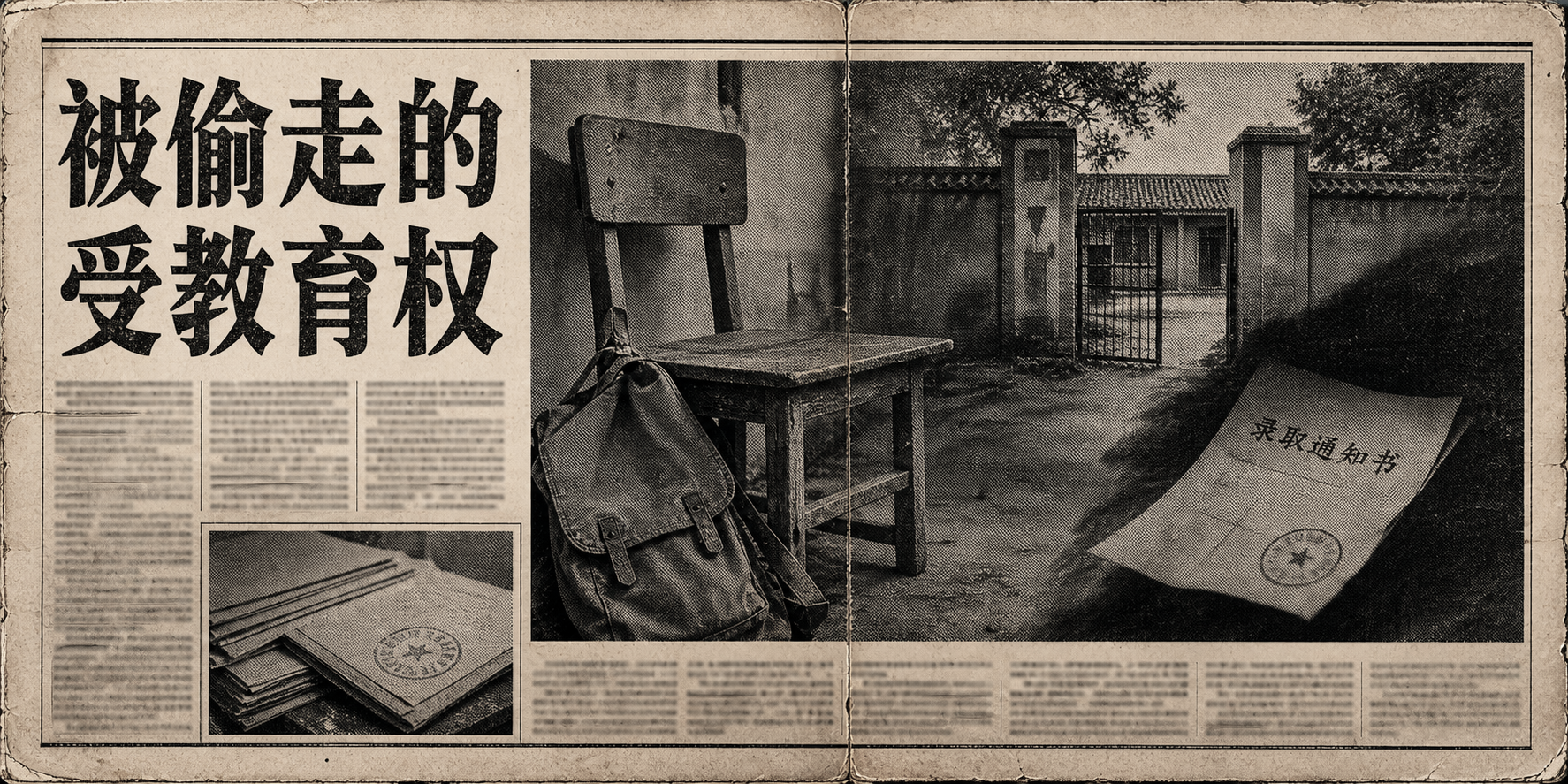
This is the transcript of episode 13 of my podcast Reasoned Talk (议正言辞). Listen on Xiaoyuzhou or Apple Podcasts . The episode is in Chinese; this transcript has been translated into English.
At the end of 1998, in Tengzhou, Shandong, a woman in her twenties named Qi Yuling had a strange encounter. A bank employee she had never met came to congratulate her. Qi was baffled. When she pressed for an explanation, she learned that another person at the bank had exactly the same name: “Qi Yuling.”
Qi later saw a photograph of this other “Qi Yuling.” The woman was Chen Xiaoqi, a former classmate from Tengzhou No. 8 Middle School. Eight years earlier, the two had attended the same school. Now Chen was working at a bank under Qi’s name.
Chen’s father, Chen Kezheng, then the village Party secretary, sent someone to offer Qi 5,000 yuan to settle the matter privately. Qi refused. Chen Kezheng and others then harassed and intimidated her family. Qi later told the media that she felt her life had been “stolen.”
She eventually chose to sue. In January 1999, Qi filed a complaint with the Zaozhuang Intermediate People’s Court in Shandong. For the first time, an identity substitution concealed for almost a decade entered a courtroom. No one expected the case to reach the Supreme People’s Court and become known as “China’s first case of judicial application of the Constitution.”
Episode 8 discussed the birth of judicial review in the United States through Marbury v. Madison, the ingenious decision in which the U.S. Supreme Court claimed authority to interpret the Constitution. After that episode, a listener asked me privately: Can China’s Supreme People’s Court interpret the Constitution? Does China have its own Marbury v. Madison?
The Qi Yuling case is often compared with American judicial review. Some call it the first Chinese case in which a court invoked the Constitution to protect a citizen’s fundamental rights. Others regard it as no more than an individual judicial reply whose significance was exaggerated. Seven years later, the reply was repealed, seemingly returning everything to where it began.
But was it really so simple? Why did a one-sentence reply from the Supreme People’s Court provoke years of debate? Why was it quietly repealed seven years later? Behind the reply lies a revealing period in which the Chinese judiciary explored whether the Constitution could be used in deciding an individual case.
Eight Stolen Years
The story began in the spring of 1990.
That year, Shandong held a province-wide entrance examination for technical secondary schools. Seventeen-year-old Qi Yuling attended Tengzhou No. 8 Middle School. She passed the preliminary selection, sat for the examination, and scored 441—above the admission threshold for the accounting program at Jining Commercial School. At the time, admission to such a school could transform a rural girl’s prospects: it could bring urban household registration and an assigned job after graduation.
Qi never received her admission notice.
Chen Xiaoqi had been in the same year at Tengzhou No. 8 Middle School. She failed the preliminary selection and was not eligible to take the entrance examination. Yet, through arrangements made by her father and with the cooperation of personnel at the schools and local education authority, Qi’s admission notice from Jining Commercial School ended up in Chen’s hands.
This was not simply a matter of taking someone else’s letter. To enroll Chen under Qi’s identity, the participants falsified school records, medical forms, and identity information. They facilitated the substitution at multiple stages, including admission review and the transfer of student files.
In the autumn of 1990, Chen entered Jining Commercial School as “Qi Yuling.” She graduated in 1993 and later found work at a bank under Qi’s identity.
The real Qi had never been told her examination score or the qualifying score for a sponsored placement. Without an admission notice, she believed that she had failed. She worked in agriculture and repeated a year of study. In 1993, she paid a 6,000-yuan surcharge to obtain urban household registration and enrolled in a labor technical school. In 1996, she was assigned to the Shandong Lunan Ferroalloy Factory, but was soon laid off during restructuring. She survived by selling breakfast food and simple meals.
Admissions administration in the 1990s depended on paper files and manual review. China had no nationwide online student-record system and no electronic identity verification. A stolen admission notice, altered file, and assumed identity could be difficult to detect. Rural students such as Qi had limited access to policy information and often did not know where to verify a result or file a complaint.
As a village Party secretary, Chen Kezheng possessed more information and had access to school and education officials. A grassroots official used institutional information asymmetry and personal connections to engineer the substitution.
The case therefore posed a basic question: if an ordinary person did not even know that someone had stolen her educational opportunity, how could the law protect her? Qi’s encounter at the bank in late 1998 changed the course of her life again. She learned the truth, rejected a private settlement, and went to court.
From the Right to a Name to the Right to Education
Qi filed suit in January 1999. On May 31, the Zaozhuang Intermediate People’s Court issued its first-instance judgment. It found that the defendants had falsified records so that Chen could enroll under Qi’s identity and had therefore infringed Qi’s right to her name. But the court held that there was insufficient evidence for her claim that her right to education had been violated. The judgment characterized the right to education as part of a citizen’s general personality rights, yet stated that the evidence showed Qi had “in fact given up the opportunity” to pursue a sponsored placement. Because she did not contact a sponsoring institution or pay the relevant fee, the court reasoned, she had not proved an infringement of her right to education.
The Shandong High People’s Court later found no evidence that Tengzhou No. 8 Middle School had told Qi either her examination score or the qualifying score. Although she had indicated before the examination that she would accept a sponsored placement, she did not know she had been admitted. How could she contact a sponsoring institution or pay a fee for an admission she did not know existed?
The first-instance court ordered Chen to stop infringing Qi’s right to her name. It also ordered Chen, her father, Jining Commercial School, Tengzhou No. 8 Middle School, and the local education authority to apologize and pay 35,000 yuan for emotional distress. It rejected Qi’s remaining claims for economic loss and additional damages.
Qi appealed to the Shandong High People’s Court.
The appeal presented a crucial procedural problem. Had the defendants infringed only Qi’s right to her name? Or, by using that infringement as their means, had they violated a more fundamental right—the constitutional right to education? If so, could conduct that formally violated the right to a name but substantively violated a constitutional right generate civil liability?
This was not an abstract exercise in wording. The civil law then in force expressly protected the right to a name: Article 99 of the General Principles of the Civil Law prohibited the appropriation or false use of another person’s name. But it contained no corresponding provision on the right to education.
That right appeared in the Constitution. Article 46 states: “Citizens of the People’s Republic of China have the right as well as the duty to receive education.” Could judges invoke such a constitutional-rights provision in a civil case? Chinese judicial practice had no clear answer.
The Shandong High People’s Court did not decide the matter on its own. Acting under the Organic Law of the People’s Courts, it requested guidance from the Supreme People’s Court. Its central question was whether a person who used infringement of the right to a name as the means of violating the constitutionally protected right to education should bear civil liability.
A One-Sentence Reply
The request remained at the Supreme People’s Court for almost two years. Its Adjudication Committee adopted a reply in June 2001. The document was formally published on July 24 and took effect on August 13 as Judicial Interpretation [2001] No. 25.
The substantive reply was one sentence long:
By infringing the right to a name, Chen Xiaoqi and the others infringed Qi Yuling’s fundamental right to education as enjoyed under the Constitution and caused specific harmful consequences; they shall bear the corresponding civil liability.
That sentence provoked years of controversy in Chinese legal scholarship and practice.
It mattered for three reasons.
First, a formal judicial interpretation expressly referred to a “fundamental right enjoyed under the Constitution” and used it in determining civil tort liability. That was a significant departure in Supreme People’s Court practice.
Second, it recognized that infringement of a constitutional right could trigger civil liability. Constitutional rights were not wholly unavailable in a concrete civil dispute—at least not in this case.
Third, it supplied a framework for legal characterization. The conduct appeared to infringe only the right to a name, but in substance it violated the more fundamental right to education. Moving from form to substance gave lower courts a possible model for similar disputes.
One qualification is essential. The reply did not grant ordinary courts authority to review legislation for constitutionality. It said that infringement of the constitutional right to education could create civil liability; it did not invalidate a statute or regulation. The case remained within the framework of civil tort liability. It was not an exercise of constitutional review.
Later media accounts and academic commentary often described the case as the first time a Chinese court used the Constitution to decide a case, or as the beginning of judicial application of the Constitution. Those descriptions have some basis, but they can mislead unless one distinguishes invoking constitutional reasoning from exercising constitutional review.
The reply located Qi’s right to education in Article 46 of the Constitution and held that the defendants’ identity substitution had violated it. It neither reviewed another legal rule for constitutionality nor issued a formal, abstract constitutional interpretation. Yet whether giving a constitutional right consequences in an individual civil case already amounted in substance to interpreting and applying the Constitution became the heart of the later dispute.
Some scholars called the method an “indirect application” of the Constitution: constitutional values and rights supplied the foundation, while civil tort liability delivered the remedy. Others argued that the Shandong High People’s Court went beyond value guidance by listing Article 46 directly among the grounds for judgment. Whether the case directly applied the Constitution or indirectly protected a constitutional right through civil law has never had a universally accepted answer.
The Final Judgment and Belated Compensation
After receiving the reply, the Shandong High People’s Court issued its final judgment on August 23, 2001. It changed important parts of the first-instance result. The court held that the defendants’ conduct “appeared in form as an infringement of the right to a name, but in substance infringed Qi Yuling’s fundamental right to education under the Constitution.” Relying on Article 46 of the Constitution, the Education Law, the General Principles of the Civil Law, the Supreme People’s Court reply, and the Civil Procedure Law, it partially vacated and modified the earlier judgment.
The damages had three components. The first was 7,000 yuan in direct economic loss, covering expenses such as repeated schooling, the urban-registration surcharge, and litigation. The second was 41,045 yuan in indirect economic loss, calculated from wages Chen received under Qi’s name between 1993 and 2001 after deducting necessary living costs. The third was 50,000 yuan for emotional distress, the maximum under the Shandong High People’s Court’s standard at the time. The total was 98,045 yuan. Jining Commercial School, Tengzhou No. 8 Middle School, and the local education authority bore joint and several liability for the relevant sums.
From 35,000 yuan at first instance to almost 100,000 yuan on appeal, and from a finding that Qi had given up the opportunity to an acknowledgment that her constitutional right had been violated, Qi won the lawsuit in an important sense. Even so, no one could call the award an equivalent return for eight stolen years.
The judgment also exposed systemic failures in admissions administration. Jining Commercial School failed to prevent an impostor from enrolling. Tengzhou No. 8 Middle School and the local education authority failed at stages including delivery of the admission notice, review of student files, and later handling of records. Multiple parts of the local education system failed at once.
The case drew intense media attention. Before internet access was widespread, newspapers and television turned school-admission identity substitution into a major public issue. Many similar revelations in later years showed that Qi’s experience was not an isolated anomaly.
For Qi, the final judgment ended the lawsuit. For Chinese law, the controversy surrounding the Supreme People’s Court reply was only beginning.
Three Views of Constitutional Application
The first position can be called the constitutional breakthrough view. It treats the Qi Yuling case as the first Chinese case in which a court used a constitutional provision to protect a citizen’s fundamental rights. Huang Songyou, then chief judge of the Supreme People’s Court’s First Civil Division, wrote that the case had “created a precedent for judicial application of the Constitution.” Media accounts quickly labeled it “China’s first case of constitutional judicialization.”
On this view, the Constitution should not remain a declaration on paper. If courts cannot even acknowledge a constitutional right when it is violated, what practical meaning does that right possess? The reply was a positive signal: in a concrete case, courts could and should attend to constitutional protection of citizens.
The limitation is that this view may exaggerate an individual case. A reply to a specific request is not the same as an institutionalized mechanism for constitutional application. Calling the case the beginning of constitutional judicialization can imply that Chinese courts acquired something like American judicial review. The reply did no such thing.
The second position is the civil law is sufficient view. It regards Qi’s loss as an ordinary civil tort that required no constitutional intervention. The identity substitution plainly infringed her right to a name and might even have involved criminal conduct, but compensation could still be handled within civil and criminal law.
This is a pragmatic position. The General Principles of the Civil Law already protected the right to a name and imposed tort liability, while the later Civil Code provides still more complete rules. There is no need to enter a grand and difficult dispute about applying the Constitution if ordinary law supplies a cause of action.
Its weakness is that it overlooks the constitutional character of the interest asserted. Qi lost more than control over her name. She lost an education, a fundamental right expressly guaranteed by the Constitution. Civil law at the time left a gap in protecting that interest; the constitutional provision was introduced precisely to fill it.
The third position is the institutional overreach view. It argues that direct reliance on the Constitution by the Supreme People’s Court could conflict with the constitutional authority of the Standing Committee of the National People’s Congress. Article 67 empowers the Standing Committee to interpret the Constitution and supervise its enforcement. If courts at every level could directly invoke and interpret the Constitution in judgments, that allocation of authority would be disrupted.
The concern has force. But the opposite rule produces its own problem: if courts are wholly prohibited from considering constitutional provisions, where can a citizen seek relief when a constitutional right is violated and ordinary legislation happens not to cover it? That dilemma is real.
The Horizontal Effect of Fundamental Rights
A deeper issue lies beneath these three positions: whether constitutional rights bind private actors. Constitutional theory calls this the “third-party effect” or “horizontal effect” of fundamental rights.
Traditionally, fundamental rights constrain the state. The government may not arbitrarily invade freedom of expression or the right to education. This is a vertical relationship between the individual and the state. But Chen Xiaoqi and Qi Yuling were both private individuals. Could a constitutional right affect the private tort relationship between them? If it could, would the right operate directly, or indirectly through civil-law provisions?
German law recognizes theories under which fundamental rights influence private relationships indirectly through the general clauses of civil law. The United States has judicial review, but the state-action doctrine ordinarily prevents constitutional rights from binding purely private conduct. Different systems have developed different routes for bringing constitutional rights into private relationships; none can simply be transplanted into another.
One can understand the Supreme People’s Court reply as follows: the court invoked the Constitution, but the final judgment still imposed civil damages. The Constitution did not directly regulate the relationship between the private parties. It supplied guidance in principle, while civil law directly governed the tort. This partly resembles the German idea of third-party effect. The comparison remains tentative, however, because the reply did not articulate that logic—and the reply itself was repealed only seven years after taking effect.
Repealed Seven Years Later
In December 2008, the Supreme People’s Court Adjudication Committee adopted a decision repealing Judicial Interpretation [2001] No. 25. Seven years after it had been hailed as the opening of constitutional judicialization, that path ended. The official explanation consisted of only four Chinese characters: “application has ceased.”
The repeal triggered another wave of debate. Because the Supreme People’s Court offered no substantive explanation, scholars looked to the institutional background. Some argued that the Court lacked authority to issue a formal constitutional interpretation and therefore had to stop the practice. Others believed that, as civil legislation developed, an individual-case reply had become unnecessary. There is no authoritative answer as to which explanation is closest to the truth.
Repeal did not invalidate the final judgment in Qi’s case. But courts could no longer rely on the reply in later disputes. In 2016, the Supreme People’s Court’s rules on the preparation of civil judgments further specified that the Constitution could not be cited directly as a ground of decision, although its principles and spirit could be discussed in the court’s reasoning. Constitutional provisions could inform explanation, but not serve directly as adjudicative grounds.
The repeal reflects a deeper institutional tension. On one side, the Constitution is the fundamental law and guarantees citizens’ rights; those rights require some route from paper into practice. On the other, constitutional enforcement in China operates through the people’s congress system. Record-filing review, constitutional review, and authoritative legal interpretation are led by the people’s congresses. The role courts may play has always been limited.
The Qi Yuling reply was an experiment within that limited space. Without creating a system of judicial review, it sought a channel through which constitutional rights could enter civil adjudication. Its repeal at least shows that the channel did not receive sustained institutional support.
If the Case Happened Today
More than two decades later, how would Chinese law handle the same events today?
The 2001 reply has been repealed, but later legislation responds to the failures exposed by the case in several ways.
First is civil law. The Civil Code took effect in 2021. Its Book on Personality Rights systematically protects the right to a name and prohibits interference with, appropriation of, or false use of another person’s name. Its tort rules provide liability for infringement of civil rights and interests. A victim today could sue directly for infringement of the right to a name and seek cessation of the infringement, an apology, and damages. Even so, present law offers no simple, uniform method for valuing a lost educational or employment opportunity or proving causation.
Second is criminal law. Amendment XI to the Criminal Law, effective in 2021, created the offense of identity substitution in admissions, now Article 280-2 of the Criminal Law:
Whoever steals or falsely uses another person’s identity to take that person’s place in obtaining admission to higher academic education, eligibility for civil-service employment, or employment-placement benefits shall be sentenced to imprisonment of not more than three years, criminal detention, or public surveillance, and shall also be fined.
The new offense followed concentrated media exposure of university-admission substitution cases between 2018 and 2020, including the Gou Jing case in Shandong. In July 2020, a group of lawyers submitted a proposal to the Standing Committee of the National People’s Congress. They wrote that taking another person’s university place “uses infringement of the right to a name as the means of infringing the constitutionally protected right to education”—language drawn directly from the 2001 reply. The legal framing of the Qi Yuling case still shaped legislative discussion two decades later.
The criminal offense applies, in the education context, to admission to higher academic education. Qi’s case involved admission to a technical secondary school. If the same conduct occurred today, Article 280-2 ordinarily would not apply directly. Whether conduct also constituted an offense involving forged or altered official documents would depend on the particular facts and could not be assumed categorically.
Third are the Education Law and administrative controls. Article 77 of the Education Law, as revised in 2021, specifically provides legal consequences for stealing or using another identity to take an admission place. It refers generally to an “admission qualification,” not only higher education, and can therefore reach technical secondary schooling. Student-record systems and identity-verification mechanisms have also made substitution more difficult. A victim may ask education authorities to investigate. Where legal requirements are met, she may seek administrative reconsideration or bring administrative litigation against a specific administrative act or a failure by an agency to perform its lawful duty.
If the Qi Yuling case happened today, the victim could use the Civil Code to sue for infringement of the right to a name and request cessation, apology, and damages. She could report the matter to police for investigation of any suspected offense. She could ask education authorities to act and, in an appropriate case, pursue administrative reconsideration or litigation. Ordinary law now provides more avenues of relief than it did in 2001. That does not mean every loss can easily be made whole.
A deeper question remains. Can better ordinary legislation fully replace protection of constitutional rights? Once legislation becomes detailed enough, is there no longer any need to advance judicial application of the Constitution?
I do not think so.
Ordinary legislation answers whether a victim has a specific legal provision on which to rely. A constitutional right carries a more fundamental commitment. It tells every person in the country that the right to education is not a temporary gift from an ordinary statute, but a basic right recognized and protected by the Constitution. Ordinary law depends on that underlying commitment.
The Qi Yuling case still matters not merely because it is called a “first case,” but because it poses an unresolved question: how should a right stated in the Constitution be protected and realized in a dispute between private parties?
There is no standard answer. The reply in Qi’s case briefly opened a door. That route is now closed, but the question has not disappeared.
Returning to Qi Yuling
After the final judgment, Qi received a little over 98,000 yuan. It was a substantial sum in 2001, but money could not restore the education she lost or the path her life might have taken. In 2013, media coverage of other admissions-substitution cases revisited her “stolen life.” Since then, reliable public reporting about her personal life has been scarce. The person herself has gradually receded from the constitutional case debated in her name.
Nor do public sources provide complete and reliable accounts of what later happened to Chen Xiaoqi, Chen Kezheng, or the other responsible individuals.
The case left more than a repealed judicial interpretation or a passage in a constitutional-law textbook. It left the life of a specific, ordinary person—a life altered beyond repair, and one that therefore forced the public to reflect on institutions.
More than thirty years after the substitution, the Qi Yuling case remains a mirror of one advance and retreat in Chinese adjudication. Law does not operate in a vacuum. People make it, and it ultimately serves people. It is repeatedly contested, repaired, and rewritten among competing values. The Qi Yuling case is only one point on that long road. Perhaps it is through the accumulation of such points that society moves a little closer to justice.
Key Figures
- Qi Yuling (originally named Qi Yuling with a different final character, 齐玉玲) — A rural woman from Tengzhou, Shandong. After finishing middle school in 1990, a classmate assumed her identity and enrolled in a technical secondary school. Her name and identity were used for eight years. She sued in 1999 and received more than 98,000 yuan after the Shandong High People’s Court’s final judgment in 2001. Her case prompted the Supreme People’s Court reply on the constitutional right to education and became known in scholarship and the media as “China’s first case of constitutional judicialization.”
- Chen Xiaoqi (formerly Chen Hengyan) — Qi’s classmate at Tengzhou No. 8 Middle School. After failing the preliminary selection in 1990, she obtained Qi’s admission notice through arrangements involving her father and others, enrolled at Jining Commercial School under Qi’s identity, graduated, and found employment.
- Chen Kezheng — Chen Xiaoqi’s father and then a village Party secretary. He played a central role in arranging his daughter’s enrollment under another identity. Media reports state that, after Qi discovered the truth, he offered 5,000 yuan for a private settlement and Qi’s family later faced violent harassment.
- Huang Songyou — Then chief judge of the Supreme People’s Court’s First Civil Division. After the reply was published, he wrote that it had pioneered judicial protection of fundamental rights enjoyed under the Constitution. He became a leading advocate of the constitutional-breakthrough interpretation.
Key Concepts and Legal Documents
- Article 46 of the Constitution — “Citizens of the People’s Republic of China have the right as well as the duty to receive education.” The Supreme People’s Court reply recognized Qi’s right to education under the Constitution, and the Shandong High People’s Court expressly cited the article in its final judgment.
- Judicial Interpretation [2001] No. 25 — The Supreme People’s Court reply adopted on June 28, 2001. Its one-sentence answer held that Chen and the other defendants had used infringement of the right to a name as the means of infringing Qi’s constitutional right to education, causing concrete loss and giving rise to civil liability. It was repealed in December 2008 because its “application had ceased.”
- Judicial application of the Constitution — The use of constitutional norms in judicial proceedings or judicial remedies for constitutional rights. Some scholars regarded the reply as a precedent, but it did not confer constitutional-review authority on courts. Whether it represented direct or indirect application remains disputed.
- Constitutional review — The power to determine whether legislation or exercises of public authority conform to the Constitution and to impose consequences for inconsistency. In China, authority to interpret the Constitution belongs to the Standing Committee of the National People’s Congress, while supervision of constitutional enforcement is led by the National People’s Congress and its Standing Committee. Ordinary courts do not possess American-style judicial review, and the Qi Yuling reply did not create it.
- Horizontal or third-party effect of fundamental rights — The question whether constitutional rights influence relations between private parties. The Qi Yuling case asks whether the constitutional right to education can have legal effect in a private tort committed by Chen against Qi.
- Article 99 of the General Principles of the Civil Law (1986) — It protected citizens’ right to decide, use, and lawfully change their names, and prohibited interference, appropriation, or false use. The first-instance court relied on it to find infringement of Qi’s right to her name.
- Articles 1012 and 1014 of the Civil Code — Article 1012 recognizes a natural person’s right to a name. Article 1014 prohibits interference with, appropriation of, or false use of another person’s name. The Civil Code was enacted in 2020 and took effect on January 1, 2021.
- Article 280-2 of the Criminal Law — Added by Amendment XI, it criminalizes taking another person’s place in obtaining admission to higher academic education, civil-service eligibility, or employment-placement benefits. Its education branch is limited to higher academic education and does not directly cover the technical secondary school involved in Qi’s case.
- Article 77 of the Education Law — It specifies consequences for stealing or using another person’s identity to obtain an admission place, including cancellation of admission or credentials, disciplinary measures, and other legal responsibility. “Admission” is not limited to higher education.
- The 2008 cleanup of judicial interpretations — Judicial Interpretation [2008] No. 15 repealed 27 judicial interpretations, including the 2001 reply. The official reason was only that its “application had ceased.” Scholars have proposed institutional limits on constitutional interpretation and the development of ordinary legislation as possible explanations.
- Rules for citing legal authority in judgments — After the 2001 reply was repealed, it could no longer serve as a ground of decision. The 2016 Rules on the Preparation of Civil Judgments further specified that the Constitution could not be cited directly as adjudicative authority, although its principles and spirit could be discussed in judicial reasoning.