Over the course of three days, police woke Jerry Lee six times.
He was living in a van. Each time the police arrived, they cited him for “camping within the city limits.” He would drive away, wait for the officers to leave, and then return to the same place to sleep. A police report noted that Lee “continues to disregard the city ordinance” and returns to the van as soon as the police leave. The day shift, it added, should check the van again and prepare to have it towed.
Justice Sonia Sotomayor included this episode in her dissent in City of Grants Pass v. Johnson. It reads like an absurd cycle: the police successfully stopped Lee from sleeping outside six times, yet none of those interventions gave a person without housing anywhere to live. He simply left for a while, then returned in the darkness when he needed to sleep again.
The problem began with a blanket.
In Grants Pass, Oregon, a person may be “camping” under the city code if they place a blanket, sleeping bag, or other bedding in a public place for the purpose of maintaining a temporary place to live. An initial violation can bring a fine. Repeated citations can result in a thirty-day exclusion from city parks. Violating an exclusion order may then constitute criminal trespass, punishable by as much as thirty days in jail and a $1,250 fine.
In Episode 14 of Reasoned Talk, we began with Papachristou v. City of Jacksonville and explained why the vagueness of traditional vagrancy laws ultimately drove them from the statute books. But if the law no longer punishes a “vagrant” directly and instead punishes the act of sleeping on the street, has it really completed the transition from status to conduct?
In 2024, Grants Pass gave local governments a fairly permissive answer. One year later, President Donald Trump signed Executive Order 14321, translating that answer into a policy agenda encompassing federal grants, civil commitment, and housing programs.
Together, these two legal documents raise a more difficult question: when a person has nowhere else to go, does punishing them for sleeping in public regulate conduct, or does it drive a particular class of people away?
From “Homeless Person” to “Person Using Bedding”
Grants Pass is a small city in the American West with a population of roughly 38,000. At the time of the litigation, an estimated 600 people there were experiencing homelessness. The city had no public homeless shelter. The only organization offering beds was a religious rescue mission that required residents to abstain from smoking, attend religious services, and follow a range of rules governing work and daily life. For some people with disabilities, those unable to work, and those unwilling to accept the religious requirements, its beds were not available in practice.
The city’s camping ordinances, however, covered nearly every kind of public space. They prohibited sleeping on streets, sidewalks, and alleyways; setting up a “campsite” on public property; and camping or parking overnight in city parks. The two class representatives, Gloria Johnson and John Logan, usually slept in their vehicles. If they used bedding and treated a vehicle as a temporary place to live, they too could fall within the prohibition.
Their lawsuit relied on the rule adopted by the U.S. Court of Appeals for the Ninth Circuit in Martin v. City of Boise in 2018. That decision held that when the number of people experiencing homelessness in a city exceeds the number of practically available shelter beds, the government may not prohibit “involuntarily homeless” people from sleeping in public. A person must sleep somewhere. If no indoor space is available, sleeping outside is not a choice that can simply be abandoned.
The federal district court followed that reasoning. It found that the homeless population in Grants Pass exceeded the number of practically available shelter beds and enjoined the city from enforcing its camping ordinances against those individuals. The Ninth Circuit affirmed. For many cities in the American West, this imposed a firm limit on enforcement: when the number of people experiencing homelessness exceeded the available shelter beds, the government could not prohibit those people from sleeping outside without potentially violating the Eighth Amendment.
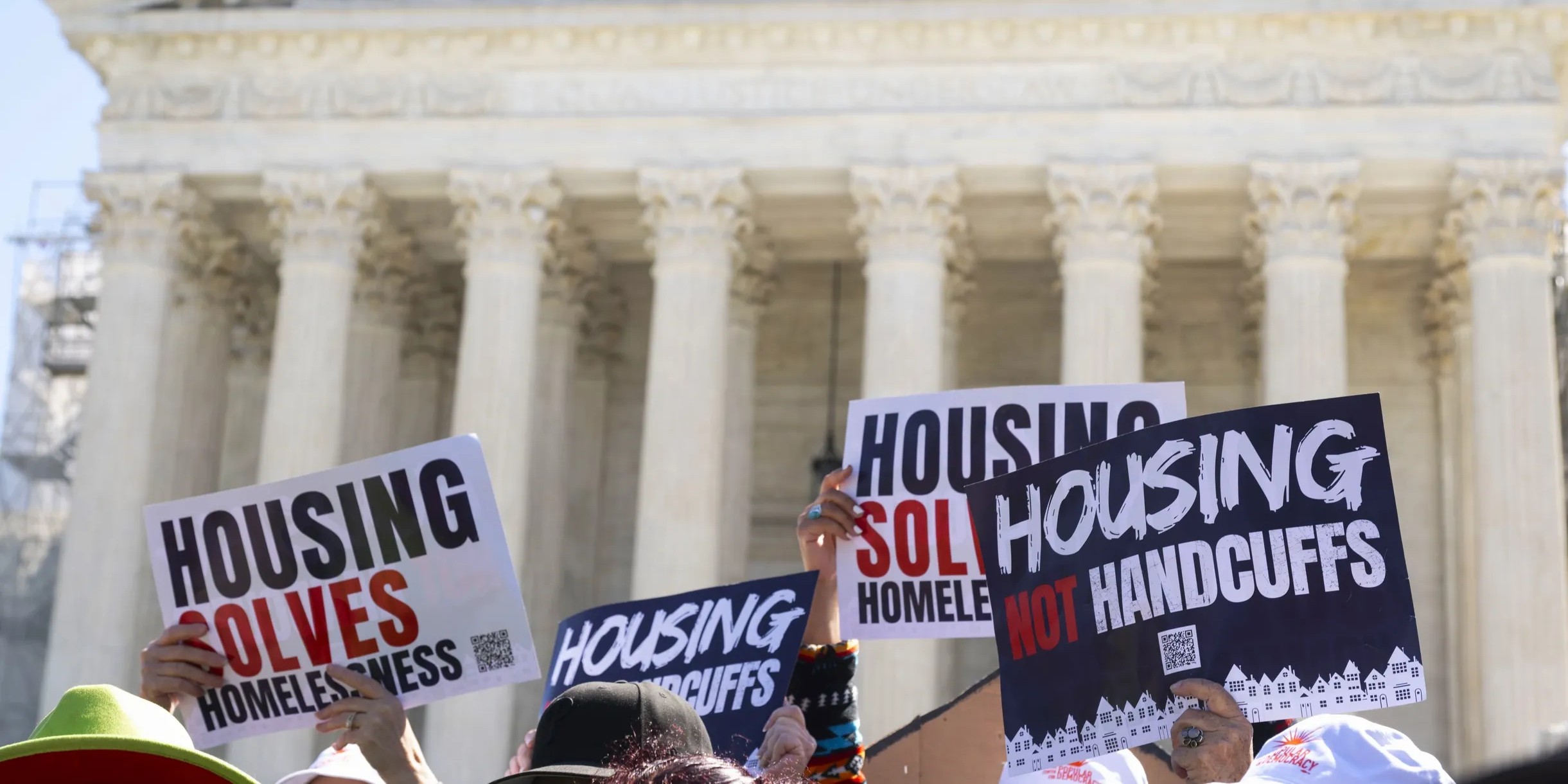
Grants Pass appealed to the Supreme Court. On June 28, 2024, the Court reversed by a vote of 6–3.
The central dispute was not whether tents affected the environment, or whether the city should build more shelters. It concerned a seemingly abstract legal classification: did the ordinances punish the status of homelessness, or the conduct of camping on public property?
“Status” Cannot Be a Crime, but “Conduct” Can
In Robinson v. California in 1962, the Supreme Court confirmed that the state cannot punish a person merely for possessing a particular status or condition. California had made the condition of narcotics addiction itself a crime. The Court held that even one day in prison could not be imposed merely because a person had an illness or existed in a particular condition; doing so would amount to “cruel and unusual punishment” prohibited by the Eighth Amendment.
Six years later, however, Powell v. Texas drew a fine line between status and conduct. Powell had alcohol dependence, but he was not convicted for the status of being an alcoholic. He was punished for the act of being intoxicated in public.
The majority in Grants Pass followed that distinction. Justice Neil Gorsuch wrote that the ordinances applied to everyone on their face. A person without housing, a backpacker passing through town, or a student camping on the lawn of a municipal building in protest could all violate the same rule by camping in public. The law did not declare that “being homeless is a crime.” It prohibited an act with a conduct element.
The majority also emphasized that the Eighth Amendment’s Cruel and Unusual Punishments Clause primarily regulates the punishments that may be imposed after conviction. It is not a general instrument for reviewing what conduct a government may define as criminal. Other constitutional protections—including freedom of speech, equal protection, and due process—may constrain the state’s power to criminalize conduct. But on the specific question before the Court, the Eighth Amendment did not bar a generally applicable public-camping prohibition.
Sotomayor, writing for the three dissenters, saw the matter very differently. “Sleep is a biological necessity, not a crime,” she argued. For someone with a home, sleeping in a park may be avoidable: they can go home or stay in a hotel. For someone with no indoor place to go, however, refusing to sleep anywhere would require staying awake forever. Although the words “homeless person” did not appear in the ordinances, the conduct they prohibited was inseparable from the condition of having no home.
That was the real disagreement between the majority and the dissent. Reading the text of the ordinance, the majority treated “a person experiencing homelessness” and “a person camping in public” as separate categories. Looking at the conditions in which the law operated, the dissent saw status and conduct as two sides of the same coin whenever a person had no alternative. The majority focused on the legal text itself; the dissent focused on the law’s social effect.
The Supreme Court Did Not Give Cities a Master Key
It is tempting to summarize Grants Pass as holding that “the Supreme Court allows cities to punish sleeping outside.” That is not accurate.
First, the Court did not declare that public sleeping is a crime. Whether to enact a camping ban, where it should apply, whether to impose fines, and whether to provide designated camping areas remain matters for state and local decision-making. The Court held only that the Eighth Amendment itself does not prohibit the enforcement of ordinary camping restrictions.
Second, the Court reviewed only the claim under the Cruel and Unusual Punishments Clause. It did not decide whether the wording of the Grants Pass ordinances was so vague that it violated due process, or whether the city engaged in selective enforcement. Those practices could still violate other constitutional provisions; they simply fell outside the scope of the case.
The Court therefore preserved generally applicable camping prohibitions, but it did not give local governments unrestricted power to remove people experiencing homelessness. Cities must still ensure that their ordinances are sufficiently clear and that enforcement is not selective—for example, by overlooking a backpacker while targeting a person without housing for the same conduct. A mistake at either stage may still produce a constitutional violation. Grants Pass cleared away an Eighth Amendment obstacle to local enforcement against homelessness, but it did not hand cities a master key.
Executive Order 14321: Changing the Flow of Money Instead of Making Arrests
On July 24, 2025, Trump signed Executive Order 14321, titled Ending Crime and Disorder on America’s Streets. The order cited a 2024 point-in-time count showing that 274,000 people were sleeping on streets, in parks, and in other places not meant for habitation—the highest number on record. It then placed “endemic vagrancy” alongside disorderly behavior, sudden confrontations, and violent attacks, and described large numbers of people experiencing homelessness as affected by drugs and mental illness. The order’s central aim was to shift the policy emphasis from “how to provide housing” to “how to restore public order.” It used three policy tools to do so.
The first was federal funding. Rules governing urban camping, loitering, and squatting are principally enacted by state and local governments. A president cannot sign an executive order and directly command every local police department in the country to arrest people sleeping outside. Executive Order 14321 took a different route. It instructed the Departments of Justice, Health and Human Services, Housing and Urban Development, and Transportation to review their discretionary grant programs and consider prioritizing states and municipalities that actively address open drug use, urban camping, loitering, and squatting. It also directed the Justice Department, within the limits of existing law, to make funding available for encampment removals where public safety is at risk and local resources are inadequate. This is not a direct command, but it can have a tangible effect. A local government remains free not to pursue those policies, yet that choice may affect its position when competing for federal grants.
The second tool was civil commitment. The order directed the Departments of Justice and Health and Human Services to promote more flexible standards for involuntary commitment, institutional treatment, and step-down care. The target population included people with serious mental illness who may endanger themselves or others, as well as those living on the street who cannot care for themselves. Civil commitment is not a criminal conviction and is usually justified in the language of treatment and protection, but it still deprives a person of liberty. In O’Connor v. Donaldson, the Supreme Court made clear that the government cannot confine a person for a long period merely because that person has a mental illness. If the person is not dangerous and can live safely alone or with help from family or friends, the state has no authority to institutionalize them involuntarily. The executive order therefore cannot transform homelessness itself into a sufficient reason for hospitalization. Officials must still confront questions such as who presents a real danger, who truly cannot care for themselves, what evidence and procedures commitment requires, and whether supportive community alternatives exist outside an institution.
The third tool was a change in the basic logic of federal homelessness programs. For more than a decade, federal policy had broadly embraced a Housing First model. Its premise is that a person should first obtain stable housing, without sobriety, drug treatment, mental-health treatment, or a minimum income serving as a condition of entry. Once housing is stable, programs offer voluntary medical care, addiction treatment, and social support. Executive Order 14321 called for ending support for certain Housing First policies, increasing treatment and service-participation requirements, and directing more resources toward transitional housing and mental-health and addiction treatment. It also allowed housing programs, where legally permissible, to collect health information and share it with law-enforcement agencies in specified circumstances.
Taken together, the three tools form a coherent policy chain: on the street, camping bans and encampment removals restore order; after people leave the street, treatment, transitional placement, and self-sufficiency requirements replace priority access to permanent housing without preconditions; and for those considered unable to care for themselves or dangerous, civil commitment becomes more readily available. This is far more complex than a simple prohibition on sleeping outside, and it goes well beyond the holding in Grants Pass.
The Judgment Encouraged “Local Experimentation,” but the Order Uses Federal Money to Set a Common Direction
The Grants Pass majority repeatedly emphasized that state and local governments should be allowed to experiment with policies for addressing homelessness. Courts should not derive a single national formula for counting shelter beds from the Eighth Amendment and then place every city’s shelter capacity under continuing federal judicial supervision. From the perspective of federalism, that reasoning is understandable. New York, Los Angeles, and a small Oregon city plainly face different conditions. Local governments must balance the competing needs of people sleeping outside, nearby residents, businesses, children, and people with disabilities in public spaces. A court can hardly govern the entire country through one rule.
Executive Order 14321, however, introduced a subtle reversal. The Supreme Court had just removed a judicial constraint in the name of respecting local experimentation. The federal executive branch then began using grant priorities to encourage jurisdictions across the country to move in the same direction: greater camping enforcement, expanded civil commitment, and treatment-first policy.
The effects were concrete. In its grant documents, the Department of Housing and Urban Development expressly stated that Grants Pass had upheld the authority of local governments to prohibit public camping, and it urged local jurisdictions to work with law enforcement to reduce public camping and open drug use. In 2026, HUD announced approximately $4.04 billion in a new round of Continuum of Care funding, proposing to prioritize $1.3 billion for transitional housing and supportive services in pursuit of the goals emphasized in Executive Order 14321.
Yet a president’s ability to set a policy direction does not mean that an executive agency may bypass Congress and freely rewrite the lawful purposes and allocation procedures governing federal grants.
On June 29, 2026, the federal district court in Rhode Island vacated two related funding notices that HUD had issued in 2025. The court concluded that the department had abruptly changed its longstanding Housing First and grant-renewal policies without adequately explaining its decision or accounting for the reliance interests of affected parties. HUD had also missed the publication deadline imposed by law. Its actions were therefore “arbitrary and capricious” under the Administrative Procedure Act and unlawful.
The judgment did not invalidate Executive Order 14321 as a whole. It addressed a more basic question of administrative law: when a government agency writes the rules governing billions of dollars in grants, it must still obey the statutes enacted by Congress and follow legally required decision-making procedures. In 2026, HUD issued another funding plan, and a group of states and service providers again filed suit. As of this writing, the new round of litigation remains pending.
The Real Question
People experiencing homelessness are not inherently people with mental illness, drug users, or threats to public safety. At the same time, outdoor encampments can create genuine risks involving fire, sanitation, drugs, and public access. Describing every attempt to preserve order as persecution of the vulnerable fails to answer the legitimate concerns of city residents. But placing everyone who sleeps outside within a narrative of “crime and disorder” does nothing to resolve why people lose housing or how they can actually leave the street.
Traditional vagrancy laws addressed this growing problem by declaring that “a certain kind of person is guilty.” Modern laws rarely speak so directly. They prefer to prohibit particular forms of disorderly conduct. As a matter of legal language, that is progress. Yet progress in legal language does not automatically produce progress in the world. After receiving a citation, a person may simply move from one block to another. After an encampment is cleared, the people who lived there must still find another place to lie down. Civil commitment can help some people who genuinely need treatment, but under some conditions it may also turn “treatment” into another form of prolonged confinement.
In 1972, Papachristou told the police not to decide first that someone “looks suspicious” and then search a vague law for a charge. More than half a century later, Grants Pass allowed cities to punish camping through more precisely defined rules, and Executive Order 14321 pushed federal policy toward order enforcement and institutional treatment. But the oldest question remains: when the state says it is merely managing the street, is it responding to a concrete danger, or is it removing disfavored people from public view?
Key Cases and Concepts
- Robinson v. California — The Supreme Court held that a state may not make the status or condition of narcotics addiction itself a crime. The case is the principal source of the rule against punishing a pure status.
- Powell v. Texas — The Court declined to extend Robinson to public intoxication, making the case an important reference point for the later distinction between status and conduct.
- Martin v. City of Boise — The Ninth Circuit held that when practically available shelter beds are insufficient, a city may not punish involuntarily homeless people for sleeping in public. Grants Pass later rejected that rule.
- City of Grants Pass v. Johnson — By a vote of 6–3, the Supreme Court held that generally applicable public-camping ordinances regulate conduct rather than the status of homelessness and therefore do not violate the Eighth Amendment.
- Executive Order 14321 — Trump’s July 24, 2025 order, Ending Crime and Disorder on America’s Streets, uses federal grants, civil commitment, program conditions, and data policies to promote a homelessness strategy more heavily focused on order, treatment, and self-sufficiency.
- Housing First — An approach that places people experiencing homelessness in stable housing without making sobriety, treatment, or a minimum income a precondition. Supportive services remain available, but participation generally is not a prerequisite to housing.
- Civil commitment — Involuntary treatment or institutional placement outside the criminal-conviction process, generally based on dangerousness, serious mental illness, or inability to care for oneself. It remains constrained by due process and disability-rights law.
- Administrative Procedure Act — The federal statute requiring agencies to act within their lawful authority and to make reasoned, non-arbitrary decisions. It has become an important tool for reviewing measures adopted to implement Executive Order 14321.
This article is further reading for Episode 14 of Reasoned Talk, “Could Being Jobless Be a Crime? America’s Constitutional Reckoning with Vagrancy Laws .” If you have not yet listened to the episode, you can begin there for the story of Papachristou and the way traditional vagrancy laws turned a police officer’s subjective suspicion into arrest and conviction. If you have thoughts of your own, feel free to share them in the comments.