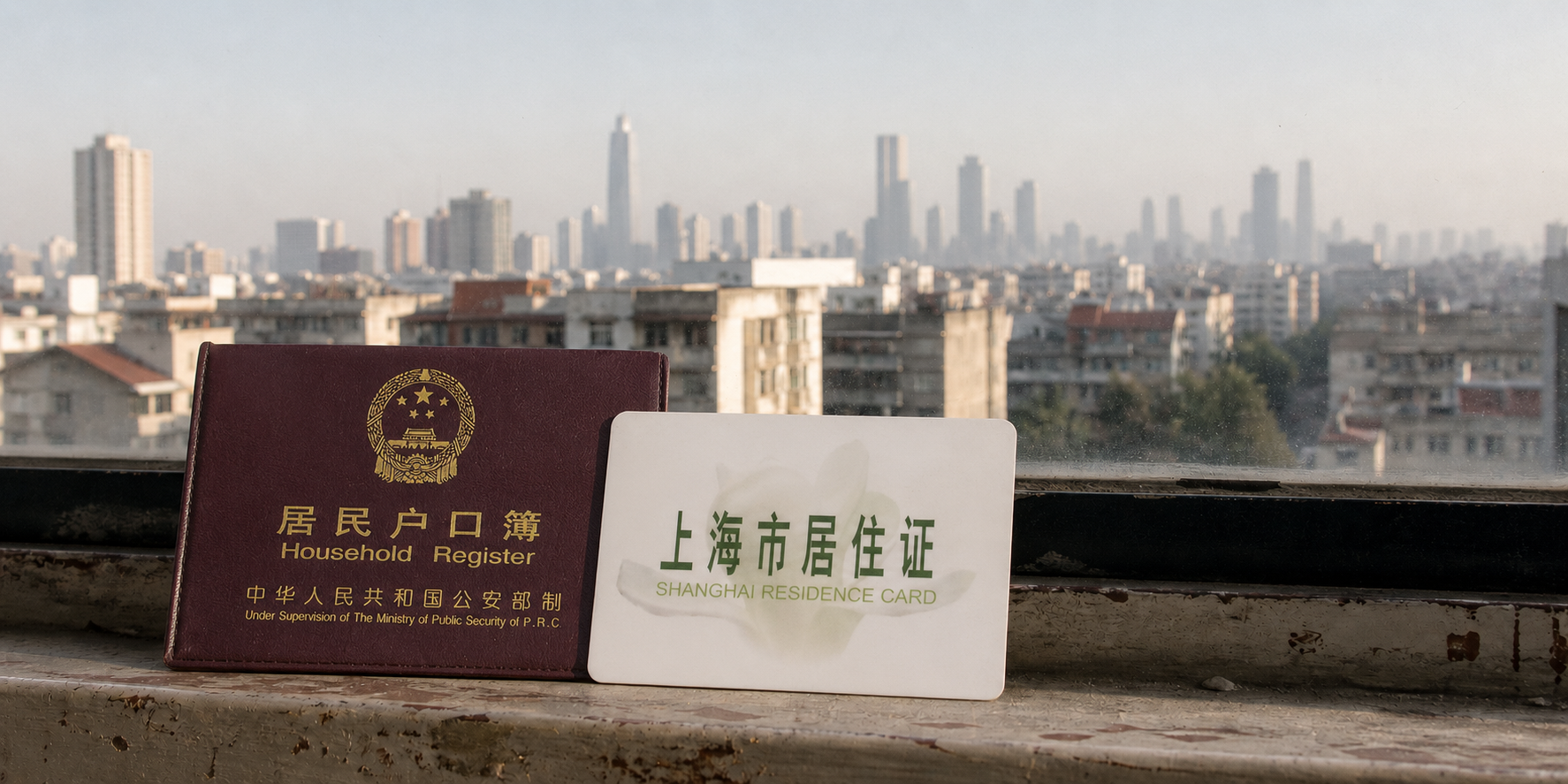
In 2016, a man in Shaoyang, Hunan, identified in the judgment only by his surname, Huang, sued the local branch of the public security bureau over a residence permit.
He was not a newcomer to Shaoyang. The court found that after marrying in 1996, Huang had moved there to live with his wife. They occupied a house beside the Tianjiangdu wharf, where he remained for twenty years. He made a living through casual work and street vending, while his household registration, or hukou, stayed elsewhere. The newly effective Interim Regulations on Residence Permits seemed to offer a possibility: with a residence permit, daily life, his children’s schooling, and access to employment would all become a little easier.
The police station did not issue him one. Their dispute ultimately came down to a somewhat absurd question: how could a person who had lived in one place for twenty years prove to an administrative agency that he really lived there?
Huang submitted his identity card, marriage certificate, testimony from neighbors, and a certificate issued by the village where his hukou was registered. The Interim Regulations on Residence Permits, however, required proof of an applicant’s address, employment, or enrollment in school. Huang could not produce a complete lease, property-ownership document, or proof of an employment relationship. In July 2016, the court dismissed his claim.
Few people know this case, but it is especially revealing when read after the Sun Zhigang case.
In 2003, Sun was wrongly swept into the custody-and-repatriation system because he did not have a “temporary residence permit.” Thirteen years later, Huang wanted the state to issue him a “residence permit,” only to be refused because his paperwork was incomplete. In Chinese, only one character in the name of the permit had changed. The relationship between the permit holder and the city, however, had changed with it.
“Temporary Residence” Began as Registration
Temporary-residence registration in the People’s Republic of China can be traced to the 1958 Household Registration Regulations, which remain in force today. Article 15 provides that when a citizen leaves the city or county of their permanent residence and stays in another city for more than three days, they must report for temporary-residence registration within three days and report again to cancel the registration before leaving.
What the regulations required was “registration,” not the “temporary residence permit” with which later generations became familiar. Household-registration authorities needed to know where a person came from, where they were staying, and when they left. A temporary residence permit had not yet become a document that people from elsewhere had to produce repeatedly when working, renting a home, or undergoing inspections in the city.
The regulations also contain an easily overlooked episode in Chinese legal history. The 1954 Constitution expressly guaranteed citizens freedom of residence and movement. During the drafting of the Household Registration Regulations, people asked whether registration and migration procedures would conflict with that constitutional right. The Ministry of Public Security specifically addressed the question in its explanation of the draft. The National People’s Congress website later described this legislative process as an early example in the history of the People’s Republic of conducting “constitutional review” of draft legislation.
The registration system on paper did not face its real test, however, until the period of reform and opening up.
In the 1980s, growing numbers of people left their hometowns to work in cities. Shenzhen illustrates the change particularly well. When the special economic zone was first established, Shenzhen had a registered population of only 76,200 but a permanent resident population of 314,100, which soon rose to 881,500. The city needed these builders, but it also urgently wanted to keep track of who they were.
In July 1983, Shenzhen adopted rules for issuing special-economic-zone temporary residence permits to people arriving from elsewhere. The Shenzhen Municipal Archives describes it as one of the earlier Chinese cities to implement such a permit system. Two years later, the Ministry of Public Security issued the Interim Provisions on the Administration of the Temporary Urban Population, and the temporary residence permit began to move from local experimentation toward nationwide use.
Was the Temporary Residence Permit a “Ticket into the City”?
In 1995, the Ministry of Public Security issued the Measures for the Application for Temporary Residence Permits, establishing uniform national rules for the system.
Under the measures, workers and business operators who were at least sixteen years old, had left the place of their hukou, and intended to live elsewhere for more than one month “were required to apply” for a temporary residence permit. Applicants for documents such as labor permits and business licenses had to present both an identity card and a temporary residence permit. Employers could not hire people without one. Permit holders were required to produce it when police inspected their documents. A person who still refused to register or obtain a permit after receiving notice could be warned or fined up to fifty yuan.
As originally designed, the temporary residence permit was a transitional measure through which the existing household-registration system responded to mass migration. For the first time, it allowed a rapidly moving population to be continuously recorded by urban administrative systems. It also gave people arriving from elsewhere a way to prove their identity and complete other formalities. In an era when people were pouring into cities over a short period and public services were still allocated mainly by hukou, urban administrators did need some form of transitional arrangement.
The problem was that the document gradually became more than the result of registration. It became a prerequisite for entering urban life. A person might have to show a temporary residence permit to find work, rent a home, or obtain a license. Even after living in a city for years, anyone whose hukou was elsewhere remained, in legal terms, only a “temporary resident.” Once the permit became entangled with street-level document checks, public-security campaigns, and custody and repatriation, “managing a population” could easily slide into “screening a population.”
Sun Zhigang encountered the most dangerous side of this system as it operated on the ground. Although the immediate focus of his case was the custody-and-repatriation system, the public also seized the moment to question the temporary residence permit system that had been in place for years.
The Shift from “Administration” to “Services”
The institutional turn had actually begun before the Sun Zhigang case. In 2002, Shanghai piloted a “talent residence permit.” In 2004, the city expanded the residence permit to cover more long-term residents arriving from elsewhere. The new document did more than record where a person was living. It connected the holder with specific benefits, including social insurance, compulsory education for children, professional qualification examinations, training, and public health services.
Shanghai’s pilot experience began to spread to other regions. In 2008, Shenzhen repealed its Regulations on the Household Administration of Temporary Residents in the Special Economic Zone and introduced new residence-permit measures. Guangdong implemented a province-wide residence permit in 2010. That same year, the State Council called for the gradual introduction of a residence-permit system throughout the country. Local approaches varied. Some emphasized recruiting talent, some relied on points-based administration, and some retained a strong public-security orientation. The overall direction, however, was becoming clear: the permit was to change from a simple instrument of population control into a vehicle connecting its holder to public services.
In 2014, the State Council’s Opinions on Further Advancing Reform of the Household Registration System called for the “full implementation of the residence-permit system.” One year later, the State Council promulgated the Interim Regulations on Residence Permits. In March 2018, the Ministry of Public Security formally repealed the 1995 Measures for the Application for Temporary Residence Permits. At the level of national administrative rules, the temporary residence permit had finally made its exit after more than two decades.
The principal difference between the 1995 and 2015 documents lies in the permit’s core function. The 1995 temporary residence permit was first and foremost “proof of temporary residence in another locality.” The 2015 residence permit, by contrast, was defined as proof that its holder lived in a particular place, enjoyed basic public services and conveniences there as a usual resident, and could apply to register a permanent hukou. The regulations expressly listed basic public services such as compulsory education, employment services, public health, cultural and sports programs, and legal aid. They also listed conveniences such as obtaining identity documents, registering a motor vehicle, applying for a driver’s license, and pursuing professional qualifications.
Only one Chinese character separates the names “temporary residence permit” and “residence permit,” yet the document’s main function shifted from “administration” to “services.” Applying for the permit also changed from a duty into a choice.
The old Measures for the Application for Temporary Residence Permits said that qualifying individuals “were required to apply.” The new Interim Regulations on Residence Permits provide that citizens who have lived in another city for more than six months and satisfy at least one of three conditions—lawful and stable employment, a lawful and stable residence, or continuous enrollment in education—“may apply” for a residence permit. The old measures required permit holders to produce the document during inspections and allowed authorities to fine people who refused to obtain one. The new regulations do not make the mere failure to apply for a residence permit punishable. Their penalties mainly target obtaining a permit by deception, misusing, buying, selling, or forging permits, and unlawfully confiscating another person’s residence permit.
Changing the name, of course, did not make every problem disappear. A residence permit is still not a hukou, and the public services that local governments can provide remain constrained by population size, fiscal capacity, and available resources. Points, length of residence, years of social-insurance contributions, and documentary requirements can all become barriers in practice. Huang’s case arose in precisely this gap. The court rejected his request because his materials were incomplete. As a matter of legal application, the judgment is not difficult to understand: an administrative agency issuing a permit needs standards that it can verify. Yet the case leaves a practical question behind. People who survive on casual work and live in informal housing are the least likely to have standard employment contracts and leases, even though they are often the people who need public services most.
How Much Further Must the Residence Permit Go?
In 2024, the State Council issued a five-year action plan for new urbanization. It called for closer integration between residence permits and national identity cards, with basic public services supplied by the place of habitual residence and gradually extended to everyone who actually lives there. In May 2026, the State Council issued its Opinions on Providing Basic Public Services at the Place of Habitual Residence. The document identified education for migrant children, public rental housing, enrollment in social insurance at the place of employment, health insurance at the place of habitual residence, employment services, and social assistance as priorities. It also called for electronic residence permits, more services available directly upon presentation of the permit, mutual recognition of permits across regions, and conversion of residence periods between jurisdictions.
The journey is not complete. Because local fiscal pressures are real, scarce public resources such as school places, subsidized housing, health insurance, and social assistance still remain primarily accessible through hukou. Whenever public resources are tight, decisions about reasonable eligibility thresholds—and about how to prevent a paper requirement from excluding people who genuinely live in a place—will continue to generate new legal disputes.
Yet looking back over more than four decades, the direction of change is clear.
In the 1980s, when cities confronted the sudden arrival of a vast migrant population, their first responses were registration, inspection, and the maintenance of order. Today, the policy debate is increasingly centered on a different question: can a person who lacks a local hukou but has lived in a city for years enjoy the same public services as a registered resident?
Key Institutional Milestones
- 1958, Household Registration Regulations: Established a unified national household-registration system; Article 15 required temporary-residence registration in cities.
- 1983, Shenzhen temporary-residence permit rules: An early effort to turn the administration of temporary residents into a permit system.
- 1985, Ministry of Public Security’s Interim Provisions on the Administration of the Temporary Urban Population: Extended the temporary-residence permit beyond local experimentation.
- 1995, Ministry of Public Security’s Measures for the Application for Temporary Residence Permits: Established uniform rules on who had to apply, document inspections, employment restrictions, and legal liability.
- 2002–2008, local residence-permit experiments: Shanghai, Shenzhen, and other cities gradually connected permits with education, social insurance, employment, and other services.
- 2014, State Council opinions on household-registration reform: Called for full implementation of the residence-permit system and for basic public services to cover permanent residents.
- 2015, Interim Regulations on Residence Permits: Established a national residence-permit system, effective January 1, 2016.
- 2018, Ministry of Public Security Order No. 148: Formally repealed the Measures for the Application for Temporary Residence Permits.
- 2026, opinions on basic public services at the place of habitual residence: Further promoted public services that move with people and expanded electronic permits, regional mutual recognition, and related functions.
This article is a companion to Episode 15 of Reasoned Talk. If you have not heard the episode, the full program explains how Sun Zhigang was wrongly taken into custody and how a tragedy helped bring the custody-and-repatriation system to an end. You are welcome to follow the WeChat public account “议正言辞” and to share your own memories of temporary residence permits and residence permits in the comments.