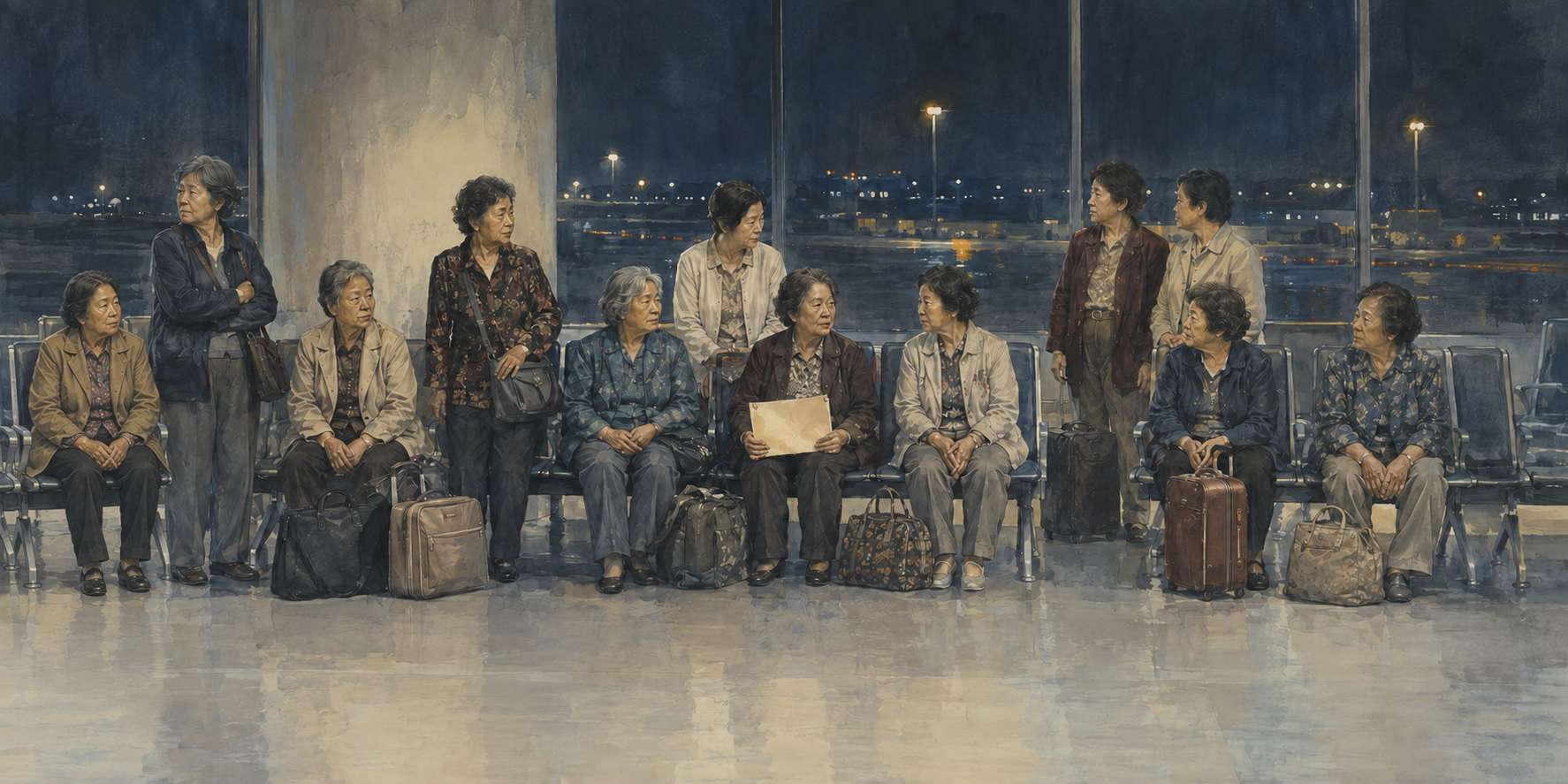
A Night at the Airport
On September 5, 1993, twelve Japanese women who had spent decades living in China arrived at Narita Airport.
They held Japanese passports and hoped to settle in Japan, but they had neither secured sponsors to receive them nor found places to live. Under the policy then in force, obtaining government assistance with travel and resettlement was difficult without a sponsor. Rather than wait any longer, they made their own way to Japan, carrying a petition addressed to the prime minister, and spent the night at the airport.
Their action became known as the kyōkō kikoku incident: a return undertaken in defiance of the usual procedures. The phrase referred to their decision to return before reception arrangements were complete. It did not mean that they had entered the country illegally.
Forty-eight years after Japan’s defeat, why did they still have to take such a step to live in their own country? The war had left all of them in China. Why, then, did war orphans gradually receive public attention while other women were long treated as people who had chosen to stay?
The Age of Thirteen
In Japanese administrative usage, Japanese people who were compelled to remain in China amid the upheaval surrounding the end of the war in 1945 are collectively known as Japanese people left behind in China.
One category is Japanese orphans left behind in China, the war orphans discussed in episode 16 of my podcast. Under the official criteria, these were people who had been separated from their guardians, or whose guardians had died, amid the chaos of war. They were generally under thirteen at the time, did not know identifying details such as their Japanese names or places of family registration, and remained in China as they grew up. Many were raised by Chinese families.
The rest were classified as women and others left behind in China. This category included not only women but also other people who did not meet the criteria for war orphans, although women made up the majority. The term “women” is retained here to reflect the administrative category used at the time.
Thirteen was not the legal age of adulthood, nor was age the only criterion for classification. Still, differences in age and knowledge of one’s identity shaped how these people were treated. Young children were seen as orphans whose relatives needed to be found. Women who were a little older, remembered their names, and had married in China were more readily assumed to have chosen to stay.
But in northeastern China in 1945, how much choice did they really have?
The Circumstances of Staying
These women had come to China for different reasons. Some had accompanied their parents as members of Manchurian settler groups. Others were settlers’ wives. Still others had responded to recruitment campaigns and traveled to northeastern China as “continental brides.”
In 1932, Japan established the puppet state of Manchukuo in northeastern China and subsequently sent a growing number of civilians to settle there. Many settlers were ordinary farmers, but the settlement program was part of Japan’s colonial policy, serving purposes of both occupation and defense. The land they received was not simply unclaimed wilderness; some of it had been farmland belonging to Chinese peasants. An account of these women’s later suffering cannot leave out that context.
Toward the end of the war, large numbers of able-bodied men in the settler communities were conscripted, leaving mostly older people, women, and children behind. On August 9, 1945, the Soviet Union entered the war against Japan, and the Red Army advanced into northeastern China. Many settler groups fled in haste. Some people died in the fighting, others during the flight, and still others from hunger, bitter cold, and disease in refugee shelters.
Those who survived first had to find a way to stay alive. Some children were entrusted to Chinese families, while some women found food, shelter, and protection by marrying Chinese men. The circumstances of each marriage differed. Some began as a means of survival in desperate conditions; some also developed into lasting bonds through years of shared life. They cannot all be described as coercion or exchange. Equally, the fact that a woman later married and had children does not establish that she originally had a free choice.
In 1953, Japan enacted the Act on Assistance for Families of Unrepatriated Persons and Others. It provided aid to families remaining in Japan and relief for some returnees. But its general definition of an unrepatriated person excluded those considered to be staying abroad of their own volition. Whether a person’s absence was deemed voluntary could therefore determine eligibility for assistance.
This did not mean that the law automatically disqualified every woman who had married a Chinese man. The real difficulty was deciding, after flight, hunger, and the separation of families, whether someone had been unable to return or unwilling to do so.
Help That Came Late
Japan and China normalized diplomatic relations in 1972. The following year, the Japanese government decided to cover travel expenses for the first temporary home visit by Japanese people left behind in China. In 1981, it began organizing group visits by war orphans to search for relatives. Television programs and newspapers carried their photographs and biographical details in the hope that someone would recognize a family member lost decades earlier.
In 1984, Japan and China exchanged diplomatic documents on the war orphans, confirming that they could return permanently if they wished, even if no relatives had been found in Japan. To put this arrangement into practice, the Japanese government introduced a resettlement sponsor system in 1985 for orphans whose identities had not yet been established.
Finding relatives, however, did not guarantee that anyone would receive them. Decades had passed. Parents might have died, and siblings had lives of their own. Some relatives feared the burden of supporting the returnees and their families and were unwilling to take responsibility for receiving them. This was a particular obstacle for women who had always known their identities.
In 1989, the government created a “special resettlement sponsor” system to find alternative sponsors for orphans whose identities had been established but whose relatives refused to receive them. It was not until 1991 that this system was extended to women and others left behind in China.
These sponsors primarily helped with preparations for return, coordination of resettlement, and everyday life. Their role was not to certify the returnees’ nationality. Such help was indeed necessary for older people who lacked housing and could not speak Japanese. But extending the system did not mean that a sponsor would immediately be found. As long as sponsors and places to settle remained unavailable, applicants had little choice but to keep waiting.
The Twelve Women Take Action
Morihiro Hosokawa’s cabinet took office in the summer of 1993. The new prime minister’s acknowledgment of Japan’s past wars of aggression led some of the women and their supporters to believe that a direct appeal might win his help. They decided to return to Japan without waiting for the government to complete the reception arrangements.
People who had long supported Japanese returnees through private aid efforts helped organize the action. The twelve women were led by sixty-nine-year-old Ms. Takekoshi. They prepared a petition to the prime minister, saying that some two thousand others in China also hoped to return and asking the government to give them the opportunity to come back to their homeland.
On September 5, the twelve arrived at Narita at their own expense. The youngest was fifty-six, the oldest eighty. They intended to petition the prime minister, but they were unable to take up their appeal with his office that day. With no accommodation arranged, they decided to spend the night in the airport lobby.
One detail needs clarification. Although the twelve are usually described collectively as “women left behind in China,” Masanobu Okitsu, a longtime supporter of returnees, has noted in his account of this history that eight belonged to that category and four were classified as war orphans. They did not all fall within the same administrative category, but all had faced difficulty securing arrangements for someone to receive them.
Maki Okubo, the Asahi Shimbun reporter who interviewed them at the airport, had been notified by a support group two days earlier. The story did not immediately become major news. The following day, however, the Asahi Shimbun and the Mainichi Shimbun gave it substantial coverage. Television news and morning programs followed, and more reporters arrived at the airport. The twelve women’s predicament quickly entered public view.
On September 6, Ministry of Health and Welfare officials took them to the Settlement Promotion Center for Japanese Orphans Repatriated from China in Tokorozawa, Saitama Prefecture. In a subsequent written response to the Diet, the government confirmed that they had entered the center and were receiving training to adjust to life in Japan. It was consulting them about their preferences and coordinating places for them to settle. Their night at the airport was over, but the question of how they would live in the years ahead remained unresolved.
Their action brought the practical barriers into sharp focus: twelve women holding Japanese passports had already arrived in Japan, yet they were still struggling to secure help with resettlement.
The State’s Responsibility
In a written response dated October 22, 1993, the Japanese government expressly denied that it regarded people as having remained in China voluntarily simply because they had been thirteen or older at Japan’s defeat. It said that thirteen was only a guideline for identity investigations and that repatriation assistance itself did not distinguish between orphans and women. Yet it continued to require resettlement sponsors, promising only to recruit more of them and arrange placements faster.
On November 9, Health and Welfare Minister Keigo Ouchi discussed the twelve women’s experience before the House of Representatives Committee on Health and Welfare. He described them as victims of history and said that the administration had to do more than speak politely: it needed to find ways to meet their requests. He also said that the state should approach the issue with a commitment to taking ultimate responsibility, including arranging sponsors and ensuring that no one was left out.
On December 15, Japan and China exchanged new diplomatic documents. The Japanese Ministry of Health and Welfare also announced a three-year plan, beginning in fiscal 1994, to receive Japanese people left behind in China who wished to return permanently as soon as possible.
On March 29, 1994, the Diet passed the Act to Facilitate the Repatriation of Japanese People Left Behind in China and Others and Support Their Self-Reliance after Permanent Return. It was promulgated on April 6 and took effect on October 1. This article uses the law’s title as originally enacted and refers to it below as the Repatriation and Self-Reliance Support Act.
Article 1 explicitly recognized that these people had been unable to return amid the upheaval caused by the war and had been compelled to remain abroad. Articles 3 through 5 set out the responsibilities of the national and local governments to facilitate their return and support their lives afterward. Subsequent provisions specified assistance with travel expenses, initial settlement grants, advice on daily life, Japanese-language learning, housing, employment, and education.
Not all of these forms of assistance were new, and the law was not the product of the twelve women’s action alone. Private support efforts, parliamentary questioning, and policy changes had been under way for years. The Narita incident made reform more urgent and helped give support that had largely depended on administrative measures a clearer statutory basis.
This was still not a law providing compensation for harm caused by the state. It established repatriation and living support; it did not resolve questions of war responsibility or damages. But it made one point clear: helping these people return and settle was a responsibility of the national and local governments, not something that could be left to relatives and volunteers alone.
After Returning
The women’s experiences are less widely known than those of the war orphans, but they were no fewer in number. As of July 31, 2026, Japan’s Ministry of Health, Labour and Welfare recorded 6,731 permanent returnees among Japanese people left behind in China: 2,557 war orphans and 4,174 women and others. These figures count the returnees themselves, excluding accompanying family members.
Changes to the system did not automatically remove the difficulties of life after return. Language, housing, income, and family relationships all required long-term support. Japan later amended the support law and introduced new pension and living-support measures in 2008. The 1994 legislation was an important step in that longer process.
We should, of course, respect people’s choices about their lives. But we must also recognize the circumstances in which those choices were made. The fact that a woman found a way to survive the war cannot justify treating the decades of separation that followed as her own responsibility.
Nor does returning to Japan erase her family and the life she built in China. Those experiences do not lose their significance when she sets foot on Japanese soil again. The freedom to return, to stay, and to continue living with family members from China: these are the choices that such long-delayed assistance should seek to protect.
People Mentioned
- Rie Takekoshi (竹越リヱ): Leader of the 1993 return, aged sixty-nine at the time. She contacted fellow participants, prepared the petition to the prime minister, and led the twelve women to Japan at their own expense.
- Maki Okubo (大久保真紀): An Asahi Shimbun reporter who interviewed the twelve women at Narita and continued to follow their lives after repatriation. Her reporting and later recollections are important sources on the incident.
- Morihiro Hosokawa (細川護熙): Became prime minister in 1993. His acknowledgment of Japan’s wars of aggression raised hopes among the women and their supporters that they might secure repatriation assistance. The twelve women addressed their petition to him.
- Keigo Ouchi (大内啓伍): Japan’s minister of health and welfare at the time. In a Diet response in November 1993, he said that the state should take ultimate responsibility for securing reception arrangements for returnees.
- Masanobu Okitsu (興津正信): A Japanese-language teacher with a long history of supporting returnees from China. In his account of the women’s history, he noted that the twelve participants comprised eight women in the administrative category of women left behind in China and four war orphans.
Laws and Concepts
- Japanese people left behind in China: Japanese people who were unable to return amid the upheaval surrounding the end of the war and were compelled to remain in China for many years. The group includes both war orphans and those classified as women and others.
- Japanese orphans left behind in China: People separated from their guardians, or whose guardians died, amid wartime upheaval, who were generally under thirteen at the time, whose identifying details were unknown, and who remained in China as they grew up. Thirteen was a guideline for identity investigations, not a legal threshold for adulthood. Subsequent identification did not remove a person from the war-orphan category.
- Women and others left behind in China: Those among the Japanese people left behind in China who did not fall within the war-orphan category. Most were women, but the category also included men. “Women” reflects the historical administrative terminology; it does not establish that those concerned had voluntarily remained in China.
- Resettlement sponsor: Known in Japanese as mimoto hikiukenin (身元引受人), a person who primarily helped with preparations before return, coordination of resettlement, and advice on everyday life afterward. Under the policy at the time, securing a sponsor was an important precondition for repatriation assistance. It was not a procedure for proving Japanese nationality.
- Special resettlement sponsor system: A system for finding alternative sponsors for people whose identities had been established but whose relatives in Japan would not receive them. Introduced for war orphans in 1989, it was extended to women and others in 1991. Wider eligibility did not mean that reception arrangements could be secured immediately.
- Act on Assistance for Families of Unrepatriated Persons and Others: Act No. 161 of 1953. Article 2 excluded people considered to be staying abroad of their own volition from its general definition of unrepatriated persons. It did not provide that marriage to a Chinese person automatically disqualified someone from assistance. See the text as originally enacted .
- Repatriation and Self-Reliance Support Act: The short title used here for the 1994 Act to Facilitate the Repatriation of Japanese People Left Behind in China and Others and Support Their Self-Reliance after Permanent Return. Articles 3–5 set out national and local government responsibilities; Articles 6–11 provide for travel expenses, initial settlement grants, advice on daily life, Japanese-language learning, housing, employment, and education. It concerns repatriation and living support, rather than compensation for harm caused by the state. See Act No. 30 of 1994 as originally enacted .
- The 2007 amendment and new support measures: Japan amended the support law in 2007 and introduced new pension, support-payment, and community-support measures in April 2008. These were later reforms and should not be read back into the original 1994 law. See the Ministry of Health, Labour and Welfare’s policy explanation .
References
The sources below are in Japanese; English titles are provided for reference.
- Maki Okubo, “The Determined Return of Japanese Women Left Behind in China: Witnessing the Power to Open a New Era” (中国残留婦人の強行帰国 時代を切り開く力を見た), Asahi Shimbun, June 2, 2013. Full text reproduced here .
- Masanobu Okitsu, “Do You Know About ‘Returnees from China’? Part 5: Japanese Women Left Behind in China” (「中国帰国者」って知っていますか? 第5回 中国残留婦人), Kazankai Foundation, March 13, 2023.
- Government of Japan, “Written Response to Questions Concerning the Permanent Repatriation of Japanese Women Left Behind in China” (中国残留婦人の永住帰国の実現に関する質問に対する答弁書), October 22, 1993.
- National Diet of Japan, Proceedings of the House of Representatives Committee on Health and Welfare, 128th Diet , November 9, 1993, response by Keigo Ouchi.
- Support and Communication Center for People Returning from China, “A Brief History of the Issue of Japanese People Left Behind in China” (中国残留邦人問題に関する略史).
- Memorial Museum for Peace: Japanese Settlers in Manchuria, “Brief Facts about the Manchurian and Mongolian Settlement Program,” with a chronology (満蒙開拓ミニ知識).
- Ministry of Health, Labour and Welfare, “Summary of Findings from the Survey of Living Conditions of Returnees from China” (中国帰国者生活実態調査結果の概要). The definitions of orphans and women and others appear at the end.
- Ministry of Health, Labour and Welfare, “Statistics on Japanese People Left Behind in China and Others” (中国残留邦人等の状況). This article uses the figures as of July 31, 2026.
Related Episode
This article offers further reading for episode 16 of Reasoned Talk, “Repatriation Was Not a Homecoming: Japan’s War Orphans and Their State Redress Lawsuits .” If you have not yet listened, the episode explores how more than two thousand repatriated war orphans used litigation to question the Japanese government’s responsibility for their return and resettlement. You are also welcome to follow my WeChat official account, 议正言辞 (Reasoned Talk), and share your thoughts in the comments.