This is the transcript of episode 19 of my podcast Reasoned Talk (议正言辞). Listen on Xiaoyuzhou or Apple Podcasts . The episode is in Chinese; this transcript has been translated into English.
On the evening of April 9, 1996, in Hohhot, Inner Mongolia, a young woman stepped out of a restaurant on Xilin South Road, saying she needed to use the toilet. A long time passed, but she did not return. Two factory workers were also having dinner nearby that evening. One had just turned eighteen. His name was Hugjiltu. After dinner, he and his colleague went their separate ways. As Hugjiltu passed a public toilet in the residential compound of the No. 1 Woolen Mill, he discovered the woman’s body. He immediately went back to his workplace, found the colleague he had eaten with, and ran with him to a nearby police post to report the crime.
No one could have imagined that reporting the crime would draw Hugjiltu into a catastrophe. According to local historical records, investigators concluded within roughly forty-eight hours of the crime that Hugjiltu, one of the men who had reported it, was the killer. He was placed under “custody and investigation” on April 12 and formally arrested on May 10. Just one month later, on June 10, he was executed. Only sixty-two days had passed since the crime.
This became the Hugjiltu case, one of the most widely known cases in Chinese legal history. Why did a young man who came forward to report a crime end up convicted of it? How could a murder case proceed all the way to execution in barely two months? What had gone wrong? This episode examines the case in detail.
Doubts About the Confession and Blood-Type Report
Later investigations established that Hugjiltu had indeed discovered the victim’s body in the women’s toilet on his own before finding his colleague and reporting it together. From the police’s perspective, he had been at the crime scene. With no other leads, someone in that position would naturally become a focus of attention. But suspicion alone was not enough. Identifying him as the killer required further, decisive evidence.
According to material subsequently made public, his conviction rested primarily on two pieces of evidence. The first was his own confession, in which he admitted violently sexually assaulting the victim, identified as Yang, and causing her death. The second was a blood-type report. Type O blood had been found beneath the nail of his left thumb, matching the victim’s blood type. Hugjiltu himself had type A blood.
On the surface, the confession and the laboratory report seemed to corroborate each other. A closer examination, however, revealed doubts. Hugjiltu said in his confession that he had suffocated the victim by covering her mouth with his hand. The autopsy attributed her death to asphyxiation caused by strangulation. The two accounts plainly did not match. And blood typing is not DNA profiling: it cannot identify a particular individual. Many people share a blood type. Finding type O blood under his thumbnail did not establish that it was the victim’s blood.
How, then, could such flawed evidence lead so quickly to a death sentence?
Severe and Swift Punishment in the Strike Hard Era
One point needs explaining. In the month before the crime, the National People’s Congress had passed a revised Criminal Procedure Law. But the new law would not take effect until January 1, 1997. Although already enacted, it was not yet in force. The law applicable to Hugjiltu’s case was therefore the older, 1979 Criminal Procedure Law.
Even that earlier law contained rules that later became familiar principles of criminal procedure. It expressly stated: “In deciding all cases, emphasis shall be placed on evidence and on investigation and study; confessions shall not be readily believed. A defendant cannot be found guilty and punished solely on the basis of a confession without other evidence.” It also expressly prohibited torture to extract confessions and forbade the collection of evidence “by threats, inducements, deception, or other unlawful means.”
Yet, as we have seen, apart from the blood-type and autopsy reports, the local police, procuratorate, and court relied above all on Hugjiltu’s confession. Material later made public also suggested that he may indeed have been tortured during interrogation. That raises the question: if the law already warned against relying on confessions and explicitly prohibited torture, why could the case be closed so quickly? Why did the Criminal Procedure Law fail to provide the protection it was supposed to offer?
To understand this, we need to return to the historical setting.
In 1979, the People’s Republic of China promulgated its first Criminal Law and Criminal Procedure Law. As reform and opening continued, public security subsequently deteriorated. In August 1983, the central leadership decided to launch a campaign to crack down on criminal activity, commonly known as “Strike Hard.” On September 2 that year, the Standing Committee of the National People’s Congress adopted the Decision on Procedures for the Speedy Trial of Criminals Who Seriously Endanger Public Security.
Article 1 provided:
To punish swiftly and severely criminals who seriously endanger public security, and to protect the interests of the state and the people, offenders who commit murder, rape, robbery, explosions, or other crimes seriously endangering public safety that warrant the death penalty shall be tried promptly when the principal facts are clear, the evidence is conclusive, and public indignation is extreme. Such trials need not be subject to the relevant service periods prescribed in Article 110 of the Criminal Procedure Law.
Article 2 then provided:
For the offenders listed in the preceding article, the period for appeal by the defendant and for protest by the people’s procuratorate shall be reduced from the ten days prescribed in Article 131 of the Criminal Procedure Law to three days.
Through this decision, the NPC Standing Committee allowed certain serious crimes to be handled under a faster procedure that bypassed provisions of the Criminal Procedure Law. The text contained limiting language—“the principal facts are clear, the evidence is conclusive, and public indignation is extreme”—but in the circumstances of the time, the decision nonetheless loosened some of the procedural constraints on those handling cases at the local level.
Meanwhile, the 1983 amendment to the Organic Law of the People’s Courts allowed the approval of death sentences for certain serious crimes to be delegated from the Supreme People’s Court to provincial-level high courts. Under the amended provisions, the Supreme People’s Court could authorize high courts to approve death sentences in cases involving murder, rape, robbery, explosions, and other crimes seriously endangering public security. This led to a practice in which the appeal and death-sentence approval were combined: in these cases, the high court served both as the appellate court and as the court approving execution.
In 1996, a second nationwide Strike Hard campaign began, running from April 1996 to February 1997. According to the Supreme People’s Court’s 1997 work report to the National People’s Congress, courts nationwide concluded more than 570,000 first-instance criminal cases during 1996, an increase of roughly 15 percent over the previous year. More than 320,000 people were sentenced that year for crimes seriously endangering public security. Of those, approximately 212,000 received prison terms of more than five years, life imprisonment, or death sentences, including death sentences with a reprieve—nearly two-thirds of the total in that category. These figures convey the period’s emphasis on severe and swift punishment.
When the entire justice system encouraged severe and swift punishment, and the law itself left room to accelerate proceedings, events could begin to escape control. Against this background, a serious crime in Hohhot was enough to put the local police, procuratorate, and courts on edge. We cannot know all the circumstances at the time. What we do know is that local investigators had fixed on Hugjiltu, the first person to discover the body. After that, the cold machinery of procedure took over.
On May 17, 1996, the Hohhot Intermediate People’s Court delivered its first-instance judgment. It convicted Hugjiltu of intentional homicide, sentencing him to death and deprivation of political rights for life, and of hooliganism, for which it imposed five years’ imprisonment. The combined sentence was death. The court rejected defense submissions that included his cooperative attitude in admitting guilt.
Hugjiltu appealed, arguing that he had no motive to kill and asking for leniency. On June 5, the Inner Mongolia Autonomous Region High People’s Court dismissed his appeal, upheld the original judgment, and approved his death sentence. He was executed on June 10. Only twenty-four days separated the first-instance judgment from execution. The appeal and death-sentence approval were disposed of in the same ruling.
The prescribed procedures had been followed, but they had barely served their intended purpose. The appeal was decided on the written record, and appellate review was combined with approval of the death sentence. In little more than twenty days, a case file containing a retracted confession, contradictions, and a lack of independent physical evidence had produced an irreversible outcome.
A Turning Point, Followed by Years of Petitions
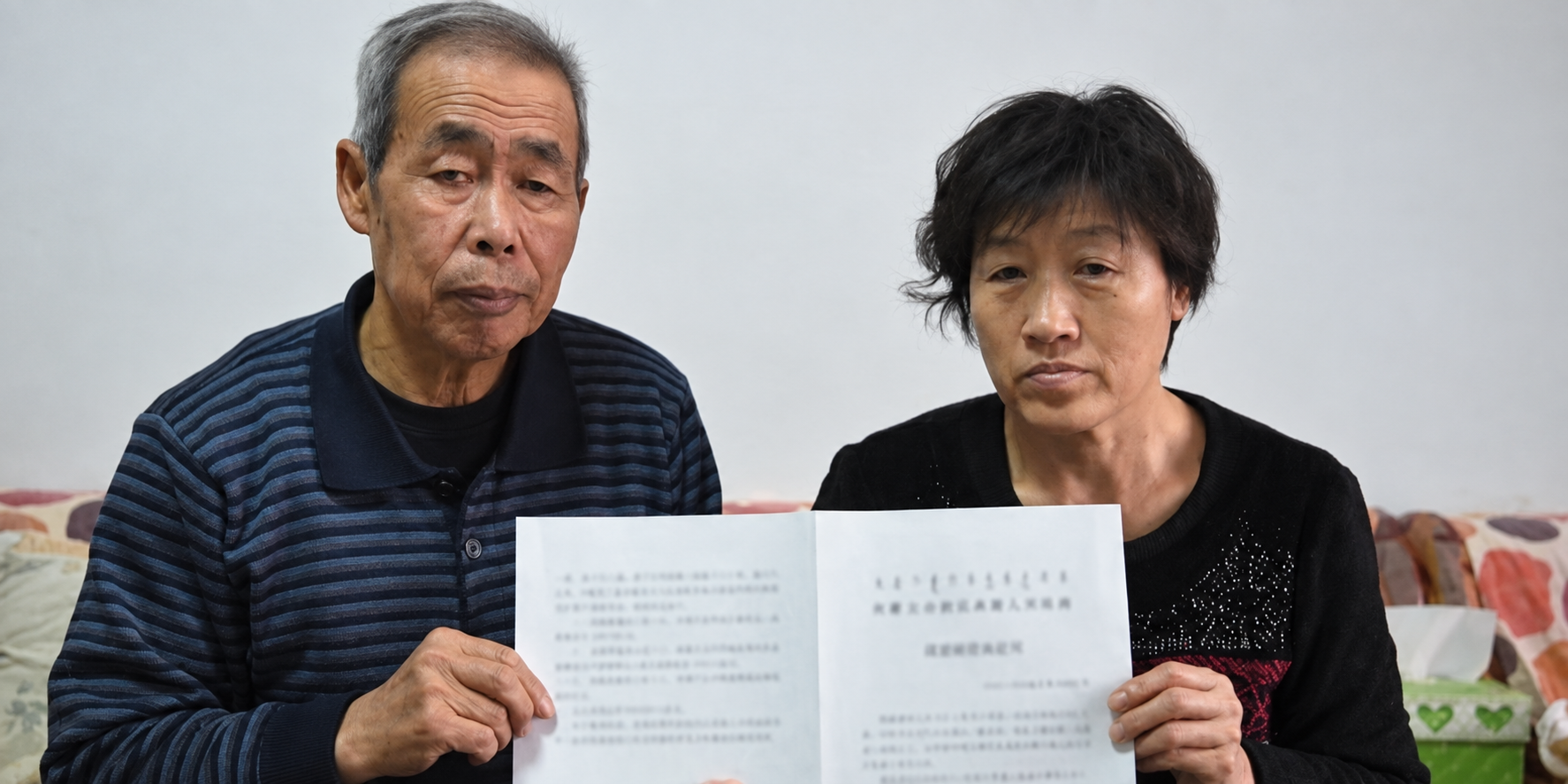
After Hugjiltu’s execution, his parents had to bear not only the loss of their son but also the stigma of being “the murderer’s parents.” According to later interviews in The Beijing News, both worked at Hohhot’s No. 1 Woolen Mill. In a factory community where everyone knew one another, their son’s convictions for homicide and hooliganism weighed heavily on the whole family. His mother, Shang Aiyun, once outgoing, hardworking, and unassuming, became withdrawn. Sometimes she went out alone and wandered aimlessly through the streets. His father, Li Sanren, often shut himself away at home. Even when their older son was dating, someone warned his girlfriend that there had been a murderer in the family.
At first, they took no public action to seek redress. Then, in 2005, came an unexpected turning point. On October 23, police arrested Zhao Zhihong, who had committed a series of rapes, robberies, murders, and other serious crimes in Hohhot, Ulanqab, and elsewhere. After his arrest, he voluntarily confessed to several crimes the police had not solved. Among them was the murder of Yang in the No. 1 Woolen Mill’s residential compound on April 9, 1996—the crime for which Hugjiltu had been sentenced to death.
Local police subsequently took Zhao to the compound to identify the crime scene. Xinhua reported that they brought him there three times to check his account. He described the toilet’s orientation and internal layout, the victim’s height and age, the manner of the assault, and the position of the body. These details closely matched the police investigation and were far more accurate than Hugjiltu’s original confession.
An acutely awkward situation had emerged: two men were now implicated as the perpetrator of the same murder. One had been sentenced to death nine years earlier; the other was voluntarily confessing nine years later. The apparent “reappearance of the real culprit” placed the judicial authorities in a difficult position. When Zhao’s series of crimes went to trial in 2006, the prosecution did not include the April 9 murder linked to Hugjiltu in its charges. Zhao himself raised it in court, saying that this was another of his crimes for which he had not been prosecuted.
His insistence may not have been entirely a matter of conscience. Under the Criminal Law and its judicial interpretations, a defendant who voluntarily discloses other crimes unknown to investigators after being taken into custody may receive a lighter or mitigated sentence. Even if Zhao was merely trying to obtain leniency, he needed the court to recognize this additional crime. His actions nevertheless placed those who had handled Hugjiltu’s case under intense pressure.
Once Hugjiltu’s parents learned of this, they acted immediately. They petitioned local judicial authorities and brought the matter to Xinhua and other media organizations. In March 2006, Inner Mongolia’s Political and Legal Affairs Commission established a group to re-examine the case. Six months later, it concluded that the evidence against Hugjiltu was plainly insufficient and recommended that the court review the case and initiate a retrial.
But the court did not immediately reopen it. Hugjiltu’s parents would wait for more than eight further years. During that time, they repeatedly submitted materials to the authorities and traveled between Hohhot and Beijing. They tried every avenue they could find, approaching judicial bodies, journalists, and lawyers in the hope that someone would bring the case back before a court. Lawyer Wang Zhenyu began assisting the family’s petitions in 2007. Lawyer Miao Li submitted a written recommendation to the Supreme People’s Court, urging it to take over the case promptly or assign a retrial to a court elsewhere, with a hearing to establish what had happened. Xinhua journalist Tang Ji wrote six internal reports on the case, repeatedly bringing it to the attention of the central leadership. Legal scholars, journalists, and other public figures also helped the family continue speaking out. These combined efforts, both within and outside the system, kept the case from fading from public view.
Asked why the court had taken so long to act, the Inner Mongolia High People’s Court later explained that the case was old, some evidence was difficult to investigate further, and a matter involving a human life required caution. That was the court’s official explanation. Other factors may also have impeded correction. The case had been jointly processed by the local police, procuratorate, and courts during the Strike Hard era and had resulted in an execution. A public reversal would have far-reaching implications. Zhao’s own case, moreover, remained unresolved. The claim that he had committed the April 9 murder rested on his confession without substantive physical evidence. Declaring him the real killer on the strength of a confession alone risked repeating the original mistake. These factors may all have increased the resistance to reopening the case.
Returning to the Original Evidence: Retrial and State Compensation
It was not until November 19, 2014, that the Inner Mongolia High People’s Court decided to retry the case. The court explained that, because the original defendant had died, the applicable judicial interpretation of the Criminal Procedure Law required the case to be examined on the written record rather than through a hearing. The petitioners’ lawyers could inspect the case file and submit their views. They applied for access to materials from Zhao Zhihong’s case, but the court refused on the ground that his case had not concluded and the materials were not suitable for disclosure. In other words, the retrial introduced no materials from Zhao’s case. It proceeded on the evidence in Hugjiltu’s original file.
On December 13, 2014, the court delivered its retrial judgment. It held that the facts underlying the original judgment were unclear and the evidence insufficient, principally for three reasons:
- Hugjiltu’s original confession that he had killed the victim by covering her mouth was inconsistent with the autopsy finding that she had died of asphyxiation caused by manual strangulation.
- Blood typing established only a class characteristic. It was neither exclusive nor uniquely identifying and could not establish that Hugjiltu had committed the crime.
- His descriptions of Yang’s height, hairstyle, clothing, and accent were inconsistent with other evidence. His confessions were also unstable, and he had retracted them.
The court accordingly set aside the 1996 first-instance judgment and appellate ruling and acquitted Hugjiltu. On the day the judgment was served, Zhao Jianping, the court’s executive vice president, apologized to his parents on the court’s behalf. Court president Hu Yifeng also sent them 30,000 yuan personally as a gesture of sympathy and told them that they could still apply to the court for state compensation.
On December 25, 2014, Hugjiltu’s parents filed their compensation claim. On December 30, the Inner Mongolia High People’s Court issued its decision, awarding Li Sanren and Shang Aiyun approximately 2.0596 million yuan in compensation for death, funeral expenses, deprivation of personal liberty, and emotional distress. They received the payment on February 3, 2015.
The nature of this compensation matters. State compensation is a legal remedy for harm caused by state organs unlawfully exercising their powers. The amount depends on statutory rules and the circumstances of the individual case. It addresses the responsibility of the state, rather than that of a particular individual.
The award included one million yuan for emotional distress, then a record in state compensation cases. It also prompted a technical objection: under the Supreme People’s Court’s relevant provisions, compensation for emotional distress should in principle not exceed 35 percent of the combined compensation for deprivation of liberty and harm to life and health. This award clearly exceeded that proportion. The Inner Mongolia High People’s Court responded that the punishment imposed had been the most severe of all—death—and had caused exceptionally grave emotional harm to the family. The amount reflected the case’s particular circumstances and was consistent with the spirit of the law. Hugjiltu’s parents also expressed their understanding of the decision.
Accountability and the Outcomes of Separate Proceedings
State compensation was followed by action against those responsible for the case. On January 31, 2016, the relevant authorities in Inner Mongolia announced that twenty-seven people had been held accountable for the wrongful conviction. Media reports identified officials across the police, procuratorate, and courts. Most measures took the form of Party or administrative discipline, including Party warnings, serious Party warnings, administrative demerits, and major demerits. Feng Zhiming, who had led the investigative team as deputy head of the Xincheng branch of the Hohhot Public Security Bureau, was dealt with separately on suspicion of offenses committed in public office. On October 18 that year, the Hulunbuir Intermediate People’s Court convicted him at first instance of accepting bribes, possessing a large amount of property of unexplained origin, illegally possessing firearms and ammunition, and embezzlement. It imposed a combined sentence of eighteen years’ imprisonment and a fine of 1.1 million yuan.
Those offenses were not directly connected to the Hugjiltu case. Many people were therefore dissatisfied with the outcome of the accountability process. Hugjiltu’s older brother, Zhaoligetu, told reporters: “We are not satisfied, and we do not accept it.” His mother, Shang Aiyun, said that accountability had still not gone far enough. Lawyers quoted in public reporting made the same point: the twenty-seven officials had faced Party and administrative responsibility, while the only person criminally punished, Feng Zhiming, had not been imprisoned for the wrongful conviction itself. When journalists asked the regional authorities how the accountability findings had been reached, they received no direct answer.
Now consider Zhao Zhihong’s case. On February 9, 2015, the Hohhot Intermediate People’s Court sentenced him to death for crimes including intentional homicide, rape, robbery, and theft. It also found that he was the perpetrator of Hohhot’s April 9 murder. On April 30, the Inner Mongolia High People’s Court upheld the judgment and submitted the death sentence to the Supreme People’s Court for approval. In July 2019, the Supreme People’s Court approved the sentence. In doing so, however, it changed part of the underlying factual findings. Of the twenty-one criminal incidents attributed to Zhao in the original proceedings, it confirmed seventeen and declined to confirm four. The April 9 murder was among those four.
The reason was primarily evidentiary. In a press briefing, the head of the Supreme People’s Court’s Fifth Criminal Division explained that Zhao had voluntarily confessed to the murder after his arrest, and details in his account broadly matched the police investigation. But his statements were inconsistent over time and contained numerous contradictions with other evidence that were difficult to explain. For example, he repeatedly said that he had ejaculated during the assault, yet no semen had been detected in the victim’s vaginal secretions or found at the scene. He also said he had pulled off her earrings, whereas the autopsy showed no injuries to either ear.
Whatever the final outcome of Zhao’s case, it could not alter Hugjiltu’s acquittal. The retrial judgment had relied on none of the materials from Zhao’s proceedings. Hugjiltu was acquitted because the facts of his own case were unclear and the evidence insufficient, not because the “real culprit” had subsequently appeared. As a matter of law, he should have been acquitted even without Zhao’s voluntary confession.
This is the Criminal Procedure Law’s principle of acquittal where the evidence leaves doubt. To determine guilt, the question is whether the prosecution has supplied sufficient evidence. If it has not, the defendant is legally not guilty. Whether the actual perpetrator is someone else does not materially change the outcome of that case. This places a greater demand on investigators: the evidence supporting a conviction must be reliable and sufficient. That standard does not fall because the public wants to see the “real killer” brought to justice, or because someone voluntarily confesses.
Justice Delayed
Thirty years have passed since the Hugjiltu case began. China’s criminal procedure has developed considerably during that time. Authority to approve death sentences for immediate execution has been brought back under the Supreme People’s Court. Subsequent revisions to the Criminal Procedure Law established rules excluding illegally obtained evidence and, for the first time, expressly prohibited compelling anyone to incriminate themselves.
On that evening of April 9, 1996, eighteen-year-old Hugjiltu tried to help by reporting a crime and instead suffered an irreversible injustice. Our justice system took eighteen full years to correct its mistake. For a shattered family, delayed justice could not restore a loved one’s life. For Chinese legal history, however, the case remains a warning close at hand. What has passed cannot be undone, but what lies ahead can still be changed. Everyone who works in law should remember these cases. They remind us how difficult justice is to achieve.
Timeline
- 1979–1980: The first Criminal Procedure Law is adopted and enters into force. It requires emphasis on evidence rather than unquestioning reliance on confessions and prohibits torture and other unlawful evidence-gathering methods.
- September 1983: The NPC Standing Committee adopts a decision allowing expedited trials for specified serious crimes, reducing the period for defendants’ appeals and procuratorial protests from ten days to three. An amendment to the Organic Law of the People’s Courts allows the Supreme People’s Court to authorize high courts to approve certain death sentences.
- March 17, 1996: Amendments to the Criminal Procedure Law are adopted, taking effect on January 1 the following year. Hugjiltu’s original proceedings remain governed by the 1979 law.
- April 9, 1996: Hugjiltu discovers a murdered woman in a public toilet in the woolen mill’s residential compound and asks a colleague to help report the crime. He is placed under custody and investigation on April 12 and formally arrested on May 10.
- May 17, 1996: The Hohhot Intermediate People’s Court convicts Hugjiltu of intentional homicide and hooliganism and imposes a combined death sentence.
- June 5 and June 10, 1996: The Inner Mongolia Autonomous Region High People’s Court dismisses his appeal, upholds the judgment, and approves the death sentence. He is executed five days later, sixty-two days after the crime.
- October 23, 2005: Zhao Zhihong is arrested and subsequently volunteers a confession to the public-toilet murder. After learning of it, Hugjiltu’s parents petition judicial authorities and approach the media.
- From March 2006: The regional Party Political and Legal Affairs Commission forms a group to re-examine the case. Roughly six months later, it concludes that the original evidence was plainly insufficient and recommends judicial review and a retrial. The case nevertheless remains outside retrial proceedings for years.
- From 2007: Wang Zhenyu helps the family petition for redress. Miao Li later recommends that the Supreme People’s Court take over the case or assign a retrial elsewhere. Xinhua journalist Tang Ji continues writing internal reports to draw attention to the case.
- November 19, 2014: The Inner Mongolia High People’s Court orders a retrial on the written record.
- December 13 and December 15, 2014: The retrial judgment is issued and subsequently served on and read to the family, acquitting Hugjiltu.
- December 30, 2014: The court awards approximately 2.0596 million yuan in state compensation, including one million yuan for emotional distress. The family receives payment on February 3, 2015.
- February and April 2015: Zhao’s trial and appeal both find that he committed the public-toilet murder. The courts impose and uphold a death sentence.
- January 31, 2016: Authorities announce the accountability findings in Hugjiltu’s case: twenty-seven people are held responsible, while Feng Zhiming is handled separately for suspected offenses in public office.
- October 18, 2016: Feng is sentenced at first instance to eighteen years’ imprisonment for four offenses, including accepting bribes. The judgment does not impose criminal liability for Hugjiltu’s wrongful conviction.
- July 2019: The Supreme People’s Court approves Zhao’s death sentence but does not confirm four of the alleged criminal incidents, including the public-toilet murder. Zhao is executed on July 30.
Key People
- Hugjiltu: An eighteen-year-old factory worker at the time of the crime, executed in 1996 and acquitted on retrial in 2014.
- Li Sanren and Shang Aiyun: Hugjiltu’s parents. They persistently sought redress after learning of Zhao’s confession in 2005 and later became the claimants for state compensation.
- Yang: The victim of the public-toilet murder. This episode follows the anonymized identification used in court materials.
- Zhao Zhihong: Arrested for a series of serious crimes, he voluntarily confessed to this murder. The trial and appellate courts found that he had committed it, but the Supreme People’s Court did not confirm that finding during death-sentence review.
- Tang Ji: A journalist with Xinhua’s Inner Mongolia bureau who wrote six internal reports on Hugjiltu’s case.
- Wang Zhenyu and Miao Li: Lawyers involved in seeking redress and reopening the case, through assistance with petitions and written recommendations respectively.
- Feng Zhiming: Head of the original investigative team and then deputy head of the Xincheng branch of the Hohhot Public Security Bureau. He was later convicted in separate proceedings of bribery and other crimes.
- Zhaoligetu: Hugjiltu’s older brother, who publicly expressed dissatisfaction with the accountability findings.
Relevant Decisions and Institutional Background
- Original Hugjiltu proceedings: Hohhot Intermediate People’s Court judgment (1996)呼刑初字第 37 号; Inner Mongolia Autonomous Region High People’s Court ruling (1996)内刑终字第 199 号.
- Hugjiltu retrial: Inner Mongolia Autonomous Region High People’s Court judgment (2014)内刑再终字第 00005 号, setting aside the original judgment and ruling and entering an acquittal.
- State compensation for Hugjiltu’s family: Inner Mongolia Autonomous Region High People’s Court decision (2014)内法赔字第 00001 号, awarding a total of 2,059,621.40 yuan.
- 1979 Criminal Procedure Law: The law governing the original proceedings. It already required emphasis on evidence rather than unquestioning reliance on confessions and prohibited unlawful evidence gathering.
- 1983 Decision on Procedures for the Speedy Trial of Criminals Who Seriously Endanger Public Security: Adjusted service periods and the deadlines for appeals and procuratorial protests in serious cases meeting specified conditions. It is central to understanding the procedural setting of severe and swift punishment.
- Changes to death-sentence approval: From 1983, high courts could approve some death sentences under authorization from the Supreme People’s Court. From 2007, approval of death sentences for immediate execution was exercised exclusively by the Supreme People’s Court.
- The 1996 and subsequent criminal procedure amendments: The 1996 amendments expressly provided for acquittal where evidence was insufficient. Later amendments further established the exclusion of illegally obtained evidence and the prohibition on compelling anyone to incriminate themselves.
Main References
The following materials are drawn from the Chinese manuscript for further reading. English renderings of source titles are provided for convenience.
- Judicial decisions: Retrial criminal judgment (2014)内刑再终字第 00005 号; Supreme People’s Court, “Typical Cases Marking the Thirtieth Anniversary of the Promulgation of the State Compensation Law” (May 15, 2024), including the principal points of the compensation decision in this case.
- Retrial and case history: People’s Court Daily, “Inner Mongolia High Court Acquits Hugjiltu on Retrial” and “Reopening a Long-Dormant Case: How Hugjiltu Was Acquitted on Retrial” (December 16, 2014); the special account “The Reversal of Hugjiltu’s Wrongful Conviction” in the 2015 Inner Mongolia Yearbook; China Law website, “The Hugjiltu Case: A Full Account.”
- Review of Zhao’s death sentence: Supreme People’s Court, “Strict Adherence to the Standard of Proof and Adjudication According to Law: Questions and Answers on the Review of Zhao Zhihong’s Death Sentence” (July 30, 2019).
- Compensation and accountability: People’s Daily, “Compensation for Emotional Distress in the Hugjiltu Case Complies with the Rules” (January 6, 2015); Xinhua, “Inner Mongolia Announces Accountability Findings in the Hugjiltu Case” (January 31, 2016); “Hugjiltu’s Family Refuses to Accept Accountability Findings” (February 1, 2016); “Hugjiltu’s Parents Cannot Accept Accountability Findings” (February 2, 2016).
- Feng Zhiming’s separate conviction: Xinhua, “Hugjiltu’s Mother Responds to Feng Zhiming’s Eighteen-Year Sentence: Accountability Still Falls Short”; The Beijing News, “Hugjiltu Investigative Team Leader Feng Zhiming Sentenced to Eighteen Years at First Instance” (both October 19, 2016).
- Legal and statistical background: The 1979 and 1996 Criminal Procedure Laws and related amendments; the 1983 expedited-trial decision; amendments to the Organic Law of the People’s Courts; the Supreme People’s Court’s 1997 work report. The figures cited for cases and people sentenced in 1996 are annual totals, not simply the results of a single campaign. The figures for severe sentences include death sentences with a reprieve.
Related Episodes
- 15 The Sun Zhigang Case: How Custody and Repatriation Came to an End : Another examination of how institutions correct errors through the experience of an individual. “Custody and investigation” in Hugjiltu’s case was a different measure from “custody and repatriation” in Sun Zhigang’s case.
- 10 You Have the Right to Remain Silent: How Miranda Warnings Changed American Justice : Further discussion of confessions, interrogation procedures, and individual rights.
- 16 Returning to a Country Is Not Coming Home: Japanese War Orphans’ State Compensation Lawsuits : A different historical setting in which to consider what state compensation can address and what it leaves unresolved.