This is the transcript of episode 21 of my podcast Reasoned Talk (议正言辞). Listen on Xiaoyuzhou or Apple Podcasts . The episode is in Chinese; this transcript has been translated into English.
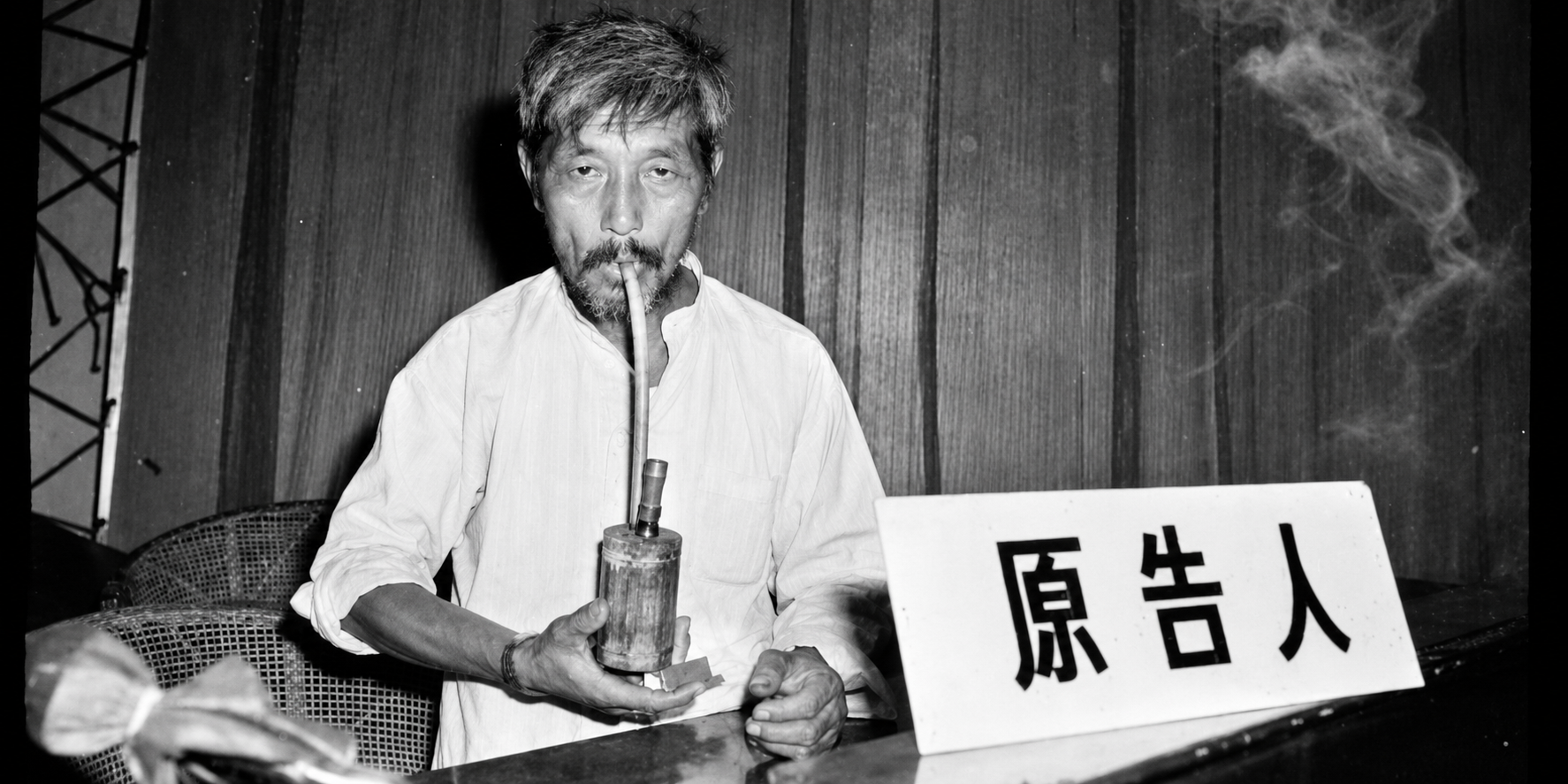
August 25, 1988, Cangnan County, Wenzhou, Zhejiang. The county cinema had been converted into a courtroom. China’s national emblem hung above a pale blue backdrop, with the judges’ bench at the center of the stage. At the plaintiffs’ table on the left sat Bao Zhengzhao, a sixty-one-year-old farmer. At the defendants’ table on the right sat Huang Deyu, then the head of the Cangnan County government. More than a thousand seats in the auditorium were filled. With many people unable to get inside, the court broadcast the proceedings outside, where a large crowd had gathered at the cinema entrance.
This was the People’s Republic of China’s famous “first case of a citizen suing the government”: farmer Bao Zhengzhao and his family had brought the Cangnan County government into court. China’s Administrative Litigation Law would not be enacted until April 1989. When Bao sued, there was no dedicated law governing this kind of litigation. The Wenzhou Intermediate People’s Court, which accepted the case, could only hear it using the 1982 Civil Procedure Law (for Trial Implementation).
How did this case, which preceded the legislation, come about? And what did the court ultimately decide? That is the case we will discuss in this episode.
Why Was the House Unlawful Despite an Approval?
Although media reports often call it “Bao Zhengzhao v. the County Government,” and we usually refer to it simply as the “Bao Zhengzhao case,” Bao was not the sole plaintiff. The plaintiffs were eight members of his family: Bao and his wife, two sons and their wives, and two daughters. They sued the Cangnan County government because, in July 1987, it had sent people to demolish part of their house.
The house was in Bacao village, Cangnan County. The area is now Bacao Community in Longgang, Wenzhou, but at the time it was a village on China’s southeastern coast. A river to its south ran from southwest to northeast into the East China Sea. The Bao family’s house stood near the riverbank on the northern side. Because the location was only a few kilometers from the river mouth, the government had built a sea embankment more than five hundred meters long across the waterway for irrigation and flood control. It was an important local water-control facility.
In 1975, the Bao family dumped stones into the river to make foundations on the embankment slope and over the water, at the western end of the embankment, about fifty meters from the sluice gate. They built a two-story house of three bays, occupying 105 square meters. Because construction on the embankment had damaged it, the local government fined the family in 1983. That penalty did not stop further construction. In 1985, they again dumped stones to form foundations on the slope and over the river east of the existing house, creating another three-bay building site of 126 square meters.
Bao Zhengzhao’s second son, Bao Songcun, was then a member of the Bacao town Party committee and had previously served as the town’s water-management administrator. On August 1, 1985, Bao Songcun submitted a building application to the town’s urban construction office. The application had the local production brigade’s endorsement, but the family had not obtained the required approval from the Cangnan County water bureau. At Bao Songcun’s urging, a staff member issued an “approval notice” in the town construction office’s name consenting to the building. Bao Songcun and the others also paid 708 yuan for the land, then began construction.
After work began, the Cangnan County water bureau discovered what was happening. On September 4, 1985, it sent the Bacao town government a letter entitled “On Immediately Stopping the Unlawful Encroachment on the River Channel.” It stated that the construction was unlawful and required it to stop immediately, with all obstructions removed and the river restored to its original condition.
The county water bureau relied on the Regulations on the Administration of Water Conservancy and Hydropower Projects, issued in April 1983 by the Ministry of Water Resources and Electric Power under the State Council. Chapter Two dealt specifically with protecting these projects. The regulations provided for protected areas to be designated according to management needs; these included river channels and the land protecting both sides of their embankments. Article 9 expressly prohibited construction activities within the protected areas. Article 11 then provided:
Where it is indeed necessary to undertake construction or similar activities within the protected area of a water conservancy or hydropower project, consent must be obtained from the competent water resources and electric power authority … and approval secured through the prescribed procedures.
But, as explained earlier, the Bao family had not obtained the county water bureau’s approval when they applied to the construction office. The office had nevertheless approved the building without the water bureau’s input. That was why the county water bureau wrote to the town government demanding that all obstructions be removed and the original condition restored. The house was still under construction, and the town head informed the family of the demand. They chose to continue and eventually completed a three-story house of three bays, built with concrete, brick, and timber.
Nearly two years passed between the water bureau’s letter in 1985 and the actual demolition in 1987. During that period, the town government, county government, district office, and other authorities repeatedly urged the family to remove the unlawful construction themselves, without conditions. They did not do so. On October 22, 1986, Bao Zhengzhao applied to the town housing-management station to register ownership. The application was not approved.
On February 1, 1987, Bao Songcun used his position on the town Party committee to obtain blank stationery bearing the town government’s official seal. He wrote a letter in the town government’s name and took it to the Wenzhou planning bureau, asking it to recognize the house as lawful. On June 20, the Wenzhou planning and water bureaus issued a notice again requiring the family to remove the construction themselves, without conditions.
On June 30, the Cangnan County government issued a “Decision on the Compulsory Demolition of Bao Zhengzhao’s Unlawfully Constructed House,” relying on the State Council’s “Urgent Notice on Removing Obstructions to Flood Discharge and Storage to Ensure Flood-Control Safety.” The decision was served on July 2. On July 4, the county government organized the demolition of part of the three-bay house the family had built in 1985.
Two details matter here. First, the extent of the demolition: the government demolished portions at the rear of the three-bay house built in 1985, rather than the whole building. Second, the method: small, controlled directional blasts were used on the parts that obstructed the water most severely, with the aim of avoiding damage to other structures. The later account that the “entire building was blown up” is therefore inaccurate.
How Did the Door to Suing the Government Open?
When Bao Zhengzhao saw his house being blasted, he picked up explosives and briefly intended to kill himself together with the demolition personnel. Several of his sons stopped him. His second son, Bao Songcun, argued that they should defend their rights through legal means and went to Hangzhou to hire a lawyer. But bringing the suit proved difficult.
They first asked the Cangnan County court to register the case and were refused. Bao Songcun later recalled that a court president had rebuked them, saying in effect that the county court could not accept a lawsuit against the county government. They then approached the Wenzhou Intermediate People’s Court, which also refused to register it. The reasoning was straightforward: the Administrative Litigation Law, which would specifically govern suits against the government, had not yet been enacted, and no law had expressly made government demolition a matter on which the government could be sued directly. The court lacked a direct statutory basis for accepting their application, and there were few precedents it could draw on. For the local courts, this was a formidable challenge.
One qualification is necessary. Calling Bao Zhengzhao’s case China’s “first case” against the government refers to its influence and historical significance. It does not mean that it was literally the first such case in Chinese history. Nor did the absence of an Administrative Litigation Law mean that there was no legal route at all for suing the government.
Article 3, paragraph 2, of the 1982 Civil Procedure Law (for Trial Implementation) provided:
Administrative cases that the law assigns to the people’s courts for adjudication shall be governed by this Law.
The key words were “the law assigns.” If another law provided that a particular category of administrative case could be heard by a court, the court could use the Civil Procedure Law when hearing it. In other words, this provision connected civil procedure with other legislation. Its application depended on the existence of another law expressly identifying a matter on which a citizen could bring a suit. The provision itself did not define the categories of administrative disputes that could be litigated.
Which other laws provided specific routes for such suits? The 1979 Electoral Law allowed a person dissatisfied with an electoral commission’s decision concerning the voter list to bring proceedings in court. Although an electoral commission was not, strictly speaking, an administrative agency, this opened a route for challenging an official decision. Several tax laws adopted in 1980 and 1981 provided routes for bringing tax disputes to court. The 1986 Regulations on Administrative Penalties for Public Security allowed a person dissatisfied with a ruling on an appeal against a public-security penalty to sue. In March 1987, a court in Lianshui County, Huai’an, Jiangsu, revoked a public-security penalty ruling by the Huaiyin public security bureau, becoming the first court since 1982 to rule against a public security authority. Before the Administrative Litigation Law was enacted in 1989, more than 130 laws and administrative regulations had specified matters on which citizens and organizations could sue administrative agencies. These cases could use the procedures laid down in the Civil Procedure Law.
Alongside these legal rules, the courts were developing the necessary institutions. In October 1986, the Wuhan Intermediate People’s Court in Hubei established the country’s first administrative division, while the Miluo County court in Yueyang, Hunan, established the first such division at the basic court level. In response to requests from courts around the country, the Supreme People’s Court issued its “Notice on Establishing Administrative Divisions” in January 1987. It called for a positive but cautious approach: pilot the arrangement first, then expand it. In October 1988, the Supreme People’s Court formally established its own administrative division. By the time the Administrative Litigation Law was enacted in 1989, courts at different levels had established more than 1,400 administrative divisions.
So, when the Bao Zhengzhao case arose, China had not yet enacted a unified Administrative Litigation Law, but scattered provisions already existed and courts had begun creating separate administrative divisions. Administrative litigation in the People’s Republic developed through practice preceding legislation.
Returning to the case itself, the courts in Cangnan and Wenzhou hesitated to register it chiefly because no statute had placed government demolition within the scope of administrative litigation. Naming the county government itself as defendant, rather than one of its constituent agencies, was also extremely unusual. The lawyer hired by the Bao family helped turn the situation around.
The family’s lawyer was Lou Xian, who also served as legal adviser to the newspaper Economic Life. After meeting the family, he reassured them and urged Bao Zhengzhao to trust the law rather than take drastic action that would escalate the conflict. At the same time, he organized the materials and published them in the newspaper as a legal consultation, drawing greater attention to the case. He then wrote to the president of the Zhejiang Provincial High People’s Court about the family’s inability to have their suit accepted. That letter became the turning point.
In February 1988, the Zhejiang Provincial High People’s Court designated the Wenzhou Intermediate People’s Court to hear the case. Because there was no Administrative Litigation Law and the Wenzhou court had no administrative division, it registered the dispute as a civil case, assigned a civil case number, and used the procedures in the 1982 Civil Procedure Law (for Trial Implementation). In March 1988, the Wenzhou court formally accepted the case and decided to hold a public hearing. That led to the scene with which this episode began.
Why Did the Bao Family Lose?
On August 25, 1988, Bao Zhengzhao’s case against the Cangnan County government opened in the temporary courtroom that the Wenzhou Intermediate People’s Court had set up inside the county cinema. The hearing ran from morning until after ten at night. According to later accounts, the plaintiffs’ lawyers presented seventy-one items of evidence and delivered submissions of more than thirty thousand Chinese characters; the defendant’s representatives submitted sixteen pages of argument.
The dispute was clear. The plaintiffs argued that the family had obtained an approval notice from the construction office, giving the house a lawful basis. The county government’s demolition infringed their property rights, and it should restore the property or compensate them. The defendant argued that the house obstructed flood discharge and had been built without the water authorities’ approval, making it unlawful. Demolishing it to protect the embankment and residents downstream was therefore lawful.
Resolving the dispute required answers to three questions:
- Was the demolished part of the house within the protected area, and did it obstruct flood discharge?
- Did the construction office have authority to approve building on water-control facilities and river channels, and what legal effect did its approval have?
- Did the county government have a legal basis for demolition, and what extent of demolition was appropriate?
Three days after the hearing, in late August 1988, the Wenzhou court delivered its first-instance judgment. It addressed these three questions in turn.
First, on the house’s location and protection of the embankment, the court held that the sea embankment was an important water-control facility serving four districts and two towns in Cangnan. It kept out saltwater, stored freshwater, drained excess water, irrigated farmland, and protected against tides and floods. It served 200,000 mu of irrigated farmland and the lives and property of 500,000 people. No organization or individual could unlawfully encroach on it. The river channel south of the embankment was a principal route for flood discharge and drainage, where the relevant regulations strictly prohibited obstructions. The family’s new house stood on the southern slope and over the river at the western end of the embankment. It was within the protected area, obstructed flood discharge, and endangered the sluice and embankment.
Second, on the construction office’s approval, the court held that the Bacao town construction office had no authority to approve construction on water-control facilities or river channels without the competent water authority’s consent. Its approval violated the relevant legal provisions and was therefore invalid.
Third, on the legal basis for compulsory demolition, the court held that the plaintiffs had failed to learn from the penalty imposed for their unlawful construction in 1975. They had again damaged the embankment and filled the river to build in 1985, violating rules issued by the State Council, the Ministry of Water Resources and Electric Power, and the Zhejiang provincial government. The construction was unlawful. After the plaintiffs failed to comply with notices requiring them to remove it themselves, the county government acted lawfully in relying on the relevant State Council rules to demolish portions of the unlawfully built house.
On that basis, the court relied on the Regulations on the Administration of Water Conservancy and Hydropower Projects and the State Council’s urgent notice on clearing flood-control obstructions to dismiss the plaintiffs’ claims. The plaintiffs were ordered to pay the litigation and appraisal costs. The judgment also specifically criticized Bao Songcun: as a member of the Bacao town Party committee and a former water-management administrator, he had disregarded the law, ignored warnings, built unlawfully, and refused to remove the obstructions. The court described his conduct as particularly serious.
The family appealed to the Zhejiang Provincial High People’s Court. According to later reports, Ren Jianxin, then president of the Supreme People’s Court, saw a report in China Youth Daily and issued an instruction that the Zhejiang court handle the case according to law. On December 26, 1988, the Zhejiang court delivered its final judgment, dismissing the appeal and upholding the original decision.
The case was over. This “first case” of a citizen suing the government ended in defeat for the plaintiffs. The judgment’s significance lay less in whether the family won than in its distinctive place in legal history. It was a “civil judgment,” bore a civil first-instance case number, and was delivered by a civil division. Its reasoning and allocation of the burden of proof did not follow the standard framework of administrative litigation. Yet it brought the unfamiliar idea of suing the government into public view. On the eve of the Administrative Litigation Law’s enactment, people could see a government appear as defendant and respond in court to a citizen’s challenge.
From Judicial Practice to Unified Legislation
Viewed across Chinese legal history, administrative law and administrative litigation were not entirely new concepts. As early as 1914, the Beijing government enacted China’s first Administrative Litigation Law. In 1932, the Nationalist government in Nanjing promulgated another Administrative Litigation Law as part of its “Six Codes.” After the People’s Republic was founded, the old Six Codes were abolished. By the 1980s, China had not yet enacted a unified Administrative Litigation Law; the relevant provisions were scattered across separate laws and regulations.
Meanwhile, preparations for legislation had begun. After the General Principles of Civil Law were adopted in 1986, Tao Xijin, then an adviser to the National People’s Congress Law Committee, proposed at a symposium that the People’s Republic establish a new system of six fundamental laws. Criminal law, criminal procedure, the General Principles of Civil Law, and civil procedure already existed. What was missing was administrative law and administrative litigation law. Wang Hanbin, then secretary-general of the NPC Standing Committee, endorsed the proposal. An administrative legislation research group was subsequently established, with Jiang Ping as chair and Luo Haocai and Ying Songnian as deputy chairs.
The group initially planned to draft General Principles of Administrative Law, modeled on the General Principles of Civil Law. Progress was difficult because theoretical groundwork and practical experience were insufficient. It then turned to procedural legislation and soon produced a preliminary draft of the Administrative Litigation Law. In 1987, the report to the Communist Party’s Thirteenth National Congress expressly called for such a law, accelerating the legislative process. By the time the Bao Zhengzhao case was heard in August 1988, drafting had already been underway for two years. On April 4, 1989, the National People’s Congress formally adopted the Administrative Litigation Law. It took effect on October 1, 1990.
The law contained seventy-five articles and comprehensively addressed the different aspects of administrative litigation.
First, it unified the right to bring proceedings. Article 2 provided that citizens, legal persons, and other organizations who considered that a specific administrative act by an administrative agency or its personnel infringed their lawful rights and interests could bring a suit in a people’s court under the law. This converted rights to sue that had previously been scattered across separate statutes into a unified rule.
Second, it clarified the standard of review. Article 5 provided that, in hearing administrative cases, the people’s courts would review whether specific administrative acts were lawful. This was crucial: it defined legality as the central question. In a case like Bao Zhengzhao’s, for example, the court would need to examine whether the county government’s demolition was lawful; whether the plaintiffs had repeatedly failed to learn their lesson would no longer be the subject of adjudication.
Third, it established the defendant’s burden of proof. Article 32 provided that the defendant—the administrative agency—bore the burden of proving the specific administrative act it had taken, and had to produce both the supporting evidence and the normative documents on which it relied. Article 33 further provided that, during litigation, the defendant could not collect evidence from the plaintiff or witnesses on its own. This differed from the civil-litigation principle that the party making an assertion must prove it. It required the administrative agency to establish the legality of its own action, rather than requiring the citizen to prove that the action was unlawful.
The law also provided for separate administrative adjudication structures, equal procedural standing for plaintiffs and defendants, and a statutory basis for compensation for harm, among other matters.
Of course, the legislative process was far from smooth. During deliberations, some deputies argued that implementing the Administrative Litigation Law might create difficulties for rural family-planning work and state grain procurement. Others suggested postponing its adoption. In its report on the results of deliberation dated April 1, 1989, the Law Committee made several changes. One was to delete the draft provision that compensation should be calculated on the basis of direct loss. The stated reason was that “there are differing understandings of what constitutes direct loss; compensation for administrative infringement is complex and requires further study.”
The 1989 law was therefore not a perfect outcome. Much remained to be improved, and China’s vast system of local courts needed time to adapt to this new institution.
The Bao Family After the Judgment
Finally, let us return to the Bao Zhengzhao case. At the end of the 1988 hearing, county head Huang Deyu walked over to the family and shook their hands. He said: “Whatever the outcome of the lawsuit, your family are citizens of Cangnan County, and the government will continue to serve you.” This scene appeared in retrospective reports and historical accounts years later, becoming a small footnote to the “first case” against the government.
The family did not subsequently face harassment for suing the government. The lawsuit also remained part of the family’s memory. Two years after the case ended, Bao Songcun’s son was born, and he named him “Bao Susong”—“litigation.” His daughter later went to university and studied law. Bao Zhengzhao died of illness in 2002. Before his death, he called his children and grandchildren to his bedside and told them to learn the law, understand it, and abide by it. For an elderly man who had once wanted to take up explosives, finding a place where he could argue his case and have his position heard was already something worth remembering.
The old house at the center of the dispute also found a new purpose. During the redevelopment of Bacao fishing port, the government acquired the Bao family’s old home. Later, the Longgang municipal Party committee and government decided to retain three rooms of the house and renovate and develop the site into the Longgang Rule of Law Museum. The museum displays the original notice to respond to the suit, the judgments, footage of the hearing, and interviews with those involved. The lawsuit that had once drawn national attention was preserved at the place where it began.
From a house that had been partly demolished to a museum recording legal history, the family’s defeat remained unchanged. But their experience of suing the government became a public memory worth preserving. Looking back, what we should remember is that there must be somewhere to question government decisions and a procedure through which to review them. Subjecting power to legal scrutiny and giving citizens a place to make their case: that is the significance the Bao Zhengzhao case leaves us.
ShowNotes
In This Episode
- A courtroom inside a cinema: A farmer sues the county government, the county head appears in court, and a public hearing runs from morning into the night.
- An approval, but still an unlawful building: Tracing the dispute from a house on a river embankment and the town construction office’s approval to the water authorities’ demand to remove obstructions.
- Opening the door to suing the government: After two courts refuse to register the case, lawyer Lou Xian uses newspaper coverage and a letter to the provincial high court to help secure a hearing.
- Suits against the government before the “first case”: Statutory provisions scattered across separate laws, administrative cases heard under civil procedure, and the establishment of administrative divisions in the courts.
- Why the family lost: Whether the house obstructed flood discharge, whether the construction office had approval authority, and whether the county government had a legal basis for demolition.
- From judicial practice to unified legislation: The history of earlier administrative litigation laws, drafting in the 1980s, and the basic rules established by the 1989 Administrative Litigation Law.
- The family after the judgment: A handshake after the hearing, a child named “Litigation,” and the transformation of the disputed old house into the Longgang Rule of Law Museum.
Key Timeline
- 1975–1983: The family creates foundations and builds on the embankment slope and over the river. It is later fined for encroaching on water-control facilities.
- August–September 1985: Bao Songcun applies for an extension, and the town construction office issues an approval. The county water authorities subsequently demand an end to the unlawful encroachment on the river, but the family continues building.
- July 4, 1987: The Cangnan County government forcibly demolishes portions at the rear of the house the family built in 1985.
- February–March 1988: The Zhejiang Provincial High People’s Court designates the Wenzhou Intermediate People’s Court to hear the case; the latter formally registers it.
- August 25, 1988: A public hearing takes place in the Cangnan County cinema, with county head Huang Deyu appearing for the defendant.
- August 28, 1988: The Wenzhou court dismisses the claims of Bao Zhengzhao and the other seven plaintiffs at first instance.
- December 26, 1988: The Zhejiang high court dismisses the appeal and upholds the original judgment.
- April 4, 1989: The Administrative Litigation Law of the People’s Republic of China is adopted.
- October 1, 1990: The Administrative Litigation Law takes effect.
- 2002 and afterward: Bao Zhengzhao dies of illness in 2002. The old house is later acquired during fishing-port redevelopment; three retained rooms are renovated and developed into the Longgang Rule of Law Museum.
People
- Bao Zhengzhao (包郑照): A farmer from Bacao village, Cangnan, Zhejiang, and the lead plaintiff. Eight members of the family joined the suit.
- Bao Songcun (包松村): Bao Zhengzhao’s second son, then a member of the Bacao town Party committee and a former town water-management administrator. He was involved in obtaining the building approval and encouraged the family to resolve the dispute through litigation.
- Huang Deyu (黄德余): Then head of the Cangnan County government, appearing in court on behalf of the defendant, the Cangnan County People’s Government.
- Lou Xian (楼献): The family’s lawyer and legal adviser to Economic Life. He helped secure registration of the case by organizing the materials, publishing them in the newspaper, and writing to the provincial high court.
- Tao Xijin (陶希晋) and Wang Hanbin (王汉斌): Important figures in advancing administrative legislation in the People’s Republic.
- Jiang Ping (江平), Luo Haocai (罗豪才), and Ying Songnian (应松年): Chair and deputy chairs of the administrative legislation research group, involved in researching and drafting the Administrative Litigation Law.
Laws and Concepts
- The “first case” of a citizen suing the government: A description of the Bao Zhengzhao case’s influence and historical importance. Before the unified Administrative Litigation Law was enacted, administrative litigation already existed under provisions in individual laws and regulations.
- Article 3, paragraph 2, of the Civil Procedure Law (for Trial Implementation): Administrative cases assigned by law to the courts were to use civil procedure. The provision itself did not establish a unified scope of administrative acts that could be challenged.
- Building approval and approval authority: Construction within a water-control project’s protected area required consent from the competent water authority and approval through prescribed procedures. The first-instance court held that the town construction office could not approve this construction on its own and that its approval was invalid.
- The Regulations on the Administration of Water Conservancy and Hydropower Projects and the State Council’s notice on removing obstructions: The principal normative documents on which the first-instance court relied to decide whether the house was unlawful and whether the county government had a basis for demolition.
- Legality review: Article 5 of the 1989 Administrative Litigation Law expressly required courts to review the legality of specific administrative acts.
- The defendant’s burden of proof: Articles 32 and 33 of the original 1989 law required administrative agencies to produce the evidence and legal basis for their acts and prohibited them from collecting evidence from plaintiffs or witnesses on their own during litigation.
- Longgang Rule of Law Museum: Created through the renovation and development of three retained rooms of the family’s old home, it displays litigation documents, hearing footage, and interviews, preserving the public memory of the case.
Related Episodes
- 13 China’s “First Constitutional Case”: Qi Yuling’s Stolen Right to Education : Another case famous as a “first,” examining how courts respond to citizens’ claims of rights.
- 15 The Sun Zhigang Case: The End of Custody and Repatriation : Another individual case through which to consider the relationship between adjudication, public debate, and institutional change.
Principal References
- Wenzhou Intermediate People’s Court, Zhejiang, Civil Judgment, (1988) Civil First Instance No. 1, August 28, 1988; reproduced in Appendix Three of Huang Chuanhui, China’s “Challenger”: The Story of the First Farmer’s Lawsuit Against a County Head (中国的「挑战者」号——首例农民告县长案始末), Haichao Publishing House, 1990.
- Gao Haihao, “A Farmer Sues the County Government” (农民告县府), People’s Daily, August 25, 1988.
- Civil Procedure Law of the People’s Republic of China (for Trial Implementation), 1982; Regulations on the Administration of Water Conservancy and Hydropower Projects, 1983; Administrative Litigation Law of the People’s Republic of China, original 1989 text.
- Wang Hanbin, “Explanation of the Draft Administrative Litigation Law of the People’s Republic of China”; NPC Law Committee report on the results of deliberation on two draft laws, published in the Gazette of the Standing Committee of the National People’s Congress, No. 2, 1989.
- Ma Huaide and Kong Xiangwen, “Achievements and Prospects of Administrative Litigation over Forty Years of Reform and Opening Up” (改革开放四十年行政诉讼的成就与展望), Peking University Law Journal (中外法学), No. 5, 2018.
- Wenzhou Publicity, “The Light of the Rule of Law in a City of Reform” (改革之城的法治之光), Wenzhou News Network, February 8, 2024.
The account of the dispute and the court’s reasoning is based primarily on the first-instance judgment. Details such as the handshake after the hearing come from later retrospective accounts. Discussion of the Administrative Litigation Law uses the provisions of the original 1989 law.