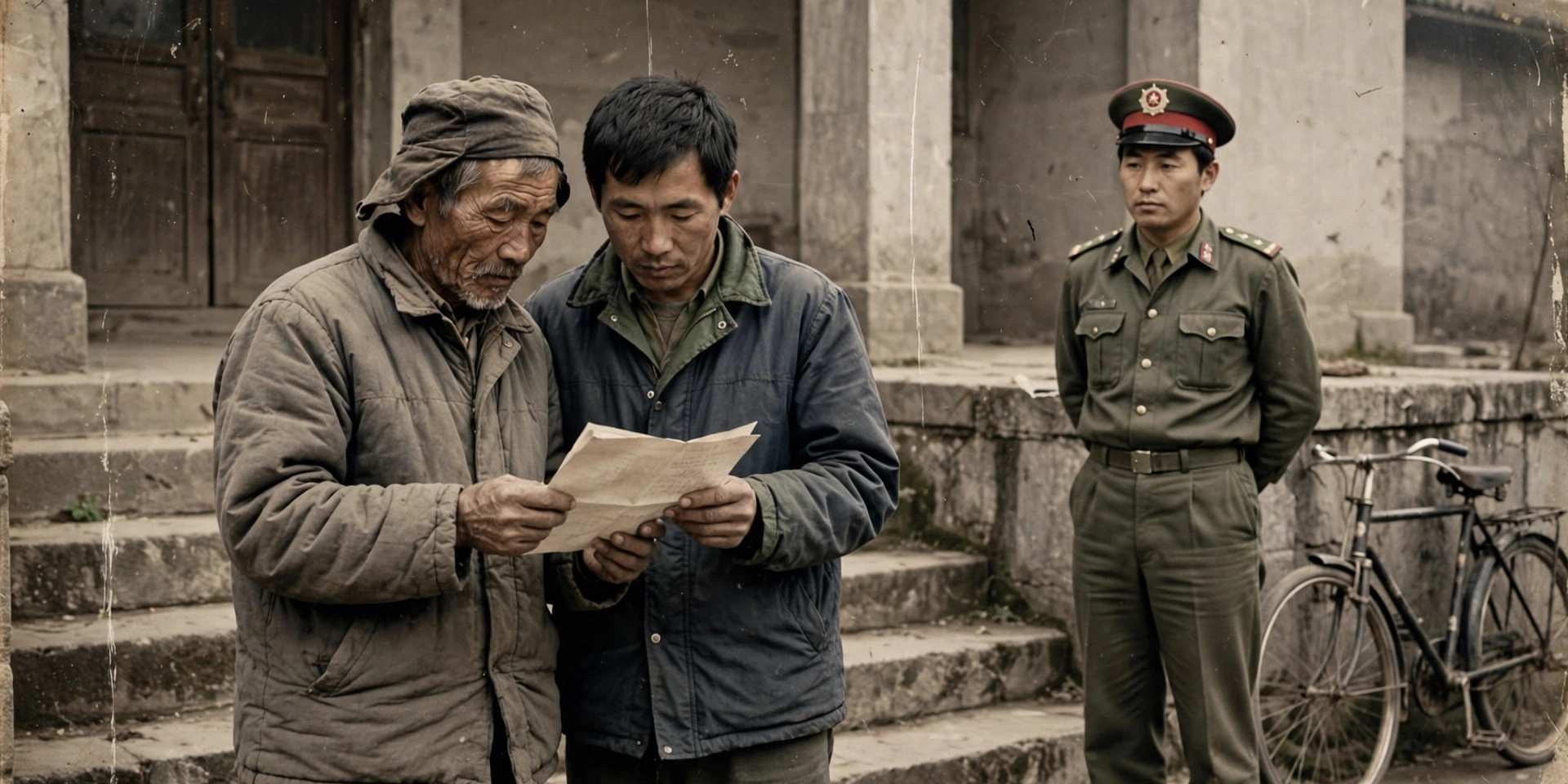
The Zhu Father and Son v. the Public Security Bureau: The First Revocation of a Police Penalty
In episode 21, we discussed the People’s Republic of China’s famous “first case” of a citizen suing the government: Bao Zhengzhao and his family v. the Cangnan County government. As mentioned there, the case earned the label “first case” because of its far-reaching historical influence, not because it was literally the first such case ever to occur.
In fact, before the Administrative Litigation Law was enacted, administrative litigation cases had already begun to appear in various places. One of them predates the Bao Zhengzhao case and was the first in which a court ruled against the public security authorities: the 1987 case of the Zhu father and son v. the Lianshui County Public Security Bureau in Huaiyin, Jiangsu. This article examines that case in detail.
The Altercation and the Detention
The two protagonists of this case, Zhu Jiacheng and his son Zhu Gongbao, were farmers from Lianshui County, Huaiyin, Jiangsu. In January 1987, their relative Zhu Xiucheng got into an argument with Chen, the Party branch secretary of his company, over a year-end bonus. When the Zhu father and son heard about it, they brought several other relatives along with Zhu Xiucheng to the company to “reason” with Chen. Another account says that the father and son had come into town for a bath, stopped by the company to visit Zhu Xiucheng, happened upon his quarrel with Chen, and were drawn into it.
Whatever the origin of the incident, the Zhu father and son did clash with Chen, and there was pushing and shoving on both sides. The local public security bureau concluded that they had disturbed the work order of the unit and imposed administrative detention of seven days on Zhu Jiacheng and ten days on Zhu Gongbao.
The father and son refused to accept the penalty. They maintained that they had only been “mediating,” had not injured anyone, and should not have been punished. Although the Administrative Litigation Law had not yet been enacted at the time, the existing laws already provided a remedy channel for precisely this situation.
Appeal First
Article 39 of the Regulations on Administrative Penalties for Public Security, adopted in 1986, provided:
A person subjected to a public security penalty ruling, or a person who was harmed, who objects to a ruling by a public security organ or a township (town) people’s government may, within five days of receiving notice, lodge an appeal with the public security organ at the next higher level, which shall render a ruling within five days of receiving the appeal; a person who objects to the higher-level organ’s ruling may, within five days of receiving notice, bring suit before the local people’s court.
This was an “appeal-first” remedy model. Anyone who objected to a public security penalty first had to appeal to the higher-level public security organ; only if still dissatisfied with that organ’s handling could they sue in court. The appeal step could not be skipped. This preliminary “appeal” procedure resembled today’s administrative reconsideration, but at the time there were no unified rules governing it.
Under the rules of the time, the Zhu father and son were required first to appeal to the higher-level public security organ, the Huaiyin Municipal Public Security Bureau, and only if they objected to the appeal ruling could they bring suit in court. As for the specifics of their appeal process, the public sources available today contain no detailed record.
Administrative Adjudication
When the case reached the Lianshui County court, the procedures for hearing it rested on the 1982 Civil Procedure Law (for Trial Implementation) and the Interim Provisions on Specific Questions of Law in the People’s Courts’ Hearing of Public Security Administrative Cases, issued by the Supreme People’s Court in 1986.
Article 3, paragraph 2, of the 1982 Civil Procedure Law (for Trial Implementation) provided:
Administrative cases that the law assigns to the people’s courts for adjudication shall be governed by this Law.
This provision allowed administrative cases to borrow civil procedure. In an era when the Administrative Litigation Law had not yet appeared, it was an effective transitional measure.
Building on this, the Supreme People’s Court’s 1986 Interim Provisions set out specific hearing procedures for public security administrative cases. They provided that such cases were generally under the jurisdiction of the basic-level court where the organ that made the first ruling was located; after accepting a case, the court was to notify the public security organ that made the later ruling to respond to the suit, and that organ could designate the organ that made the original ruling to respond instead.
This “later ruling” connects with the “appeal” procedure described above. The penalty against the Zhu father and son was imposed by the Lianshui County Public Security Bureau, while the organ that made the “later” ruling, the higher-level organ that handled their appeal, was the Huaiyin Municipal Public Security Bureau. Under the provisions, then, in the court proceedings the Huaiyin bureau could respond to the suit itself or designate the Lianshui bureau to do so.
Because the judgment in this case was never made public, reports differ: some say the judgment was directed at the Huaiyin Municipal Public Security Bureau, others say the Lianshui County bureau. The accounts conflict, and this article cannot verify which is correct. But whichever organ responded, the substance of what the court had to review was the same.
Revocation
Article 4 of the Supreme People’s Court’s 1986 Interim Provisions provided:
The people’s court shall review only whether the public security organ’s later ruling conforms to the facts and is lawful, and shall accordingly render a ruling upholding or revoking it.
On this basis, the court reviewed the penalty ruling in the case at both the factual and legal levels. In the end, it held that the penalty suffered from “unclear facts, undetermined responsibility, and impropriety.” Because the judgment was never published, we cannot know the court’s specific reasoning, but the rules of the time allow some inferences.
First, “unclear facts.” The public security organ detained the Zhu father and son on the ground that they had “disturbed the order of a unit.” Under Article 19, item 1, of the Regulations on Administrative Penalties for Public Security then in force, punishing conduct that disturbs public order required that it reach the degree of “causing work to be unable to proceed normally.” In this case, the altercation between the Zhu father and son and Chen very likely never reached that degree.
Second, “undetermined responsibility.” During the altercation that day, the pushing and shoving were most likely mutual; this was not a one-sided beating of Chen by the Zhu father and son. And the dispute arose from Zhu Xiucheng’s bonus, so the father and son were not simply making trouble. In other words, both sides bore some responsibility, and it could not all be placed on the Zhu father and son.
Taken together, if the public security organ could not prove that the Zhu father and son’s conduct had reached the degree of disturbing the work order of the unit, or could not adequately establish each side’s specific responsibility in the clash, the detention penalty might lack a sufficient factual and legal basis. In the end, the court ruled to revoke the county public security bureau’s penalty.
Review and Petition
After the Lianshui County court’s judgment, the public security organ objected and applied to the Huaiyin Intermediate People’s Court for review. After reviewing the case, the Huaiyin court upheld the original ruling. The public security organ then petitioned the Jiangsu Provincial High People’s Court. Liu Tianxing, then head of the administrative division of the Jiangsu High Court, later recalled that when the case arrived at the provincial court, the administrative division reviewed it carefully, the adjudication committee discussed it, and the court concluded that the original handling was sound, and accordingly dismissed the petition.
In his recollection, Liu Tianxing also spoke of the pressure of handling the case. Other provinces’ courts, he said, telephoned to ask how revoking a public security penalty had been accomplished and whether the pressure was great. His answer was that “the pressure was great.” Some people understood such a decision as the court failing to support administrative organs in exercising their authority. The president of the provincial high court also required the case to be handled cautiously and in detail, so that the decision would withstand scrutiny. While the case was being handled, the provincial high court, as requested, sent the case file to Beijing; later it received a telephone call from the Supreme People’s Court and learned that after reading the file, Zheng Tianxiang, president of the Supreme People’s Court, also approved of the Jiangsu court’s handling.
In the end, the Lianshui County court’s revocation judgment was not overturned in the proceedings that followed. It was the court’s prudence and persistence of this kind that withstood the pressure from all sides and produced this “first case” in which the public security authorities lost.
The Judgment’s Impact
Although this case never matched the Bao Zhengzhao case in influence, it did prompt public discussion at the time. In July 1987, People’s Daily published a commentary on the case praising citizens’ growing legal awareness. The fact that a detention penalty could be reviewed by a court gave concrete usefulness to “studying the law and understanding the law.”
In April 1989, the Administrative Litigation Law was adopted. Article 3 of the original law expressly provided for the independent adjudication of administrative cases, and Article 54 provided for judgments of revocation and other forms, while allowing courts to modify administrative penalties that were manifestly unfair. The litigation rules that had been scattered across individual statutes and specialized provisions thus moved toward a unified set of rules.
As for the lives of the Zhu father and son after their victory, public sources give no complete account. Article 42 of the 1986 Regulations on Administrative Penalties for Public Security provided that where a public security penalty was erroneous, the authority should admit the error to the person punished, return fines and confiscated property, and compensate for losses where lawful rights and interests had been harmed. Whether the Zhu father and son received compensation, and whether the public security organ admitted error to them, cannot be confirmed at present.
What is certain, however, is that this lawsuit of 1987 had already demonstrated that, before the Administrative Litigation Law was enacted, China’s institution of “citizens suing officials” had already been put into practice in part. The legal professionals of that era answered history’s questions in their own way, and gave their answer in a concrete adjudication.
This article is supplementary reading for episode 21 of Reasoned Talk, “China’s ‘First Case’ Against the Government: Bao Zhengzhao v. Cangnan County Before the Administrative Litigation Law” (listen on Xiaoyuzhou ). The episode explains why the Bao Zhengzhao case came to be called the “first case”; this article focuses on the earlier Zhu father and son case and on how a court revoked a public security penalty before the Administrative Litigation Law existed.
Principal Sources
- [1] Xin Qinchang, “What Matters Is Cultivating Citizens’ Legal Awareness” (重在培养公民法律意识), People’s Daily, July 5, 1987, p. 4, public transcription .
- [2] Wang Doudou, “Thirty Years of the Rule of Law in China: The Courts’ Three Modes of Adjudication” (法治中国30年:人民法院三大审判前行足迹), Legal Daily report; Sohu reprint , July 27, 2008.
- [3] Liu Tianxing, oral account, interviewed and edited by Lu Peng, Yang Huiqi, and Dai Nuoyi, “Telling Our History: The First Public Security Administrative Case Ever Revoked in China” (讲述我们的历史|全国第一例被撤销的公安行政案件), Jiangsu High People’s Court, February 16, 2023, full text .
- [4] Civil Procedure Law of the People’s Republic of China (for Trial Implementation), original 1982 text, Article 3, paragraph 2, historical text .
- [5] Regulations on Administrative Penalties for Public Security of the People’s Republic of China, original 1986 text, especially Articles 19, 34, 39, 40, and 42, reprinted by the Fuxin Municipal Public Security Bureau .
- [6] Supreme People’s Court, Interim Provisions on Specific Questions of Law in the People’s Courts’ Hearing of Public Security Administrative Cases, October 24, 1986, public transcription ; on which organ should respond to suit, see also the Xinhua report carried in People’s Daily, November 15, 1986, report .
- [7] Zhang Weiwei, “A Legislative Revolution Overturning ‘Officials Above the People’: The Birth of the Administrative Litigation Law” (一场颠覆"官贵民贱"的立法革命——行政诉讼法诞生录), China NPC (中国人大), No. 2, 2014, People’s Daily Online reprint .
- [8] Zhang Kuanming and Zhao Bingqing, “Those Who Contributed Quietly Behind the Scenes” (默默在幕后奉献的人), Jiangsu Courts website, March 17, 2015, full text , used only to verify the date of the intermediate court’s renaming.
- [9] Ma Huaide and Kong Xiangwen, “Achievements and Prospects of Administrative Litigation over Forty Years of Reform and Opening Up,” Peking University Law Journal (中外法学), No. 5, 2018, China Legal Studies website reprint , case passage and note 4.
- [10] Wang Hanbin, “Explanation of the Draft Administrative Litigation Law of the People’s Republic of China”; Administrative Litigation Law of the People’s Republic of China, original 1989 text, in Gazette of the Standing Committee of the National People’s Congress, No. 2, 1989, pp. 64–79, gazette scan .