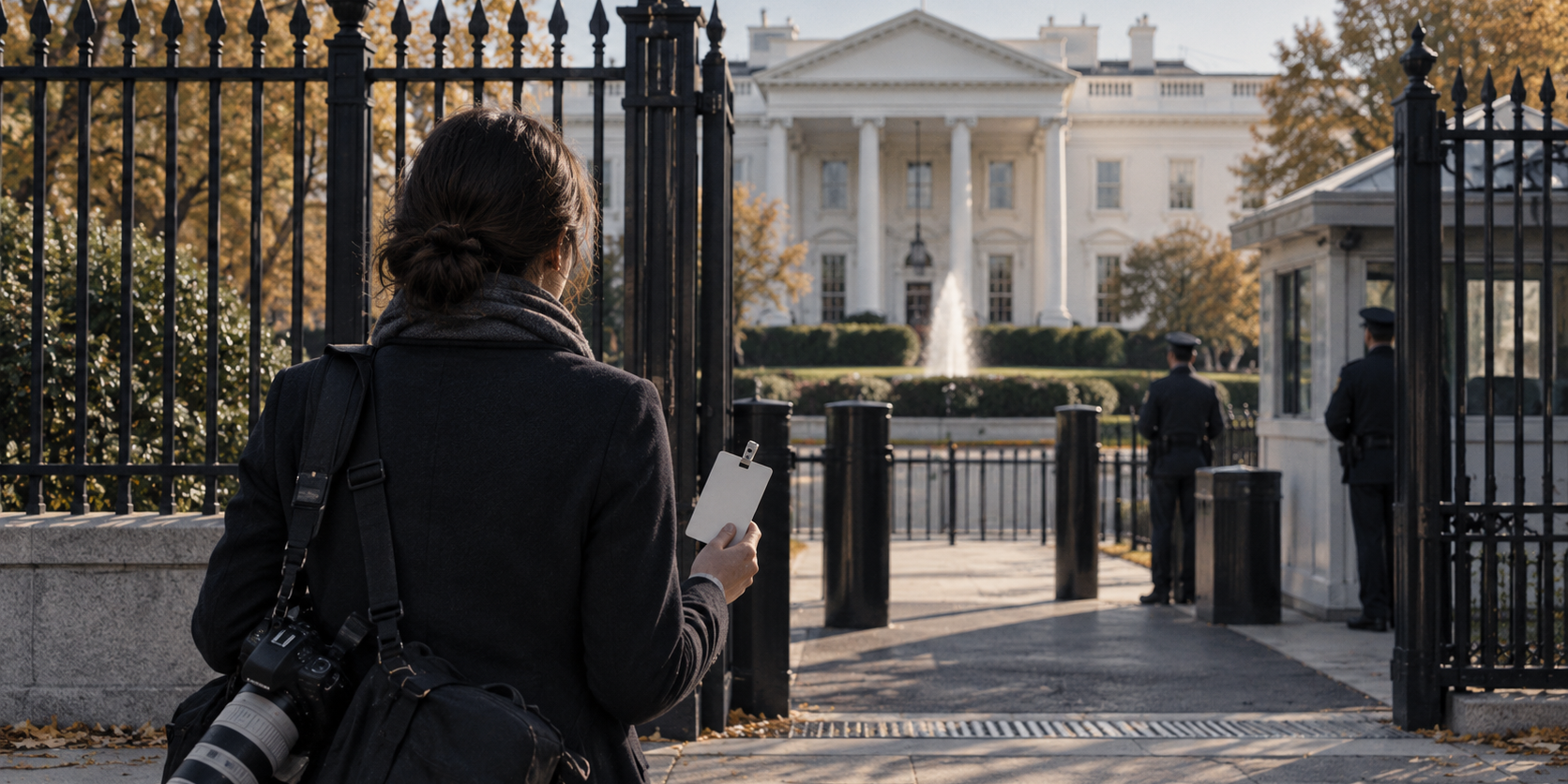
In episode 22, we discussed the lawsuit that three news organizations brought against the White House in September 2026. During the proceedings, lawyers on both sides treated the White House press area as a “nonpublic forum.”
What does “public forum” mean here? Why is the White House press area a nonpublic forum? And why has this concept become so consequential in the three organizations’ lawsuit? This article takes a closer look at the doctrine under the First Amendment.
1939: Hague and the Language of Public Trust
The public forum doctrine did not emerge fully formed. Its origins are usually traced to a dispute over public assemblies in New Jersey in 1939.
In the 1930s, Jersey City had an ordinance requiring anyone wishing to hold a parade or assembly in a street or park to obtain a permit from the director of public safety. The director could refuse permission if, in his judgment, the event might lead to riots, disturbances, or disorderly assembly.
At the time, the Committee for Industrial Organization (CIO) was organizing locally, distributing leaflets and holding meetings. In 1937, Jersey City Mayor Frank Hague used municipal ordinances to prevent the CIO from meeting in public places and distributing its materials. Police broke up meetings, arrested and expelled organizers, and harassed people associated with the organization. The CIO and other plaintiffs sued the city officials.
The case reached the Supreme Court, which decided it in June 1939. The Court upheld the plaintiffs’ claims concerning assembly and expression and found the relevant ordinances unconstitutional. The case was Hague v. Committee for Industrial Organization. The Justices disagreed over the reasoning, however, and did not produce a single majority opinion. Paraphrasing Justice Roberts’s opinion:
Regardless of who holds title to streets and parks, they have always been held “in trust” for public use and have long served as places for assembly, the exchange of ideas, and discussion of public questions. Such uses have been part of citizens’ privileges, immunities, rights, and liberties since ancient times. Government may regulate them in the public interest, but it cannot use regulation as a pretext to curtail or deny them.
Roberts did not use the words “public forum.” But later decisions repeatedly returned to this passage. Over time, it became a starting point for the doctrine.
How the Concept Took Shape
Over the next four decades, waves of social movements brought the courts numerous disputes about public assembly. In the decades following the rise of the antiwar and civil rights movements, courts considered whether political advertisements could appear on public buses, whether controversial plays could be staged in municipal theaters, and whether political leaflets could be distributed on military bases. These disputes raised a common question: how far could government regulate the use of public places?
From the 1970s onward, courts began explicitly using the term public forum. The concept concerns both the character and use of a place and the government’s authority over it. Streets and parks managed by government have long served as places for public assembly and expression. Government cannot simply invoke its position as property owner to exclude expression at will. It may regulate use, but must respect the freedoms protected by the First Amendment.
The doctrine distinguishes the government’s ownership of property from the public’s right to use it for expression. It asks how much protection the First Amendment provides when government manages that property. A privately owned place does not automatically become a public forum under the First Amendment merely because the public is allowed to enter.
1983: Perry and the Three Categories
In the 1970s, two competing teachers’ unions operated in Perry Township, Indiana: the Perry Education Association (PEA) and the Perry Local Educators’ Association (PLEA). The local schools had an interschool mail system, used primarily for official school communications but also for teachers’ personal messages. Before 1977, both unions had equal access to it. After PEA won a representation election in 1977, it negotiated an agreement with the school district granting it access as the teachers’ exclusive bargaining representative and excluding other school employee organizations, including PLEA. The restriction concerned access by competing unions; teachers could still use the system individually.
PLEA argued that this distinction violated freedom of speech under the First Amendment and equal protection under the Fourteenth Amendment, and sued the relevant school district officials. The case eventually reached the Supreme Court, with PEA as the appellant. In 1983, the Court ruled against PLEA by 5–4 in Perry Education Association v. Perry Local Educators’ Association.
The Court held that the school mail system was a nonpublic forum and that the exclusive-access agreement was constitutional. Justice White set out a framework dividing government property into three categories, with different standards of review:
- Traditional public forums: Streets, parks, and sidewalks long used for public expression. Content-based restrictions must satisfy strict scrutiny: they must be necessary to serve a compelling governmental interest and narrowly drawn to achieve it. Viewpoint discrimination is prohibited.
- Designated public forums: Property that government voluntarily opens to public expression despite having no obligation to do so. While it remains open on that basis, it receives the same protection as a traditional public forum.
- Nonpublic forums: Property that government reserves for particular purposes or particular users. It may impose reasonable, viewpoint-neutral restrictions and regulate use in light of the forum’s purposes.
In Perry, the Court considered the interschool mail system’s role in transmitting official school communications and its practice of selective access. It concluded that the system had not been opened to the public generally and was therefore a nonpublic forum. Giving PEA preferential access was reasonable because it was consistent with that function. As the exclusive bargaining representative, PEA had statutory duties to represent all teachers in dealings with the district, and the mail system helped it perform those duties. PLEA had no comparable official responsibilities, so the district was not required to give it equivalent access. The majority viewed the distinction as one based on the unions’ status, rather than their viewpoints, and therefore lawful.
Perry brought the doctrine into a more settled framework. It also left an important question: how should courts assess restrictions in nonpublic forums? What if government uses its management authority to suppress unwelcome views?
The Limits of Regulation in a Nonpublic Forum
Three later decisions helped define those limits.
The first was Cornelius v. NAACP Legal Defense and Educational Fund in 1985. In 1957, President Eisenhower established a fundraising campaign known as the Combined Federal Campaign (CFC), allowing federal employees to donate to charities of their choice. In 1982, President Reagan issued an executive order limiting participation to organizations providing direct health and welfare services and expressly excluding organizations engaged in political activity, advocacy, lobbying, or litigation. Under the new rules, the NAACP Legal Defense and Educational Fund and other organizations were barred from participating. The Legal Defense Fund sued. The lower courts initially ruled for the plaintiffs, but the Supreme Court reversed and remanded for further proceedings.
The majority held that the CFC was a nonpublic forum intended to raise money for health and welfare services, rather than to open a venue for public discussion. Access could be limited by subject matter or speaker identity, provided that the distinctions were reasonable in light of the forum’s purposes and viewpoint neutral. The Court did not decide whether the government’s explanation concealed an effort to suppress particular viewpoints; it left that issue for the lower courts on remand.
The second was Arkansas Educational Television Commission v. Forbes in 1998. The Arkansas Educational Television Commission (AETC), a state-owned public broadcaster, organized a televised debate for the state’s Third Congressional District election in 1992. It invited the principal Democratic and Republican candidates but excluded independent candidate Ralph Forbes, citing his limited campaign organization and public support. Forbes sued.
The Supreme Court held that the debate was a nonpublic forum because access was selective and invitations were issued individually; the broadcaster had not opened participation generally to all qualified candidates. It could make reasonable, viewpoint-neutral editorial judgments based on newsworthiness, time constraints, and programming considerations. The accepted reason for excluding Forbes was his lack of appreciable public support, independently of his political views. The decision did not give government blanket permission to exclude candidates simply because they were independents.
The third was Minnesota Voters Alliance v. Mansky in 2018. A longstanding Minnesota election law prohibited people from wearing political badges, buttons, or insignia inside polling places. In 2010, the Minnesota Voters Alliance and other plaintiffs challenged the restriction.
The Supreme Court treated the polling place as a nonpublic forum devoted to voting rather than free-ranging political debate, permitting some content-based restrictions. Minnesota’s law, however, did not clearly define what counted as “political” and lacked objective, workable enforcement standards (for example, the First Amendment could appear on a shirt, but the Second Amendment could not). The restriction therefore failed the reasonableness requirement.
Together, these decisions define the limits of government regulation in nonpublic forums. Restrictions on expression and access must be reasonable in light of the forum’s purposes and viewpoint neutral. A restriction that fails either requirement cannot survive this First Amendment analysis. Passing forum analysis does not establish compliance with other legal requirements, such as due process.
Returning to the White House Press Area
Why is the White House press area a nonpublic forum, and what restrictions can government impose there?
On the first question, the Perry framework directs attention to its function and access policies. The area primarily facilitates news gathering and is selectively available to qualified journalists. Considering those policies and its actual uses, the area has not been opened to public expression generally and is therefore a nonpublic forum.
On the second, White House credentialing policies, as a means of regulating access to that forum, are subject to the requirements of reasonableness and viewpoint neutrality. A central issue in the three news organizations’ 2026 lawsuit is therefore whether their exclusion served the press area’s particular functions and whether it discriminated against their viewpoints.
Across nearly ninety years, the public forum doctrine has developed a measure for the government’s authority within the spaces it controls. It recognizes that government may set conditions for particular uses, while requiring it to refrain from viewpoint discrimination. The White House press area’s status as a nonpublic forum permits regulation. It does not place the area beyond constitutional limits or allow officials to exclude reporters simply because they dislike their organization’s coverage.
This article accompanies episode 22 of Reasoned Talk, “Three News Organizations Sue the White House: Press Freedom and the Legal Limits of Press Credentials” . The episode examines the White House credentialing system and the decisions in Sherrill, Karem, Ateba, and the Associated Press litigation. This follow-up explores the public forum doctrine behind those cases and how courts draw limits on the government’s authority to control access to property it manages.
Principal References
- [1] Hague v. Committee for Industrial Organization, 307 U.S. 496 (1939), full opinion at Cornell LII .
- [2] Perry Education Association v. Perry Local Educators’ Association, 460 U.S. 37 (1983), full opinion at Cornell LII .
- [3] Cornelius v. NAACP Legal Defense & Educational Fund, 473 U.S. 788 (1985), full opinion at Cornell LII .
- [4] Arkansas Educational Television Commission v. Forbes, 523 U.S. 666 (1998), full opinion at Cornell LII .
- [5] Minnesota Voters Alliance v. Mansky, 585 U.S. 342 (2018), No. 16-1435, full opinion at Cornell LII .
- [6] Rosenberger v. Rector & Visitors of the University of Virginia, 515 U.S. 819 (1995), full opinion at Cornell LII .
- [7] Christian Legal Society Chapter of the University of California v. Martinez, 561 U.S. 661 (2010), full opinion at Cornell LII .
- [8] Congressional Research Service, Constitution Annotated, “Viewpoint Neutrality in Forum Analysis,” Cornell LII .
- [9] First Amendment Encyclopedia, “Public Forum Doctrine,” article .