
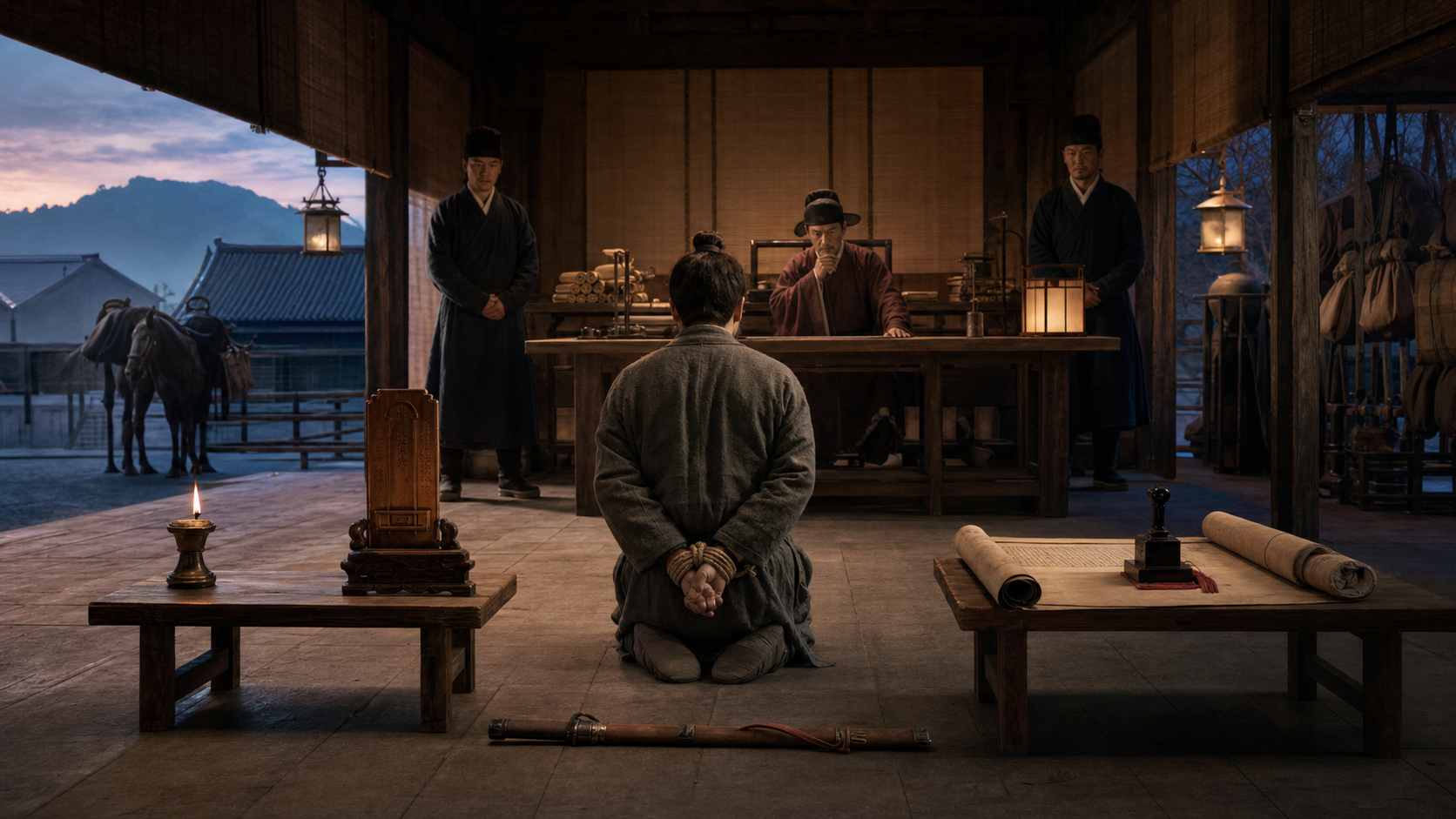
A killing followed by surrender
In late seventh-century China, during Wu Zetian’s rule, a man named Xu Yuanqing set out to avenge his father. He came from Xiagui County, in what is now Shaanxi, in the country’s northwest.
His father, Xu Shuang, had been killed by a county official named Zhao Shiyun. Xu changed his name, concealed his identity, and took menial work at a government relay station.
These stations offered accommodation and fresh horses to people traveling on government business. For an official on a long journey, a station was a place to break the trip and prepare to move on. Xu worked in that setting, waiting for an opportunity to reach his father’s killer.
Eventually, Zhao came to stay. By then, he was serving as a censor, an official charged with investigating the conduct of other officials. He had risen from a county post to service at the imperial court. At the station, the son of the man he had killed was waiting.
Xu killed Zhao. With his revenge complete, he surrendered to the authorities. He placed his own life in the hands of the government whose official he had just killed.
The case reached Wu Zetian, who wanted to spare him the death penalty. But a court adviser named Chen Zi’ang opposed a pardon. He proposed that Xu be executed, and that the government then publicly honor his devotion to his father.
That recommendation brings the difficulty into focus. The same government taught children to remain loyal to their parents and punished people who deliberately killed. Here was a son who had taken a life in the name of that loyalty, then submitted to judgment. What should the court’s decision teach everyone who heard his story?
About a century later, the writer and official Liu Zongyuan returned to the case. He challenged Chen’s answer by asking why Xu’s father had been killed in the first place.
The story survives in the New Book of Tang, a history compiled long after these events. Its account doesn’t establish whether Zhao had lawfully punished Xu’s father or used his office to kill an innocent man. It doesn’t tell us what legal remedies Xu had tried before taking revenge, either. Those gaps matter to the judgment Liu would ask the court to make.
On this episode of Reasoned Talk, we’ll follow the case from Xu’s revenge to the disagreement over how to judge it. First, we need to understand the Tang legal system, and why a son’s duty to his father could place such a difficult demand on it.
The Tang legal order
The Tang dynasty had a developed written legal system. Its best-known surviving text is the Tang Code with Commentaries, whose seventh-century compilation brought together criminal rules and authoritative explanations of how to apply them. I’ll refer to it simply as the Tang Code.
This was a legal order with detailed distinctions between offenses, degrees of responsibility, and punishments. A planned killing exposed the killer to the death penalty. Xu’s willingness to surrender made his story morally striking, but it didn’t make the killing disappear.
At the local level, the official who governed a county also exercised judicial authority. The county magistrate administered local affairs and dealt with criminal cases. Administrative power and the power to judge were concentrated in the same office.
Higher authorities could review serious cases. At the center, the Court of Judicial Review handled major criminal matters. The Ministry of Punishments reviewed cases and supervised penal administration. The Censorate investigated official misconduct. These bodies worked within the imperial government, with the sovereign holding the final authority over life and death.
The written rules also addressed abuses by officials. They penalized officials who deliberately distorted a case to convict someone wrongly. They regulated interrogation, including the use of torture, and required further reporting and approval before an execution could proceed.
Those procedures tell us what officials were supposed to do. They don’t establish what happened to Xu’s father. That distinction matters: an institution can have rules against wrongful punishment and still fail to prevent it.
For Xu’s case, another feature of the Code is just as important. It gave legal force to family obligations and differences in social status. The relationship between two people could affect the seriousness of an offense. A child striking a parent was treated differently from a quarrel between unrelated people.
Among the offenses known as the Ten Abominations was a serious failure of duty toward parents or grandparents. Family loyalty was therefore part of the legal order itself.
That makes this case more difficult than a simple confrontation between a harsh state and a compassionate private conscience. The state had helped teach the very duty that Xu claimed to be fulfilling.
What a son owed his father
The familiar English expression for this duty is filial piety. It covers the obligations children were understood to owe their parents, including respect, care, mourning, and loyalty.
In the Confucian tradition, those obligations helped sustain the wider social order. Learning how to behave toward one’s parents was connected to learning how to behave toward others, including people in authority.
But loyalty to a parent could also create a demand for revenge.
The Book of Rites contains a forceful image of that demand. In a passage about avenging a parent, a son is told not to share the same sky with his father’s enemy. The image gives an idea of how seriously such a killing could be understood. Living peacefully alongside the killer might itself appear to betray the dead parent.
To understand the argument, we also need the Chinese term li, often translated as rites. Here, it means more than ceremonies. It includes norms governing relationships, duties, mourning, and proper conduct. When I refer to Confucian moral norms, that’s the broader sense I have in mind.
These norms help explain why Xu’s act might command admiration. That moral claim is what Chen Zi’ang had to address when he argued against a pardon.
Chen Zi’ang: punish the killing, honor the son
Chen Zi’ang was a court adviser and a poet. According to the historical account, Wu Zetian was considering sparing Xu’s life. Chen submitted an argument against doing so.
He recognized the force of Xu’s claim. Avenging his father and surrendering afterward showed a willingness to sacrifice his own life. Chen treated that willingness as evidence of exceptional moral commitment.
At the same time, he insisted that the government had to preserve its prohibition on killing. If admiration for Xu became a reason to set the punishment aside, what principle would govern the next case?
Suppose the court pardoned a son for avenging his father. The man he killed might also have a son, who could claim the same duty. Each family could treat the next killing as the correction of the last one. Chen feared that such a rule would allow retaliation to continue without end.
His proposed answer was to execute Xu, then formally honor his filial devotion at his home and grave.
The punishment would uphold the public rule against killing. The honor would recognize the son’s moral courage. Chen wanted both actions to teach something: people should remain faithful to their parents, and they should understand that the state would still enforce its laws.
There is a further, unsettling step in his reasoning. He suggests that Xu’s willingness to die is part of what makes the act admirable. To spare him for his own benefit would diminish the sacrifice that gave his conduct its moral force.
The New Book of Tang says his argument met with approval at the time. It preserves the recommendation and Chen’s request to make it a lasting rule. It gives no detailed record of an execution or of honors being carried out.
It was that proposed rule that Liu Zongyuan later challenged.
Liu Zongyuan: investigate the first killing
Liu Zongyuan was a writer and official of a later Tang generation, writing about a century after the original case. He wasn’t taking part in the original proceedings. He was responding to the argument that had survived them.
His essay is commonly known in English as a refutation of Chen’s argument on revenge.
Liu begins by challenging the combination of punishment and honor. If an act deserves praise, punishing it abuses the power to punish. If it deserves punishment, praising it corrupts the moral standard the government claims to uphold.
For Liu, both moral teaching and criminal punishment are supposed to prevent wrongful violence. A decision that publicly contradicts itself defeats that common purpose.
He then turns to the fact that Chen’s solution leaves unresolved: why did Xu’s father die?
Liu sets out two possible situations. These are alternatives that need investigation. We shouldn’t mistake either one for an established account of the father’s death.
In the first, Zhao used his official position to settle a private grievance. Xu’s father was innocent, but Zhao killed him. Other officials failed to investigate, and appeals for justice went unheard.
If that is what happened, Liu argues, Xu’s revenge fulfilled a legitimate moral duty after the authorities had failed him. The officials responsible should be ashamed. They should be occupied with acknowledging their own failure, rather than executing the son who acted in its aftermath.
Here, Liu is willing to defend revenge. His argument depends on an unjust killing and a failure of public justice. It is much more demanding than a general claim that family loyalty excuses violence.
This is Liu’s argument about how the case ought to be judged. It doesn’t establish that the written Code already provided a general defense of revenge.
Now consider the second possibility. Xu’s father committed a crime, and Zhao lawfully carried out the punishment.
In that situation, Liu argues, the father died through the operation of the law. The son cannot turn the official who enforced it into a private enemy merely because the punishment fell on his own family. Killing that official would attack the legal order itself. Xu should then be punished, and there would be no reason to honor him.
The distinction changes the case. Zhao’s official title doesn’t prove that the first killing was lawful. Xu’s relationship to his father doesn’t prove that revenge was justified. Each claim has to be tested against what happened.
Liu also rejects Chen’s suggestion that family duties necessarily produce endless retaliation. The moral tradition he invokes distinguishes an unjust killing from a lawful punishment. It doesn’t authorize relatives to retaliate regardless of right and wrong.
His own essay ends by asking that this approach replace Chen’s as the basis for deciding similar cases. The disagreement concerns the rule future officials should use, as well as the treatment of one man.
The practical limits of Liu’s answer
Liu’s answer depends on an investigation, but it leaves a practical problem. If the officials charged with providing justice have failed, who can reliably establish that failure? The son may believe the evidence is clear. Other people may see the same events differently.
A person who takes revenge must act before knowing whether a later investigation will support his claim. If he is mistaken, his attempt at redress may produce another wrongful death. Liu’s distinction helps a court judge an act of revenge after it happens. It offers much less certainty to someone deciding whether to act.
Law, morality, and the authority to punish
It can be tempting to translate this dispute directly into a familiar Western debate: natural law against legal positivism.
There is a useful comparison here. Natural-law theories connect law’s authority to moral standards. Legal positivism asks what makes a rule part of a legal system and distinguishes that question from whether the rule is morally good. That distinction doesn’t itself require anyone to approve of an unjust law or believe that it must always be obeyed.
Those ideas can help us formulate questions about Xu’s case. They shouldn’t turn Chen and Liu into representatives of modern schools of legal philosophy.
Chen’s appeal to sacrifice and Liu’s use of Confucian texts both make moral claims within the legal order we’ve described, which already recognized family duties.
This also connects with the question from our first episode: how can law constrain the people who exercise state power?
The Tang rules we looked at included review of serious cases and penalties for wrongful convictions. Their value to an injured family depended on whether officials would hear its complaint, examine the evidence, and provide a remedy.
A ban on private revenge asks families to entrust justice to the state. That trust is harder to sustain when complaints against its officials cannot be heard.
Returning to Xu Yuanqing
Xu Yuanqing’s revenge ended with his surrender. He had placed his own life in the authorities’ hands. The record that reaches us leaves the first death unresolved.
The officials judging him needed to examine the death that brought him to the relay station, as well as the killing he committed there. Their power to decide whether he would live carried a responsibility to account for what had happened to his father.
ShowNotes
Names and terminology
Chinese personal names retain surname-first order. Xu refers to the son, Zhao to the official he killed, Chen to Chen Zi’ang, and Liu to Liu Zongyuan. The father is identified as Xu’s father or by his full name, Xu Shuang.
| Chinese | English used here | Meaning in this episode |
|---|---|---|
| 徐元庆 | Xu Yuanqing | The son who killed his father’s killer and surrendered. |
| 徐爽 | Xu Shuang | His father; the surviving narrative does not establish whether his killing was lawful. |
| 赵师韫 | Zhao Shiyun | The county official who killed Xu’s father and later became a censor. |
| 陈子昂 | Chen Zi’ang | The adviser who proposed punishment together with public recognition of filial devotion. The apostrophe separates the syllables Zi and ang. |
| 柳宗元 | Liu Zongyuan | The later writer who insisted on investigating the father’s death before judging the revenge. |
| 武则天 | Wu Zetian | The ruler during whose period of power the account places the case. No precise year is established here. |
| 孝、孝道 | filial duty | The obligations children were understood to owe their parents; also commonly called filial piety. |
| 礼 | li; Confucian moral norms | Rites is introduced as the familiar translation, with an explanation that the term also covers duties, relationships, and proper conduct. |
| 《唐律疏议》 | Tang Code with Commentaries; then Tang Code | The code and its explanations. It is not a modern constitution or a complete record of actual judicial practice. |
| 县令 | county magistrate | The local administrator with judicial responsibilities; distinct from Zhao’s office. |
| 县尉 | county official | A functional deepisodeion is used in the episode. The historical title is often rendered county commandant; Zhao was not the county magistrate. |
| 御史;御史台 | censor; Censorate | An official and institution concerned with scrutiny of officials; censor does not mean a modern media censor here. |
| 大理寺;刑部 | Court of Judicial Review; Ministry of Punishments | Conventional English renderings used consistently for the two central institutions. Judicial review here does not mean modern constitutional review. |
| 复仇;私力救济 | revenge; private redress | The episode uses revenge for the deliberate retaliatory killing. It does not imply that the act was lawful self-defense. |
| 自然法;法律实证主义 | natural law; legal positivism | Comparative concepts used with limits; neither is assigned to a Tang writer as a historical affiliation. |
Sources and reading
Texts and links checked on October 24, 2026. Classical Chinese passages are paraphrased in English for this episode; the English wording is not presented as a quotation from a published translation.
- The narrative and its limits: New Book of Tang, volume 195, entry on Xu Yuanqing . The entry supplies the father’s name, Zhao’s county office and later role as a censor, the relay-station employment, the killing, surrender, and the ruler’s wish to spare Xu. It reports contemporary approval of Chen’s argument rather than giving a separate, detailed record of an execution or formal honors. The episode therefore distinguishes the recommendation from an independently documented implementation.
- Chen’s argument: Chen Zi’ang, “Memorial on Revenge” (復讎議狀) . The argument addresses family retaliation, the public prohibition on killing, sacrifice, punishment, and formal commendation. “Memorial on Revenge” is the deepisodeive English title used here; other translations occur.
- Liu’s reply: Liu Zongyuan, “Refutation of the Argument on Revenge” (駁復讎議) , especially the alternatives beginning 若元慶之父 and 其或元慶之父. These are conditional arguments, not findings that Xu’s father was innocent or that officials suppressed his family’s complaints. The text also explains why lawful punishment does not create a legitimate family claim to revenge.
- Revenge in the ritual tradition: Book of Rites, “Tan Gong,” Chinese text with translation and commentary by Robert Eno (2016), section 3.47, printed pp. 55–56. The passage concerns a child’s duty toward a parent’s enemy; the accompanying note also reproduces the “same sky” formulation from “Qu Li, Part One.” The episode paraphrases the classical image rather than quoting Eno’s English translation. Liu’s qualifications should be read alongside that forceful expression of duty.
- Family duties within the Code: Tang Code with Commentaries, volume 1, “Ten Abominations” , especially 不孝 and 不義; and Columbia University’s English selections from Article 6 , translated in Sources of Chinese Tradition, second edition, volume 1, pp. 549–552. The episode does not infer that killing any censor automatically constituted the particular offense of 不義; that category depended on specified relationships and circumstances.
- Planned killing and official accountability: Tang Code, volume 17, provision 256, 謀殺人 ; volume 29, interrogation provisions ; and volume 30, provisions 485, 487, and 497 , on reporting requirements, wrongful imposition of criminal liability, and approval before execution. The Code provides institutional context; it does not supply a surviving judgment identifying the precise provision applied in Xu’s case.
- Central judicial administration: Six Compendia of the Tang (唐六典), volume 18, Court of Judicial Review , including the explanation of adjudication and referral to the Ministry of Punishments; and volume 13, Censorate , on investigating officials and hearing grievances. This eighth-century institutional account is used for broad context, not as a record of the route taken by Xu’s case. Office names and responsibilities changed over the dynasty.
- Limits of the modern comparison: Leslie Green and Thomas Adams, “Legal Positivism,” Stanford Encyclopedia of Philosophy , introduction and section 4. Legal validity, moral evaluation, and a duty to obey are distinct questions. The comparison in the episode is an interpretive aid, not a claim that Chen or Liu belonged to a modern jurisprudential school.