
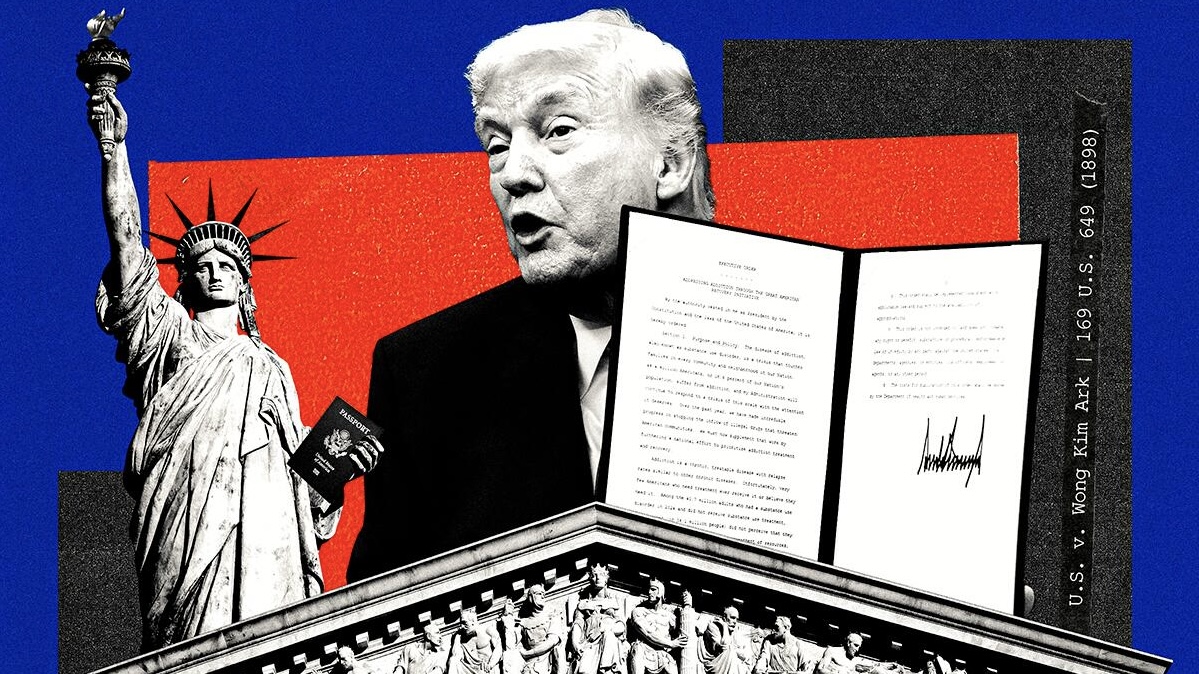
Trump lost at the Supreme Court. Why are families suing again?
Donald Trump lost his birthright citizenship case at the Supreme Court. Then he tried again.
In June 2026, the Court ruled against his first executive order. On August sixth, he signed another. And on September twenty-eighth, families filed Nathan v. Trump in federal court in Washington, D.C., challenging the new restrictions.
How can the same right be in dispute again after a Supreme Court defeat?
The answer involves both the meaning of citizenship and the courts’ power to protect it. To see how those questions became entangled, we need to start with what Trump’s first order actually did.
What Trump’s first order would have changed
On January twentieth, 2025, the first day of his second term, Trump signed Executive Order 14160, titled Protecting the Meaning and Value of American Citizenship.
It directed federal agencies to withhold recognition of citizenship from two categories of children born in the United States.
The first involved a mother unlawfully present in the country, where the father was neither an American citizen nor a lawful permanent resident at the time of birth. A lawful permanent resident is someone with what is commonly called a green card.
The second involved a mother whose presence was lawful but temporary, again where the father was neither a citizen nor a lawful permanent resident. This could include some families here on student, work, or tourist visas.
The order targeted births after its specified thirty-day period. It therefore reached beyond unauthorized immigration to some families whose presence in the country was entirely lawful.
The administration argued that these children fell outside the Fourteenth Amendment’s citizenship guarantee. Everything turned on a qualification in that amendment: being subject to American jurisdiction. The government said territorial presence was insufficient; a stronger political connection was required.
To understand why that interpretation provoked such a constitutional confrontation, we need to go back to the guarantee’s origins.
Why citizenship was written into the Constitution
In 1857, four years before the Civil War began, the Supreme Court decided Dred Scott v. Sandford. It held that people of African descent whose ancestors had been brought to America and enslaved could not be citizens of the United States within the meaning of the Constitution. The exclusion applied even to people who were free.
Scott had sought his freedom through the courts. The Supreme Court denied that someone in his position belonged to the political community whose federal courts he was asking to hear his claim.
After the Civil War, the Thirteenth Amendment abolished slavery. Emancipation left an urgent question: what legal status would formerly enslaved people possess?
Congress addressed citizenship in the Civil Rights Act of 1866. In 1868, the Fourteenth Amendment placed a citizenship guarantee in the Constitution itself.
Its opening sentence makes people born or naturalized in the United States citizens of the nation and of the state where they reside, provided they are, in its words, “subject to the jurisdiction thereof.”
The amendment overturned Dred Scott’s citizenship rule. Its language also established a general guarantee, without requiring a child’s parents to be citizens.
The jurisdiction qualification remained to be interpreted. A generation later, the government tried to use it to exclude the American-born son of Chinese immigrants.
What Wong Kim Ark established
In August 1895, Wong Kim Ark returned to San Francisco after a visit to China. American officials refused to let him land. He had been born in San Francisco, but the government argued that his parents’ Chinese nationality made him Chinese, too, and subject to exclusion under American immigration laws.
His parents had established a permanent home in San Francisco, where they lived and worked. They remained subjects of the Chinese emperor, and neither served in a diplomatic capacity.
The United States barred Chinese immigrants from naturalization. The Chinese exclusion laws had also severely restricted immigration. Wong’s claim tested whether that system could exclude someone whose citizenship arose from birth in the country.
His case reached the Supreme Court in 1898. Justice Horace Gray wrote the majority opinion, and the Court ruled for Wong by six votes to two.
The reasoning drew on the English common-law tradition of citizenship by birthplace, known as jus soli, or the right of the soil. A child born within the sovereign’s territory and allegiance generally belonged to that political community.
The exceptions were narrow. Children of accredited foreign diplomats were treated differently because diplomatic status limited the receiving country’s jurisdiction. Births during hostile military occupation presented another exceptional situation. Members of sovereign tribal communities had a distinct historical position, later addressed by federal citizenship legislation.
Wong’s parents fell outside the relevant exceptions. Their foreign nationality and inability to become citizens did not prevent their son from being a citizen at birth.
Citizenship by descent, often called jus sanguinis, could coexist with this rule. American law recognizes it for many children born abroad to American parents. Wong’s case concerned a different basis for citizenship: birth within the United States.
His parents’ settled residence would become a point of contention in Trump’s case. Did it merely describe their circumstances, or establish a condition that every immigrant family had to meet?
That was a question about the right itself. The first issue to reach the Supreme Court in the modern litigation, however, concerned what judges could do while that question was still being argued.
CASA: a victory about judicial power
States, organizations, and individuals sued over Trump’s 2025 order. Federal district courts issued preliminary injunctions blocking enforcement while the cases continued.
An injunction directs someone to do something, or to stop doing it. Preliminary relief protects against harm before final resolution. Here, judges found that the challengers were likely to succeed and that allowing the policy to operate in the meantime would cause serious harm.
The government asked the Supreme Court to limit the protection those orders provided. At this stage, it did not ask the Court to decide whether its citizenship policy was lawful.
On June twenty-seventh, 2025, the Court decided Trump v. CASA by six votes to three. Justice Amy Coney Barrett wrote the majority opinion.
The dispute concerned universal injunctions: orders protecting people beyond the plaintiffs who brought the lawsuits. The majority concluded that such relief likely exceeded the traditional equitable authority Congress had given federal courts.
Consider a simplified example. A parent sues to prevent the government from denying her child’s citizenship. An order protecting that child addresses her injury. Extending protection to every affected child in the country requires further justification.
The Court partially paused the injunctions where they went beyond what was necessary to give each plaintiff complete relief. It left the treatment of state plaintiffs for further consideration.
The majority’s concern was institutional. A universal injunction lets one district judge block a federal policy for everyone, sometimes early in litigation. That power can operate against administrations of either party and encourage litigants to search for a favorable court.
Justice Sonia Sotomayor’s dissent emphasized the cost to people outside the lawsuits. Families facing the same policy could receive different protection, depending on whether they had access to lawyers and had brought a claim.
The decision limited a method of obtaining relief; it did not decide the citizenship question. Nor did it ban every order with nationwide effects. A properly certified class action remained available, and the Court allowed thirty days before the citizenship restrictions could take effect.
That combination gave the challengers a route forward and a deadline.
How a class action changed the case
On the day CASA was decided, challengers filed Barbara v. Trump in New Hampshire. The American Civil Liberties Union and partner organizations sought protection for a nationwide class of affected children.
A class action lets named representatives litigate for a defined group. Federal Rule of Civil Procedure 23 requires the group to be too numerous for everyone to join individually and its members to share common questions. The representatives’ claims must be typical of the class, and they must represent it adequately. A class seeking an injunction must also satisfy the rule’s conditions for relief addressing the group as a whole.
On July tenth, 2025, Judge Joseph Laplante provisionally certified a class of children covered by the order and issued a preliminary injunction protecting it.
This explains how broad protection remained possible after CASA. The court had examined the requirements for representative litigation and granted relief to that defined class. Its members could live anywhere in the country.
The class injunction preserved protection while the substantive challenge continued. The government sought Supreme Court review, and the case reached it as Trump v. Barbara.
The Court accepted the case before the court of appeals had issued its judgment, a procedure known as certiorari before judgment. It heard argument on April first, 2026.
The jurisdiction language we encountered in the Fourteenth Amendment was now directly before the Court.
Barbara: where the justices disagreed
On June thirtieth, 2026, the Supreme Court ruled against the executive order by six votes to three. Chief Justice John Roberts wrote the Court’s opinion.
The majority held that children born in the United States to parents unlawfully or temporarily present were citizens at birth under the Fourteenth Amendment. It drew on the amendment’s text, its common-law background, Reconstruction, and Wong Kim Ark.
The disagreement over permanent residence now became central.
Justice Clarence Thomas’s dissent linked constitutional citizenship to domicile: a legal home involving residence and an intention to remain. He also relied on the Civil Rights Act of 1866, which referred to people not subject to a foreign power. He read that history as requiring a stronger political connection than ordinary territorial jurisdiction.
For Roberts’s majority, Wong Kim Ark’s references to the parents’ domicile did not establish the condition the administration proposed. Those references were part of the factual setting, but the earlier opinion’s broader reasoning supported citizenship beyond families in precisely those circumstances.
Justice Samuel Alito emphasized exclusive allegiance. He challenged the majority’s treatment of children whose parents came temporarily, including for the purpose of giving birth. His concerns about birth tourism formed part of an argument about the amendment’s text and history.
Justice Neil Gorsuch joined Thomas’s dissent and added an objection to the scope of the challenge. The plaintiffs had attacked the order on its face and obtained protection against all its applications. In his view, at least some applications involving temporary visitors were lawful, which was enough to defeat the challenge in the form presented.
These arguments failed to persuade the majority. The Court read the general guarantee and its narrow exceptions as protecting the children covered by the order.
Justice Ketanji Brown Jackson, who joined the majority, also wrote separately. She connected citizenship to Reconstruction’s rejection of inherited caste and subordination. Denying membership to children because of their parents’ position, she argued, threatened that broader commitment.
Her concern makes the stakes clear. A child might grow up in the only country they had ever known while being excluded from its political community. Citizenship by birth prevents that exclusion from simply passing from parents to children.
The Court affirmed the district court’s judgment, leaving the class protected. Although it was reviewing a preliminary injunction, it had now resolved the constitutional question.
There was, however, a difference between the votes for the judgment and the votes for that constitutional holding.
Six votes against the order, five for the guarantee
Justice Brett Kavanaugh supplied the sixth vote against the order. He found that it conflicted with the citizenship provision of the Immigration and Nationality Act.
Congress had adopted the constitutional wording in federal nationality legislation. Kavanaugh read the statute as preserving the established broad rule. The president could not create new exceptions on his own.
Kavanaugh expressly disagreed with the constitutional holding. In his view, the Fourteenth Amendment would permit Congress to legislate the proposed exceptions, although Congress had not done so.
That left five justices behind the constitutional guarantee: Roberts, Sotomayor, Elena Kagan, Barrett, and Jackson. Kavanaugh and the three dissenters rejected that interpretation, even though Kavanaugh voted against the order on statutory grounds.
The practical difference concerns Congress’s power. An ordinary statute can be amended through legislation. A constitutional guarantee binds Congress as well as the president. Under the majority’s holding, legislation imposing the same exclusions would face a constitutional barrier.
Kavanaugh’s proposed route therefore expressed his own view of the Constitution, rather than permission from the Court for Congress to change the rule.
His opinion also showed that future challengers had four justices sympathetic to a narrower constitutional interpretation. Judicial appointments could affect their prospects. A change in membership would still leave Barbara in place unless a later Court overruled it in another case.
That is one possible way the dispute could return. Trump’s immediate response used a different argument.
Why Nathan is a new case
Trump’s August order claimed to identify people who already fell within the exceptions recognized by the Supreme Court. The administration was presenting its new restrictions as an application of Barbara.
One part of the order reaches children when neither parent is a citizen and a parent works for an international organization possessing the specified immunity. In Nathan, the challengers dispute treating such employment as grounds for denying a child’s citizenship under the narrow diplomatic exception. They say the administration has created an additional exclusion.
That gives a concrete answer to the question we began with. The new dispute concerns whether the administration is applying the Court’s exceptions correctly or expanding them to exclude additional children. The president’s claim to be following a judgment can itself require judicial scrutiny.
The families are asking courts to apply the constitutional and statutory protections to the new order and its implementing measures. Barbara provides a binding constitutional rule, but a new policy creates new questions about its application and the relief needed to stop it.
The two earlier decisions both matter here. Barbara establishes the citizenship protection. CASA governs an important limit on how courts can provide relief. A family needs a procedure that can secure timely protection as well as a legal argument that it is entitled to citizenship.
When Wong Kim Ark challenged his exclusion, he needed officials to recognize that he was returning to his own country. Today’s families again need recognition of a status they argue the Constitution already gives their children.
Trump’s new order keeps that problem before the courts: how will a constitutional guarantee be enforced when the government draws the boundary of citizenship again?
Show notes
Key dates
- 1857: Dred Scott v. Sandford denies federal constitutional citizenship to the class of people of African descent described in the decision, including free descendants of enslaved people.
- 1866: Congress enacts the Civil Rights Act of 1866, including a statutory citizenship provision.
- 1868: The Fourteenth Amendment constitutionalizes a citizenship guarantee and overturns Dred Scott’s citizenship rule.
- 1895: Wong Kim Ark is refused entry at San Francisco after a visit to China.
- March 28, 1898: United States v. Wong Kim Ark is decided, 6–2.
- January 20, 2025: Trump signs Executive Order 14160. Its section 2 sets out the two parental-status categories and its prospective application.
- June 27, 2025: Trump v. CASA limits universal injunctive relief without deciding the citizenship order’s substantive legality. Barbara v. Trump is filed the same day.
- July 10, 2025: The New Hampshire district court provisionally certifies a nationwide class of affected children and issues a class injunction, stayed for seven days to allow appellate review. The certified class excludes parents and uses births on or after February 20, 2025.
- April 1, 2026: The Supreme Court hears argument in Trump v. Barbara.
- June 30, 2026: The Court affirms the district court. Six justices vote against the executive order; five join the constitutional holding. Kavanaugh relies on the statute for the result and expressly rejects the constitutional holding.
- August 6, 2026: Trump signs Executive Order 14418, claiming to identify additional categories outside the birthright-citizenship rule recognized in Barbara.
- August 11 and September 9, 2026: Plaintiffs’ counsel announce further motions concerning a subsequent executive order. These entries identify litigation activity, not adjudicated outcomes.
- September 28, 2026: Nathan v. Trump, No. 1:26-cv-03377, is filed in the District of Columbia, challenging the August order and implementing agency actions. A new complaint is not a new constitutional ruling.
Terms and distinctions
| Term | Meaning in this episode |
|---|---|
| Birthright citizenship | Citizenship acquired at birth. The dispute here concerns births within the United States, although American law also recognizes citizenship by descent in specified cases. |
| Jus soli; jus sanguinis | Acquisition based on birthplace; acquisition based on parentage. A legal system may use both. The executive order also uses immigration status, so the dispute cannot be reduced to ancestry alone. |
| Subject to the jurisdiction | The qualification in the Citizenship Clause at the center of the dispute. The majority and separate opinions disagree over its original meaning and application. |
| Domicile | A legal home, conventionally involving residence and an intention to remain. It should not be equated without explanation with the modern immigration category of lawful permanent resident. |
| Preliminary injunction | Interim relief before final resolution. A grant reflects legal standards including likelihood of success and irreparable harm; it is not by itself a final trial judgment. |
| Universal injunction | Used here for relief protecting nonparties generally. CASA’s limitation concerns remedial authority and complete relief, rather than geography alone. |
| Nationwide class injunction | Relief for a defined class certified under Rule 23. Class members are represented through a procedure with its own requirements; the relief can extend across the country. |
| Certiorari before judgment | Supreme Court review before the court of appeals enters judgment. It does not mean the case skipped district court proceedings. |
| Facial challenge | A challenge to a measure as a whole. Gorsuch’s separate opinion invokes the demanding standard applicable to the challenge presented; the script does not make that formulation a universal rule for every type of constitutional claim. |
| Constitutional holding; statutory ground | A constitutional protection binds Congress as well as the executive. A statutory ground can independently invalidate executive action even when a justice reads the Constitution differently. |
The votes in Barbara
| Question | Positions |
|---|---|
| Did this executive order fail? | 6–3: Roberts, Sotomayor, Kagan, Barrett, Jackson, and Kavanaugh voted for the judgment against it. Thomas, Alito, and Gorsuch dissented. |
| Does the Fourteenth Amendment protect the affected children? | 5–4: Roberts, Sotomayor, Kagan, Barrett, and Jackson joined the constitutional holding. Kavanaugh expressly disagreed, alongside the three dissenters on that question. |
| What made Kavanaugh’s vote different? | He concluded that the order violated 8 U.S.C. § 1401(a), while arguing that Congress could constitutionally legislate the proposed exceptions. His view does not override the five-justice constitutional holding. |
Sources and reading
- The constitutional text: National Archives, The Constitution: Amendments 11–27 , Amendment XIV, sections 1 and 5. The Script paraphrases the citizenship sentence and quotes only its jurisdiction qualification.
- Dred Scott: Dred Scott v. Sandford, 60 U.S. (19 How.) 393 (1857) , especially the citizenship ruling and denial of federal jurisdiction. The scope is described in relation to the class identified in the opinion; the episode does not equate the decision with a holding that every person of every African background had identical circumstances.
- Wong’s circumstances and the 1898 holding: United States v. Wong Kim Ark, 169 U.S. 649 (1898) , especially pp. 652–653, 674–675, 682, 693, and 705. The agreed record identifies his 1873 birth, his parents’ permanent domicile, his 1895 return, and their lack of diplomatic employment. The script separates those facts from later disagreement about how broadly the reasoning applies. Chinese exclusion and racial naturalization restrictions are not described as already in force at his birth.
- What the order actually directs: Executive Order 14160, “Protecting the Meaning and Value of American Citizenship” , January 20, 2025, 90 Fed. Reg. 8449, especially sections 2–3. Both categories retain the specified condition concerning the father. The order’s date is distinguished from its Federal Register publication on January 29. Its recognition and documentation directions are distinguished from a lawful amendment of constitutional citizenship.
- CASA and the limits of interim relief: Trump v. CASA, Inc., Nos. 24A884, 24A885, and 24A886 , June 27, 2025. See Barrett’s opinion, especially slip pp. 1–5, 19, 21–24, and 26, and Sotomayor’s dissent. The Court addressed the likely limits of equitable authority conferred by the Judiciary Act, partially stayed relief exceeding what plaintiffs required, and did not decide the order’s merits. The script avoids saying citizenship actually became different from state to state as an automatic result of CASA.
- The representative procedure: Federal Rule of Civil Procedure 23 , especially subdivisions (a), (b)(2), and (c). The four general prerequisites and the additional basis for classwide injunctive relief are both relevant.
- The class definition and injunction: Barbara v. Trump, No. 1:25-cv-00244-JL-AJ, Document 65 , D.N.H., July 10, 2025, especially printed pp. 9–11 and 36–38. This is the district court’s order, reproduced by Justia. The proposed class included parents; the certified class did not. The order uses February 20, 2025, as the first date of birth and provides a seven-day stay.
- The substantive decision and separate opinions: Trump v. Barbara, No. 25-365, 609 U.S. ___ (2026) , argued April 1 and decided June 30, 2026. Roberts’s opinion occupies PDF pages 6–31 (slip pp. 1–26); Jackson’s concurrence, PDF pages 32–51; Kavanaugh’s opinion, PDF pages 52–61; Thomas’s dissent, PDF pages 62–152; Alito’s dissent, PDF pages 153–191; Gorsuch’s dissent, PDF pages 192–194. Page numbering restarts for each opinion. Kavanaugh’s slip p. 1 expressly rejects the constitutional holding while finding a statutory violation. Jackson’s concurrence discusses Reconstruction and caste; the three dissents are characterized by their legal arguments, without adopting their historical conclusions as settled fact. The procedural posture remains review of preliminary relief, even though the Supreme Court resolves the constitutional issue.
- The separate statutory protection: 8 U.S.C. § 1401 , especially subsection (a), with subsection (b) relevant to the historical tribal-citizenship distinction. The script does not suggest that Congress can override Barbara’s constitutional holding merely by amending this provision.
- The post-decision requests: ACLU, August 11, 2026 announcement and September 9, 2026 announcement . These are statements by counsel for the plaintiffs, used in the timeline to identify their requests for clarification and a new class. Their characterizations of the order’s legality are not presented as a subsequent judicial holding, and these announcements do not establish the latest docket status.
- Trump’s renewed order: Executive Order 14418, “Continuing To Protect the Meaning and Value of American Citizenship” , August 6, 2026, especially sections 1–2. Section 2(b)(iv), read with section 2’s condition that neither parent is a citizen, supplies the international-organization example in the closing. The order claims to implement exceptions within Barbara; the script identifies that as the administration’s position, not an authoritative interpretation of the Supreme Court’s holding. This example does not summarize every category in the order.
- The new case used in the opening: Nathan v. Trump, No. 1:26-cv-03377, Document 1 , D.D.C., filed September 28, 2026, especially paragraphs 6–10, 29, 43, 49–50, and 94–102, and the requested relief. The complaint challenges the new order and implementing actions under the Fourteenth Amendment and 8 U.S.C. § 1401. Its treatment of the diplomatic exception and international-organization employment is attributed to the challengers. It is evidence of their claims and filing, not a judicial finding that the new order is unlawful. See also the filing docket reproduced by Justia and counsel’s case summary for the withdrawal of the requests in Barbara and filing of a separate action in Washington. The script identifies a recent new lawsuit and makes no claim that no other litigation activity occurred afterward.