
This is the transcript of episode 24 of my podcast Reasoned Talk (议正言辞). Listen on Xiaoyuzhou . The episode is in Chinese; this transcript has been translated into English.
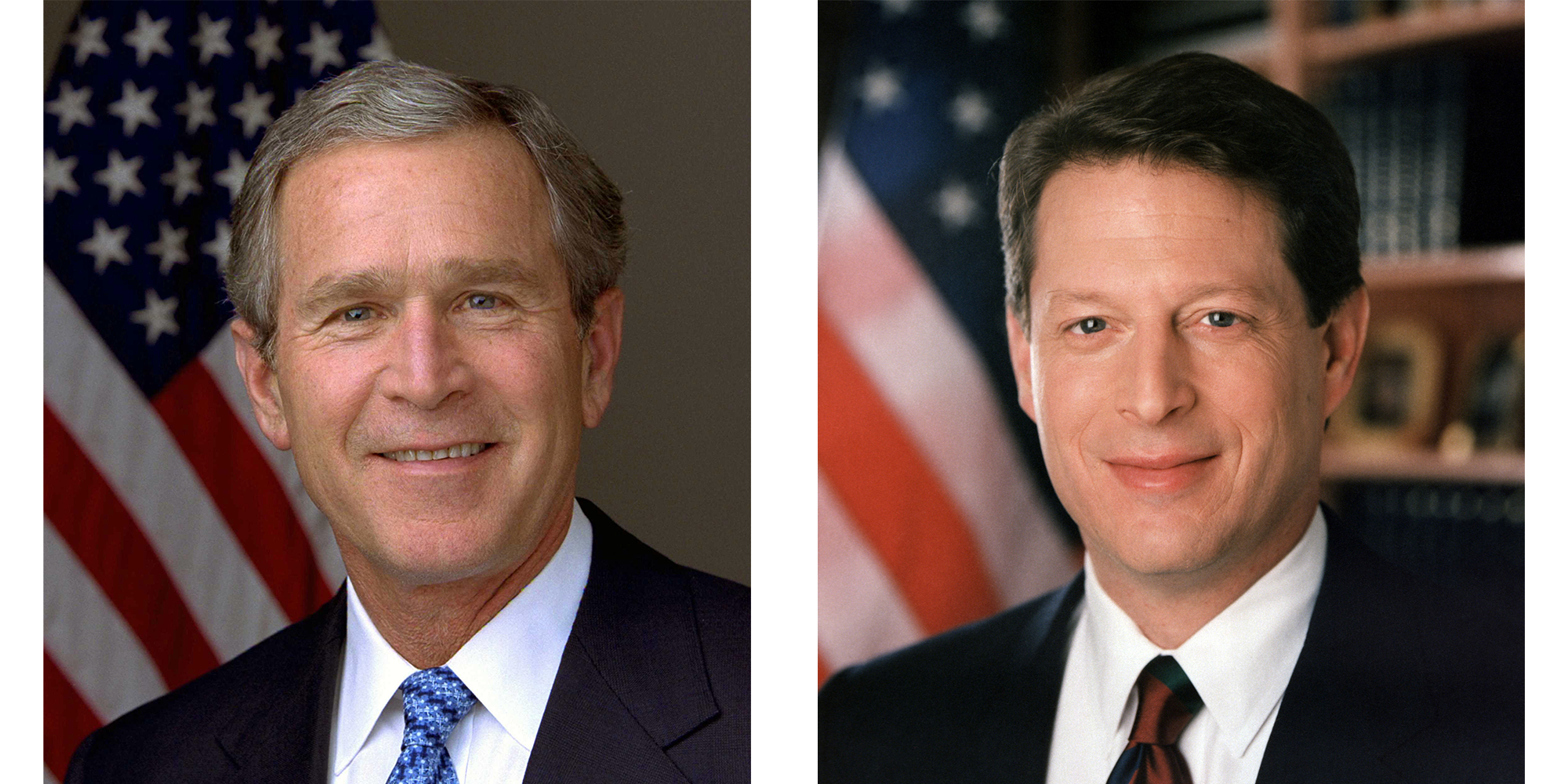
On November 7, 2000, the United States held its presidential election. The Republican nominee was George W. Bush, the younger Bush; the Democratic nominee was the sitting vice president, Al Gore. The two candidates were closely matched, and so were their vote totals. As the results in other states became clear, Bush was projected to win 246 electoral votes and Gore 267. Neither had reached the 270 needed to win. Florida’s 25 electoral votes would decide the outcome.
Their vote totals in Florida were remarkably close, too. According to the initial figures released by the Florida Division of Elections, Bush had 2,909,135 votes and Gore 2,907,351: a lead of 1,784 for Bush. Under Florida law, however, a margin below 0.5 percent triggered an automatic recount. Many Florida counties used punch-card ballots, which were counted by machine, so the automatic recount was also conducted by machine. It did little to settle the contest. Instead, the gap narrowed further, from more than 1,700 votes to just over 300.
Why could machine counts differ? With a punch-card ballot, a cleanly punched hole was readable by the machine. But if the punch was incomplete, leaving a piece of paper partly attached or only an indentation in the card, the machine might not detect a vote. A ballot on which the machine detected no presidential vote was called an “undervote.” Some reflected incomplete punches; others reflected a voter’s deliberate decision to leave the race blank. Gore’s side later estimated that there were about 60,000 such ballots statewide. It invoked Florida’s election “protest” procedure and requested manual recounts in four counties. Its reasoning was straightforward: if the machines could not read the ballots, people should examine them.
Bush’s side firmly opposed that approach. The first round of litigation concerned the legality of manual recounts and the deadline for submitting county returns. The Florida Supreme Court extended the reporting deadline to November 26. By then, two counties had completed and submitted their manual recounts; one had finished but failed to submit its results in time; and another had not finished. The Florida Elections Canvassing Commission ultimately certified Bush as the winner by 537 votes, giving him the state’s 25 electoral votes.
Gore disputed the certification. His side argued that some ballots had already been identified as valid by hand but had not been included in the certified total. Other ballots had never received manual review and might also contain valid votes. Gore therefore brought an election “contest” in court, asking it to correct the certified result.
Bush intervened on the defendants’ side, alongside the state authorities. That lawsuit and the appeals that followed eventually developed into the case known as Bush v. Gore. This episode examines how the courts came to determine the outcome of a presidential election.
From Four County Recounts to Statewide Review
Bush argued that once the state had certified its result, Gore could not demand a recount merely because some ballots had not been examined by hand. Gore first had to produce evidence showing a reasonable probability that a recount would change the election’s outcome. The trial court accepted that argument and denied relief for failure to meet the burden of proof. The Florida Supreme Court took a different view: Gore could obtain relief by showing that legal votes had been omitted in numbers sufficient to place the result in doubt.
Bush also argued that even if a manual recount were justified, it should not be confined to the counties Gore had chosen. Those counties tended to favor the Democrats. Searching only there for uncounted votes, Bush maintained, was unfair to him. That argument had an unintended consequence.
On December 8, the Florida Supreme Court ruled 4–3. It ordered the inclusion of valid votes already identified by manual recounts in two counties, and directed manual review of all remaining undervotes statewide that had not yet been examined by hand. Litigation initially focused on a few counties had expanded into statewide review. How to ensure that every county applied a uniform standard would become central to the U.S. Supreme Court’s scrutiny.
The ruling appeared favorable to Gore, but it created a more difficult problem.
The court had ordered statewide manual review without specifying a concrete, uniform standard. Drawing on Florida election law, it adopted the principle of “voter intent”: a ballot should count whenever the voter’s intent was clear. But what did “clear” mean? For a punch-card ballot that had not been fully pierced, one person might consider a visible indentation enough to show intent. Another might require an actual opening in the card. The same ballot could produce different results in different counties, or even in the hands of different counters.
Time made the problem harder. Under the federal law then in force, a state seeking “safe harbor” protection had to resolve its election disputes finally, under rules adopted before election day, at least six days before the presidential electors met. Congress, when counting electoral votes, would then be bound by that determination of who the state’s electors were. To obtain that protection, Florida had to resolve its disputes by December 12. Missing that date did not automatically invalidate its electoral votes.
But the Florida Supreme Court had not ordered statewide review of the undervotes until December 8, just four days before the safe-harbor date. To finish in time, counting had to begin immediately. Yet applying a uniform standard required more time to formulate rules, train personnel, and resolve disputes. Florida faced a dilemma: a hurried recount might fail to treat every ballot equally, while developing consistent standards and proper procedures might take it past the safe-harbor date.
Bush quickly seized on this problem. He sought relief from the U.S. Supreme Court, asking it to suspend the recount and review the state court’s ruling. Even if there was a legal basis for a recount, he argued, conducting one without uniform standards could violate the Fourteenth Amendment’s Equal Protection Clause.
He also raised a separate constitutional argument. Article II, Section 1 provides that each state’s legislature determines the manner of appointing its presidential electors. Florida’s legislature had already enacted election rules. By expanding the manual recount and adjusting the procedures for judicial relief after the election, Bush argued, the Florida courts had effectively changed those rules. Their actions had infringed the legislature’s constitutional authority.
Uniform Ballot Standards and Equal Protection
These two arguments brought a state election dispute before the U.S. Supreme Court. Its task was to determine whether the Florida court’s ruling violated the federal Constitution.
On December 9, the Supreme Court voted 5–4 to stay the recount and take the case. Manual review had already begun in Florida. With only nine days remaining before the electors met, the proceedings moved quickly. The parties filed briefs on December 10; oral argument took place on December 11; and the Court ruled on December 12.
The decision was issued per curiam, in the name of the Court rather than under an individual justice’s name. Five justices, in the Court’s majority opinion, held that Florida’s manual recount procedures violated the Fourteenth Amendment’s Equal Protection Clause. Justices Souter and Breyer also identified inconsistent ballot standards, but favored setting uniform standards and continuing the count. Interpreting marks on punch-card ballots depended on the counters’ judgment. The Florida Supreme Court’s test—a clear indication of voter intent—was an acceptable starting point. The difficulty was the absence of specific rules ensuring that the test was applied consistently.
A Miami-Dade County supervisor testified that the three members of the county canvassing board had used different standards to identify legal votes. Palm Beach County repeatedly changed its approach. It began with a 1990 guideline excluding ballots whose chads remained completely attached, then counted ballots if light could be seen through the opening, and later returned to the original rule. It eventually abandoned a fixed rule altogether, until a court required it to count indented ballots as well. Broward County used a more permissive standard, producing nearly three times as many additional legal votes as Palm Beach, although their populations were not different by a comparable factor.
The majority concluded that the Florida Supreme Court had ordered a recount without basic procedural safeguards. Having granted its citizens the right to vote for presidential electors, Florida could not arbitrarily treat their ballots differently and value one person’s vote more highly than another’s.
Once the recount procedures were found defective, what should happen next? Should Florida adopt a uniform standard and continue counting, or should the process end with the state’s existing certified result? On that question, the nine justices divided 5–4.
Why Not Let Florida Continue Counting?
In theory, the Supreme Court could have remanded the case so that the Florida courts could establish uniform standards and resume the manual recount. But the decision came on December 12. Formulating standards and then counting would necessarily take Florida past the safe-harbor date.
Was Florida willing to surrender safe-harbor protection in order to continue? The five-justice majority believed that the answer depended on the Florida legislature’s intent. An important source for identifying that intent was the Florida Supreme Court’s own earlier interpretation of state election law.
In the earlier litigation over the deadline for submitting county returns, the Florida Supreme Court had said that the legislature did not intend a delayed reporting deadline to impair the effectiveness of Florida’s electoral votes in the presidential election. The majority understood this to mean that the legislature wanted safe-harbor protection and had therefore made December 12 the operative deadline. On that reading, the Florida courts could not prolong the recount at the cost of missing it. December 12 had already arrived. There was no time to establish uniform standards, resolve disputes, and complete a constitutional recount. The majority therefore reversed the state court’s recount judgment, bringing the process to an end.
The other four justices disagreed with ending the recount. Safe harbor provided a legal protection; missing December 12 would not itself invalidate Florida’s electoral votes. The legislature wanted its electoral votes to be effective, but had not explicitly made December 12 a mandatory deadline. Wanting the protection did not necessarily mean forbidding any count after that date. Moreover, the recount had been suspended since December 9 by the U.S. Supreme Court itself. The dissenters would have given Florida an opportunity to adopt standards and try to finish before the electors met on December 18.
The Supreme Court ultimately reversed the Florida Supreme Court’s judgment and remanded the case. Under the majority’s reasoning, however, no further constitutional recount was possible. The Florida Supreme Court subsequently dismissed the contest. The November 26 certification remained in place, and the additional votes Gore had sought to include were not added to it.
The Authority of State Courts and State Legislatures
The December 12 decision also included a concurrence signed by three justices. They agreed with the judgment but offered an independent ground for it: the Florida Supreme Court’s ruling should be reversed even without the equal protection argument. Article II, Section 1, Clause 2, they reasoned, assigned the power to prescribe the manner of appointing presidential electors to state legislatures—in this case, the Florida legislature. In their view, the state court’s interpretation had departed substantially from the legislature’s rules and infringed its authority. This was the position Bush had advanced.
The five-justice majority concluded that equal protection was sufficient to resolve the case, so it did not decide the allocation of authority between the state court and legislature. A dissenting opinion emphasized that interpreting state law was the state courts’ responsibility and that federal courts should respect their interpretations. To me, this is the most interesting question in the case. How should courts exercise their power to interpret statutes while respecting the boundary between judging and legislating? Years later, the Supreme Court would confront a related question in a congressional redistricting case.
Gore Accepts the Decision, and the Election Ends
Returning to Bush v. Gore: on the evening of December 13, after the decision, Gore addressed the nation from Washington. He began by saying that he had just telephoned Bush to congratulate him on becoming the forty-third president. He then addressed the ruling: “While I strongly disagree with the court’s decision, I accept it.” For the sake of national unity and the democratic system, he conceded the election.
On December 18, the electors met and voted. Bush received 271 electoral votes and Gore 266. A District of Columbia elector cast a blank ballot, accounting for the missing vote in the final tally. On January 6, 2001, Congress met in joint session to count the electoral votes.
The person presiding was the sitting vice president, Gore himself. When Florida’s turn came, several House members rose to object to its 25 electoral votes. Gore asked whether a senator had joined the objections. Under the law then in force, a written objection required the signatures of at least one representative and one senator before Congress could consider it. None of these House objections had a senator’s signature. Gore ultimately announced Bush’s election.
That brings us back to the scene at the beginning. Whether a punch-card ballot was valid was initially a question for election counters. Before the Supreme Court, it became a question of federal constitutional law, raising more fundamental issues of equal protection and judicial authority.
People with different political commitments may reach different conclusions about these issues, just as the justices did. In the end, Gore, who had come within a step of the presidency, chose to concede. Perhaps he believed that the rule of law and democracy were equally important. Allowing disagreement or political advantage to fuel an endless struggle would have been unacceptable for either.
ShowNotes
Key Timeline
November 7–9, 2000: Voting took place on November 7. On November 8, Florida released preliminary results showing Bush ahead by 1,784 votes, triggering an automatic recount. On November 9, the Democrats requested manual recounts in Volusia, Palm Beach, Broward, and Miami-Dade counties.
November 14 and 21: November 14 was the original reporting deadline. On November 21, the Florida Supreme Court extended the reporting period in litigation arising from the election protest stage.
November 26–27: On November 26, Florida certified 2,912,790 votes for Bush and 2,912,253 for Gore, a margin of 537. On November 27, Gore filed an election contest in Leon County Circuit Court.
December 4: Leon County Circuit Court denied Gore relief. In a separate case that same day, the U.S. Supreme Court vacated the Florida Supreme Court’s decision extending the reporting deadline and remanded for clarification of its basis in state law.
December 8: The Florida Supreme Court voted 4–3 to reverse the trial court in part. It ordered the inclusion of valid votes identified through manual recounts in two counties and manual review of roughly 9,000 Miami-Dade undervotes, together with other undervotes that had not yet been reviewed by hand.
December 9–11: On December 9, the U.S. Supreme Court stayed the statewide manual recount by a 5–4 vote and took Bush’s case. It heard oral argument on December 11. That day, the Florida Supreme Court also issued its opinion on remand in the earlier reporting-deadline case.
December 12: The safe-harbor date. The U.S. Supreme Court voted 5–4 to reverse and remand the Florida Supreme Court’s recount judgment. The recount did not resume.
December 13–14: On December 13, Gore accepted the decision and conceded. On December 14, the Florida Supreme Court dismissed the remanded contest; it published its reasons on December 22.
December 18: The electors voted: Bush received 271 electoral votes and Gore 266. District of Columbia elector Barbara Lett-Simmons cast a blank ballot to protest the District’s lack of voting representation in Congress.
January 6, 2001: Gore presided over Congress’s joint session. Objections to Florida’s electoral votes lacked a senator’s signature and were not considered. Gore announced the final result.
Key Concepts
Election protest: Florida Statutes § 102.166. Before state certification, Gore’s side used this procedure to request manual recounts from county canvassing boards.
Election contest: Florida Statutes § 102.168. This was a lawsuit brought in circuit court after certification. Under subsection (3)(c), the number of legal votes rejected or illegal votes received had to be sufficient to change the outcome or place it in doubt.
Undervote: A ballot on which the machine detected no presidential choice. The voter might have deliberately left it blank, or the machine might have failed to detect a punch.
Overvote: A ballot on which the machine detected multiple presidential choices and therefore counted no vote for any candidate. Some counties’ earlier reviews had covered all ballots, while the subsequent statewide order focused on undervotes. The majority also questioned this difference in the scope of review.
Equal protection: Section 1 of the Fourteenth Amendment. Five justices, in the Court’s opinion, held that the statewide recount lacked rules ensuring equal treatment of ballots. Dissenting Justices Souter and Breyer also identified inconsistent standards, but would have allowed counting to continue under uniform rules.
Safe harbor: Under 3 U.S.C. § 5 as it stood in 2000, a state that finally resolved an election dispute in time, under rules adopted before election day, received a protection: Congress would treat that determination as conclusive regarding the identity of the state’s electors. Missing the date meant losing that protection, although the electoral votes could still be counted.
The state legislature’s authority: Article II, Section 1, Clause 2. Chief Justice Rehnquist wrote a concurrence joined by Justices Scalia and Thomas. They argued that the Florida Supreme Court’s interpretation of state law had departed substantially from the legislature’s rules for appointing electors. The majority resolved the case under equal protection without deciding this argument.
Decisions, Statutes, and Original Records
Sources checked on November 5, 2026.
- Bush v. Gore, 531 U.S. 98 (2000) : The Court’s opinion appears at pages 100–111. Pages 109–111 address its scope, the remedy, and safe harbor. Rehnquist’s concurrence and four dissenting opinions follow.
- Bush v. Gore, 531 U.S. 1046 (2000), the December 9 stay order : Scalia explained why the recount should be stopped pending review; Stevens dissented.
- Gore v. Harris, 772 So. 2d 1243 (Fla. 2000) : The Florida Supreme Court’s decision ordering manual recounts. The webpage contains the version corrected on December 14; the original decision was issued on December 8. The Florida Supreme Court’s opinion on remand records its December 14 dismissal order.
- Bush v. Palm Beach County Canvassing Board, 531 U.S. 70 (2000) : The separate reporting-deadline case. The Florida Supreme Court discussed safe harbor in its December 11 opinion on remand , which the U.S. Supreme Court majority cited the following day.
- 3 U.S.C. § 5 (2000 edition) : This episode discusses the rules applicable in 2000. Section 5, along with § 7 on the electors’ meeting date and § 15 on Congress’s counting procedure, was amended in the 2022 reforms.
- Florida election law (2000 edition): § 101.5614, including the voter-intent rule · § 102.166, election protests · § 102.168, election contests .
- Results and contemporary records: Florida’s certified totals · Gore’s December 13 address · National Archives electoral vote results · January 6, 2001, Congressional Record, pages H31–H36 · Contemporary reporting on Lett-Simmons’s blank ballot .