
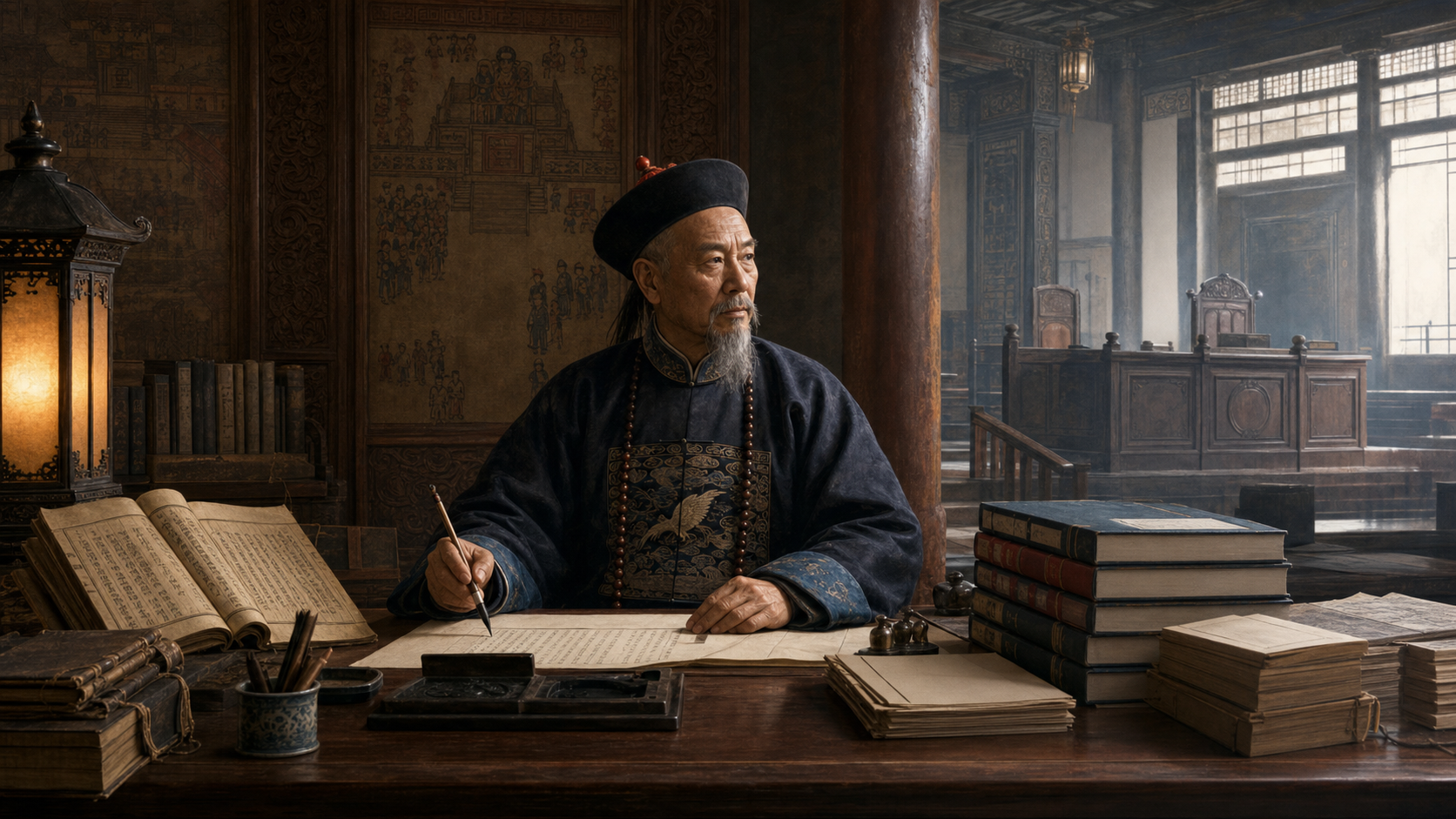
Who gets to hear the case?
Suppose you’re a merchant in China in 1902. You sell a shipment of goods to a British trader, and he refuses to pay. Where will you take the complaint? Under the treaty rules, you could go to the British consul. If the consul couldn’t settle it, British and Chinese officials were supposed to examine the dispute together.
The rule for crimes was different. A British subject accused of a crime in China would be tried by British authorities under British law. That’s what I mean by extraterritoriality here. Some treaties gave foreign governments legal authority over their own people on Chinese soil.
In the summer of 1902, the British negotiator James Mackay went to Wuchang, where he discussed the issue with a senior Qing official named Zhang Zhidong. The two governments were negotiating a trade treaty. Qing officials wanted to recover the power to judge cases involving foreigners on Chinese soil. Britain argued that Qing courts offered British subjects too few safeguards.
If you heard episode 4 , you’ll remember how much power a Qing county magistrate had. He ran the county, investigated crimes, and judged the cases himself. Qing law allowed officials to use physical coercion during questioning, within limits. In Little Cabbage’s case, confessions obtained under torture helped sustain a murder accusation for more than three years.
The difference went beyond how a magistrate took a confession. The Great Qing Code and Substatutes put rules about debts, family duties, official conduct, and serious crimes in the same code. If you were late enough in repaying a private debt, you could be beaten and still have to pay it back. Qing reformers looked at foreign systems where a dispute over a debt could end with an order to pay. Criminal punishment was a separate matter.
Zhang pushed to make legal reform part of the bargain. In the Mackay Treaty, signed that September, Britain agreed to help China reform its judicial system. Britain also said it would be prepared to give up its extraterritorial rights once it judged that China’s laws, the way they were administered, and other considerations warranted it. The United States and Japan later accepted similar language in their own treaties.
The man asked to rewrite the law
By the time Britain signed that treaty, the Qing court had already appointed two officials to revise the laws, Shen Jiaben and Wu Tingfang. To see why the court was in such a hurry, go back two years. The armies of the Eight-Nation Alliance had entered Beijing during the Boxer crisis, and Empress Dowager Cixi had fled to Xi’an. In 1901, while still away from Beijing, the court called for reforms to help it hold on to power. Liu Kunyi and Zhang Zhidong followed with joint proposals. Revising the laws became part of the wider program we call the New Policies.
Shen had worked in the Ministry of Punishments and passed the highest level of the imperial civil-service examinations. He went on to serve as a prefect in Tianjin and Baoding. By 1900, he’d been appointed judicial commissioner of Shanxi.
Before he could take up that post, a French missionary with a grievance from an earlier dispute accused him of helping the Boxers. The allied forces detained him in Baoding. The accusation fell apart for lack of evidence. Within two years, Shen was being asked to study the legal systems of the powers whose forces had held him.
Shen’s office translated foreign laws and brought in Japanese jurists to teach and help draft new codes. Shen also read Yan Fu’s translation of Montesquieu’s The Spirit of the Laws. He’d spent years studying statutes and decided cases. Montesquieu gave him another way to ask why a rule existed and what it was supposed to achieve.
There’s a line in the Guanzi, an old Chinese text, that describes law as a standard for all under heaven, a measure for public affairs. The reformers had to decide which rules could still serve as that measure. As Shen put it, some of the old rules were worth keeping, and the new ones deserved a hearing.
Companies and punishments
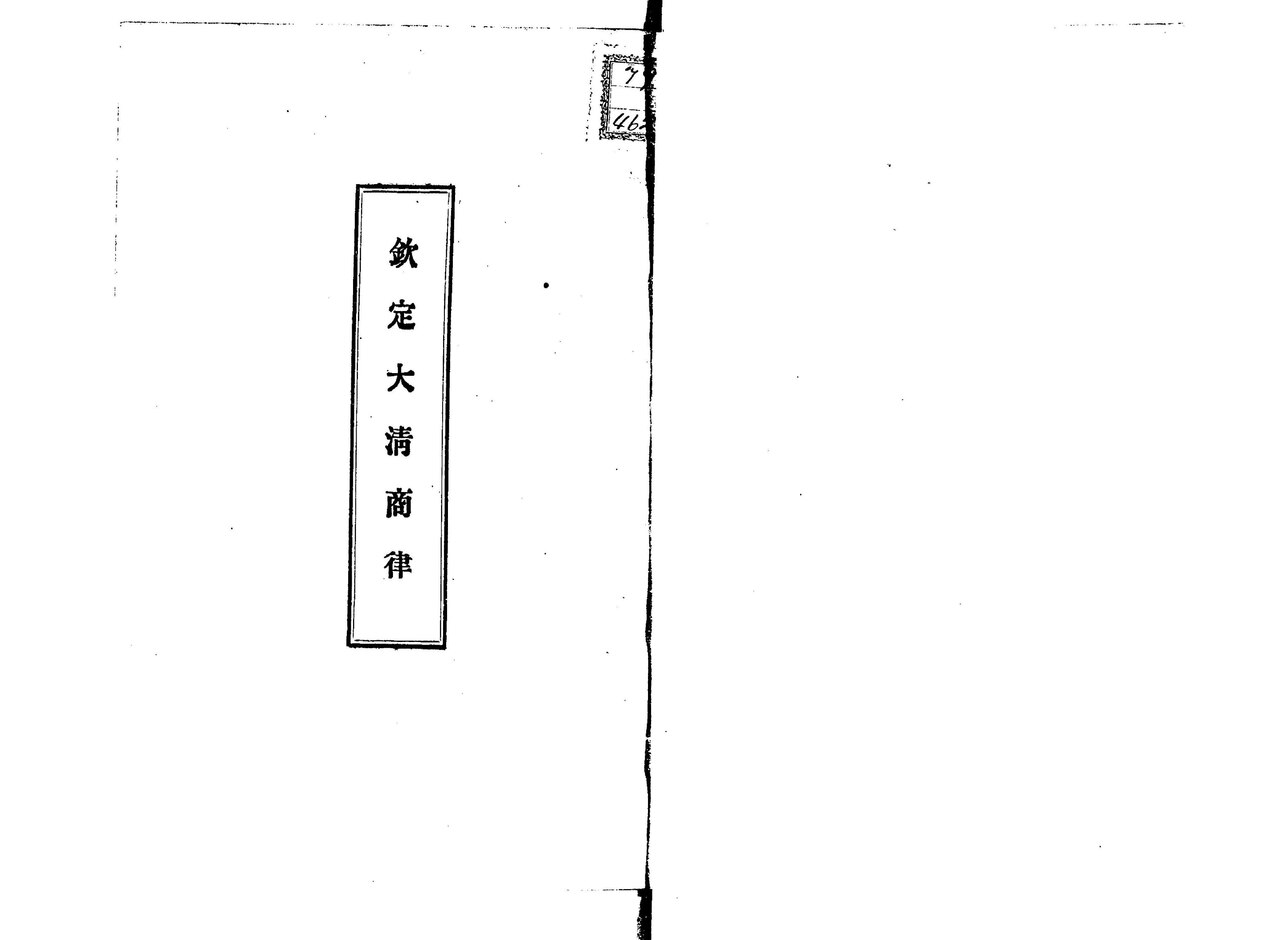
One of the first changes came in commercial law. The Great Qing Commercial Code of 1904 recognized companies with limited liability. If you invested in one of those companies, the amount you agreed to put in set the limit of your liability. That mattered in a society where business debts could draw in the whole household.
A year later, after Shen and Wu petitioned the court, an edict abolished lingchi, the punishment by slicing that Little Cabbage had once faced. The same edict abolished the public display of severed heads and the mutilation of corpses. The reformers also took aim at punitive tattooing and the practice of punishing relatives who had no knowledge of the offense. For some offenses that had been punished with bamboo, they substituted fines.
Who controls the courts?
Rewriting the penalties was one thing. If the county magistrate still ran the county and decided its cases, he still held the power we saw in the Little Cabbage case. In 1906 the imperial court started changing that arrangement in Beijing.
The Ministry of Punishments became the Ministry of Law, which would run the judicial system. The old Court of Judicial Review gave way to a new Supreme Court, the Dali Yuan. Its job was to decide cases. The division looked clear until officials had to settle two questions. Who could appoint a judge? And who could draw the boundaries of the area that judge would serve? Both institutions wanted a say.
Provincial governors had gained considerable military, financial, and judicial authority during and after the Taiping and Nian rebellions. The new courts would take some of that authority out of their hands. Provincial officials pushed back on where courts would sit, who could qualify as a judge, and who would supervise them.
The reformers also needed people trained to apply the new laws. Shen and Wu had raised that problem when they asked the court to set up a law school in Beijing. New courts opened in some places, but many communities still relied on their magistrates to decide cases. The Qing ran out of time to establish the new system across the country.
Two codes in the making
Alongside the court reforms, work continued on a separate criminal code. The Japanese jurist Okada Asatarō helped prepare it, drawing on Japan’s 1907 criminal code. That year the Qing court sent a draft to officials in Beijing and in the provinces for comment.
A civil code was taking shape at the same time. The Japanese jurist Matsuoka Yoshimasa helped prepare the first three books of the Draft Qing Civil Code, drawing on German and Japanese law. They set out general rules and covered obligations and property. Say you bought something in good faith and then found out the seller had no right to sell it. Could you keep it? If you had a claim against someone, how long could you wait to bring it?
The books on family and succession gave more weight to a person’s place in the household. Marriage generally required parental consent. A wife could own property in her own name, while her husband generally had the right to manage it and take the income. A daughter could inherit under some circumstances, but in one of the fallback rules she ranked behind the head of the household.
What does a son owe his father?
The question of what the law owed individuals and what it owed families came to a head over the criminal code. That’s the debate over rites and law. Here, rites means the Confucian duties that governed relationships, especially within the family. Shen and an official named Yang Du backed the new code’s approach. Lao Naixuan and Zhang Zhidong defended more of the old rules. Zhang was the same official who’d made reform part of the bargain with Britain.
Lao thought the drafters were treating the new criminal code as if it were meant for foreigners. He argued that criminal law had a job to do inside the household. Take self-defense. If a father unlawfully attacked his adult son, could the son use force to protect himself? Shen’s side said the general rule of self-defense should apply. To Lao’s side, striking a parent was itself a serious offense.
The two sides also disagreed over when people could conceal a relative’s crime. Shen’s side was willing to retain a protection for relatives. The conservatives wanted to keep the distinctions based on seniority and on how closely people were related, as measured by the traditional grades of mourning. Then there was the question of consensual sex involving a woman without a husband, including a widow. The reformers were prepared to leave it outside criminal law. Their opponents thought punishment was needed to uphold family and social order.
For the conservatives, family authority helped hold the country together. Yang Du saw that same authority as a barrier to building a constitutional state. He wanted the law to bind people directly to the state.
The new criminal code and its exceptions
While officials were still debating the draft, several of the earlier changes to punishments went into a revised version of the old code in 1910. The court issued the separate New Qing Criminal Code the following January. Article Ten set out what we now call the principle of legality. Under the old code, an official could sometimes apply a rule for a similar offense to conduct the law hadn’t expressly covered. Article Ten required a law that actually defined the conduct as a crime.
The new code dropped privileges such as the Eight Deliberations. Under that system, members of the imperial family and others with special standing could get a separate review and possibly a lighter sentence. The new penalties included life imprisonment as well as fixed prison terms.
The drafters had also argued over when children could face criminal punishment. Shen started at sixteen. The threshold came down to fifteen during revisions, then to twelve in the final code. Younger children could still be sent for corrective education.
The compromise is easiest to hear if you put two provisions side by side. Article Fifteen recognized self-defense against an unlawful attack. But at the back of the code was a five-article appendix called the Provisional Rules. It took away that defense in cases involving offenses against senior relatives. Under that exception, the son who fought off his father would lose the protection Article Fifteen offered.
The appendix also made consensual sex involving a woman without a husband a crime for both partners, if a qualifying senior relative of the woman filed a complaint. And although the main text specified hanging, the appendix retained beheading for certain capital offenses.
The laws that outlived the dynasty
In Beijing, a conservative official named Liu Tingchen joined the attacks on Shen’s work. Shen lost his position in charge of revising the laws in 1911. That October, an uprising began in Wuchang, where Zhang and Mackay had discussed the trade treaty nine years earlier. The Qing emperor abdicated in February 1912. The new criminal code had never taken effect.
That same year, the Republic of China adapted it, dropped the Provisional Rules, and issued a provisional criminal code of its own. The Draft Qing Civil Code never took effect, but it gave the republic a starting point for another draft. The Nationalist government eventually enacted a civil code. China’s current Civil Code still gives property and contracts their own books.
The Qing never recovered jurisdiction over British subjects. Britain and the United States gave up their extraterritorial rights in separate treaties with China in 1943, four decades after the Mackay Treaty.
At the treaty table, Zhang wanted Chinese courts to have the power to judge. The debate over self-defense showed what could happen once the reformers started asking how those courts should judge. Once the right of self-defense was in the code, officials who wanted a father’s authority to prevail had to make a case for an exception in the law itself.
ShowNotes
Names and terms
- Shen Jiaben (沈家本) and Wu Tingfang (伍廷芳) were appointed to revise Qing law in 1902. Shen had served in the Ministry of Punishments (刑部), the same English name used in episode 04 on Little Cabbage.
- Zhang Zhidong (张之洞) was governor-general of Huguang and pressed the issue of extraterritoriality in talks with James Mackay. Liu Kunyi (刘坤一) joined Zhang in submitting reform proposals to the Qing court in 1901.
- Okada Asatarō (冈田朝太郎) and Matsuoka Yoshimasa (松冈义正) were the Japanese jurists who helped draft the new criminal and civil codes, respectively. Japanese names follow surname-first order.
- Yang Du (杨度) defended the new code as part of building a constitutional state. Lao Naixuan (劳乃宣) argued for keeping more of the old rules on family obligations. Liu Tingchen (刘廷琛) later challenged the reformers at court.
- Extraterritoriality (治外法权) refers here to treaty privileges held by foreign powers in China. Consular jurisdiction (领事裁判权) was the authority foreign consular officials exercised over certain cases under those arrangements.
- Debate over rites and law (礼法之争) refers in this episode to the late-Qing dispute over which Confucian family duties the new criminal code should enforce.
- Great Qing Code and Substatutes (大清律例) is the old imperial code. Great Qing Commercial Code (钦定大清商律) is the 1904 commercial legislation. New Qing Criminal Code (大清新刑律) is the criminal code promulgated in 1911. Its appendix is called the Provisional Rules (暂行章程). Draft Qing Civil Code (大清民律草案) is the 1911 civil draft.
- Ministry of Law (法部) administered the judicial system after the 1906 reform. Supreme Court (大理院, Dali Yuan) was the new highest court. It replaced the older Court of Judicial Review (大理寺).
Sources and reading
- Articles XV–XVII of the 1858 treaty distinguish mixed disputes from criminal cases against British subjects. Article XII of the 1902 treaty sets out Britain’s position on relinquishing extraterritorial rights. The journal study traces Zhang’s role in the Wuchang negotiations. Treaty of Tientsin, 1858 Mackay Treaty, September 5, 1902 study of Article XII and consular jurisdiction in Studies in Qing History
- The Law Revision Bureau entry in the archival guide dates the appointment edict to the sixth day of the fourth lunar month of 1902, before the September treaty. Guide to the holdings of the First Historical Archives of China Shen Jiaben’s biography in the Draft History of Qing
- The first memorial explains why the new codes would need people trained to apply them. The second discusses separating civil and criminal cases. The Qing code’s provisions on money and debt include penalties for overdue private debts. Shen and Wu’s memorial proposing a law school memorial on ending judicial torture money and debt in the Qing code
- The commercial code contains nine provisions on merchants and 131 on companies. It distinguishes companies with limited liability from those with unlimited liability. Great Qing Commercial Code, National Diet Library scan
- See Articles 10–11, 15 and 37–38 of the new code and Articles 1, 4 and 5 of its appendix. The accompanying edict records the final change in the age threshold from fifteen to twelve. Chen Xinyu traces the earlier drafts and the two tracks of penal reform. New Qing Criminal Code and its Provisional Rules Chen Xinyu’s study of Shen Jiaben and the late-Qing criminal law
- The Draft History of Qing records Lao Naixuan’s objections. Chen Xinyu’s study of Yang Du’s 1910 essay explains Yang’s case for a stronger state. Draft History of Qing, volume 142 Chen Xinyu’s study of Yang’s 1910 essay
- Articles 311 and 1278–1279 cover limitation periods and good-faith acquisition of movable property. Articles 1338, 1357–1358 and 1466–1468 cover marriage, a wife’s property and succession. Han Shiyuan traces the later civil codes. See Books II and III of the current code for the separate treatment of property and contracts. Draft Qing Civil Code Han Shiyuan’s history of Chinese contract law Civil Code of the People’s Republic of China
- Ouyang Xiang and Wu Zeyong trace the disputes over the new courts and why they spread unevenly. Ouyang Xiang’s study of the dispute between provincial officials and central ministries Wu Zeyong’s study of late-Qing civil procedure and court reform
- Volume 49 records the order sending Shen back to his ministry post and Liu Tingchen’s memorial on the new code. Veritable Records of the Xuantong Reign, volume 49
- The abdication edict dates the end of Qing rule. The 1912 text records the republic’s adoption of the revised criminal code. The U.S. diplomatic records document the relinquishment of British and American extraterritorial rights in 1943. Imperial Edict of Abdication, National Museum of China the republic’s 1912 provisional criminal code U.S. diplomatic records on the 1943 treaties
- The line about law as a measure for public affairs is an English rendering of a passage from the Guanzi. Guanzi, “Ming fa jie”
Related episodes
- Little Cabbage: The Failure of Justice in Late-Qing China
- From China to Europe: State Power and the Rule of Law
- Shi Jianqiao and the clash of rites and law (English translation of Chinese episode 07)
- Chinese episode 09